Showing posts with label Khell. Show all posts

Sunday, August 18, 2013

EK-ANKI UPDES ANI SONDEX


Tiatr ani nattkulim Gõyant khub famad. Halinchea kallar tiatranchim vo nattkuleanchim hat-borovpam chhapun yetat (chodd korun Tiatr Academy-ntlean) hi gozal bhov khuxalkayechi. Osleach borpavollinchem ek pustok mhollear Arso: 26 Nattkuleancho Jhelo jem Pri. Michael Fernandes hannem boroilam. Hea pustokachem khaxelponn mhollear sovis-ui nattkuleanche mathalle, A-Z hea 26 Inglez okxoranche volleri promannem asat.
            Pri. Michael Fernandes-achem borovp Jivit, Gulab, Goan Review, V. Ixtt and kaim firgoz-potrancher uzvaddak ailam. Nibon’d, kannio, kovita, kantaram oxe sahityache sabar prokar tannem hatall’leat.  Arso hem tachem poilem nattkuleanchem pustok.
            Hea pustokacher nodor martoch amkam disun yeta ki him nattkulim bori dekh ani xikovnn diunk boroileant. Kannio sompeo asat ani hakach lagun borovpeak bori dekh diunk adar ditat. Bhurgeponnavoilo mog, vhoddilank respet ani man divop, promannikponn, Kristi mul’lyam , soimacho husko, adi osle mud’de hea pustokant borovpian ghetleat. Gõychi osmitay ani daiz, bhailo lok ani tanchea probhavank lagon je bodol ami onnbhovtat, osle-i mud’de Pri. Michael Fernandes-an amche mukhar manddleat.           
            Hea pustokant amkam oxem dison yeta ki jim patram vaitt monis mhunnon dakhoileant tanchem kalliz ani mon rokddench bodolta. Je toren – ani sompeponnim – him patram apunn borea rostear choltole mhonn utor ditat tantum kholay disun yenam. Punn ek-anki nattkuleank vell ani zago unno asta hem monant dhorun, borovpeachi hi oddchonn amcheamni somzum yeta.
Bãym hea nattkuleant Pri. Michael Fernandes amchea paromporik bãychem mhotv dakhoita ani ami udok kiteak chotrayen vaprunk zai temvui dakholl korta. Hea nattkuleant Saxtti boli vapurlolean ruch anink vaddlea. Dusrea-i kaim nattkuleamni Gõycheo her bolio vapurleat ani haka lagun borovpeak porbim! Kaim nattkuleamni je sonvad (dialogues) vapurleat te padriche sermanv koxe distat. Dekhik: Advogad. Sogllea suvatancher Povitr Pustokantle nomunne diupachi goroz asa,  hoi?
            Zantteanchi ani kheritponnim amchea avoy-bapaychi ami seva korunk zai hem dhoronn ak’khea pustokant amkam mellta. “Dor eka putak ani dhuvek mhozo ulo – tumchim avoy-bapuy kitlim-i zanttim pasun zalear, tankam pois korum nakat, nhoi mhonn azilant-ui ghalum nakat. Kiteak, je tyag ani koxtt tumchim avoy-bapuy tumche khatir kaddtat te sonvsarantle her khuinchech monis kaddchenant.” Pri. Michael Fernandes-achem hem dhoronn zorui hanv mandun ghetam torui hea rostear cholunk sodanch vatt meklli asta kai?
            Kaim nattkuleancho hangasor hanv ul’lekh korunk sodtam. Maim hea nattkuleant, Alroy-ak  sirvis mellunk ek lak farik korunk zai asta. Punn te itle duddu taka  mellttole zalear tannem poilim Saibinn mãycheo murteo moddunk zai asta ani Saibinnicher bhavarth dovorpant kaim boreponn ani faido nam oxem soglleank kollit korunk zai asta. Alroy oxench korta ani rokddoch taka aksident zata. Toxench Tallnni hea nattkuleant, ji zaun asa kanni dog supurlea bhavanchi, tanchi avoy tankam promannikponnan lisanv korunk sangta ani apunn bazarant veta. Eklo bhav tallnnek sampoddta ani aplea ixttam barabor khellpak veta ani thoimsor buddun morta.  ‘Devan-khast-laili’ osle vichar Pri. Michael Fernandes-a sarkea tornattea padrin soddun diunk zai. Amchea jivitant unneponnam asat, chuki ghoddtat hem monant dhorun ami amchem jivit jiyeunk zai, oslem novsorlolem  chintop khub gorjechem.
Hea nattkuleanchea jheleant zaite vixoy (themes) portun portun distat tori tanchi vachta asatanam addkholl zata oxem disonam. Kovorachem chitr Alvito D’Costa-n bore bhaxen kelam. Xevottak, hem pustok vachpak ruchichem asach ani iskolamni ‘Annual Gatherings’-a vellar machier haddunk khub faideachem poddtolem oxem hanv sobhemazar sangtam. Pri. Michael Fernandes-a sarkea tornattea borovpeank oslench protsahon mell’llear Konknnichem Sahitya pormollun, aninkui borovpi  mukhar sortole nhoi?

            Arso: 26 Nattkuleancho Jhelo borovpi Pri. Michael Fernandes (Bann’nnavle: Micferns Prokaxon), 2010; panam IX+237, Rs. 100/-; Fon: 91-0832-2221688 (Mellta: Dalgado Konknni Akademi, Ponnje)


            Inglezint hoch lekh vach hanga.

Tuesday, July 30, 2013

DANCING TO THE SAME OLD TUNE


A few weeks ago, in the columns of this very newspaper, I had suggested that projects which dealt with the documentation of traditional practices unwittingly or not become enterprises where modernity was interrogated. I had also suggested that such an enterprise, therefore, should also interrogate traditions in the same token. In this review of a documentary Dances of Goa directed by Nalini Elvino de Sousa and produced by Sociedade de Fomento, I shall try to grapple with such narratives in the selfsame framework.
            Dances of Goa, in Konkani, English and Hindi, is resplendent with colour-rich images and soulful, mellifluous sounds of many of Goa’s traditional dances which are largely performed by the SC/ST/OBC population of Goa such as the fugddi, bhonvaddo, morulo, goff etc. Also featured are mando and khell-tiatr. In the technical aspects such as camera-work, sound and editing, this documentary is not lacking in any way. However, it is the narratives that are offered to the viewer by this documentary which need to be critically analyzed and thus will form the meat of this review.
           

The documentary, a series of 12 episodes, opens with the narrator observing that “…much has changed and life is no longer simple.” Thus, this sets the stage for a binary opposition between tradition and modernity; with the two worlds distinctly separated from each other. Traditional practices here are seen as fossilized, ossified entities, which I would argue creates problems as traditions do change.
            The gaze that is directed largely at Goa’s tribal population is one in which the tribal is projected as ‘essentialized’ and ‘othered’ being. In the episode which deals with fugddi, we are told that “…the Velips can proudly boast of setting a fine example of living eco-friendly and self-sustainable lives. The harmony which they share with their environs is a lesson, urban man can learn from.” Elsewhere there is mention about Quepem as being “…one of Goa’s still green talukas with hills and thick vegetation…” One only has to drive towards Maina-Pirla to see what mining has done to these hills and the green cover!
Further problems emerge because this documentary tries to understand Goa’s traditional practices through a nationalistic lens where one origin is sought and where Christianity is understood and is brushed aside as an historical accident. Take for instance the comments of Pandurang Phaldesai, (then) Member Secretary, Kala Academy, Goa: “Our ancestors have the same roots. Same culture. Due to historical accidents (itihasik apghat) two religions emerged. But our culture remained the same. Our heritage is the harmony that we have maintained.”
            Bhonvaddo is a form of dance that is practiced by persons of the Mahar caste. We are told that although not many persons from the Mahar caste are engaged in their traditional occupation of weaving baskets “…members still continue with the folk performances they were associated with.” Also what is interesting is the fact that when the narrator refers to the “Mahars”, the subtitle has the term “‘Harijan’”. We need to recognize the fact that Dalit groups have rejected this patronizing Gandhian term today. It is through such subtle techniques, I would claim, the seriousness of the role of caste is elided and erased in this documentary.
            Since this documentary clearly understands tradition through nationalist biases, how would one fit in mando given the fact that the mando resulted due to the colonial encounter? The argument falls back on a dubious revision of history in which, “During 451 years of colonial history Catholic Goans used music as a mediator of identity negotiation. In a political context repressing musical sonority of Indian flavour, in which Portuguese was the official language, Catholic Goans created their own music, sung in Konkani and performed according to Portuguese models. Mando is a good example of this and was able to acquire an emblematic status.” Information on the mando is given through an interview by Inácio Sardinha who chose to speak in Portuguese. I am not against anybody speaking in Portuguese, but the specific context in which Portuguese is used tells us something: that an attempt is made to reclaim the mando to the elite Catholic locations in which it had emerged and have since been considered to have fallen from grace. Perhaps, the ideological under-currents that are reflected in this documentary are best illustrated by an article that Nalini Elvino de Sousa, the director of this documentary, wrote in 2012 (See The Goan on a Saturday, 28-12-2012). Being surprised that “a bunch of people jumping all around, clapping hands to the sound of a kind of Konkani rock song with lyrics of a Mando…” at a wedding she attended, de Sousa tells her husband that this is “murdering the Mando”. If people want to sing and dance to the mando de Sousa argues that there is only one way and that is to “do it the right way.” Therefore, a certain conception of ‘purity’ is demanded from all of us and any innovation, such as “jumping and clapping” is to be frowned upon.
           
My final comments will be on khell-tiatrs. An interesting observation that Rafael Fernandes, professor of English at Goa University, makes in the context of tiatrs is “…that as long as Tiatr is alive, the Konkani language doesn’t have to worry.” What I would like to point out is although the documentary acknowledges the contribution of tiatrs, the crucial issue of tiatrs being viewed as lacking standard and thus, delegitimizing the cultural productions of the larger realm of the Roman script is glossed over. The fact is that cultural productions in romi are considered to be ‘polluted’ by the dominant discourse in Goa and hence not capable to represent the mainstream Goan culture. While on the subject of romi, it is quite troubling to observe that the subtitles in the Konkani version are only in the nagri script.
            The images and narratives that are presented in this documentary are uni-dimensional. While confining such traditional practices to a fossilized museum, the performance in contemporary times is expected to be mechanical and static. Can we look beyond such notions?


(A version of this article appeared on Gomantak Times, dt: July 30, 2013).

Saturday, May 14, 2011

IMPROVING AND ENCOURAGING TALENT IN TRADITIONAL 'KHELLS'


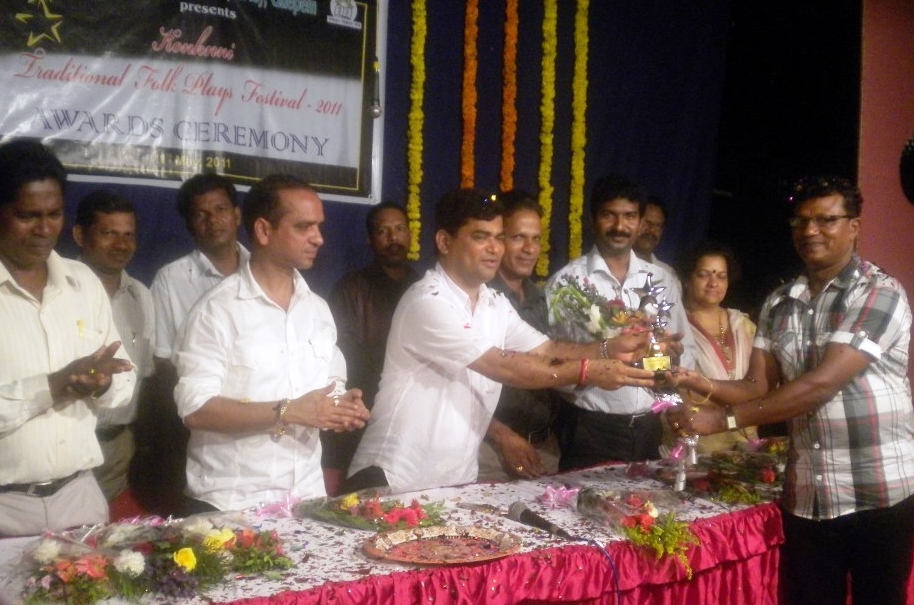
Seby de Quepem receiving the best play award
Despite the onslaught of cable and other more glittering forms of entertainment, the traditional khells have survived all odds. The khells along with the tiatrs are the most loved form of theatre amongst Goans, especially Catholics. Originally, the khells were performed on the ground and hence were called zomnnivoile khell. These khells which were staged during Carnival in Quepem received a shot in the arm due to the efforts of the Navyug Vikas Manch, Quepem.
The Navyug Vikas Manch held the prize-distribution ceremony of Konknni Traditional Folk Play Festival organized during this year’s Carnival on 11 May, 2011. The folk plays were staged at various places in Quepem and were judged by a panel of three eminent judges: John Claro Fernandes, the noted tiatrist from Quepem, Jose Salvador Fernandes, the secretary of Dalgado Konknni Akademi and Jerome Rodrigues, a music teacher from Quepem and former conductor of Kala Academy’s Goa Symphony Orchestra. The khells are a traditional part of the Carnival celebrations which consists of three one-act plays called partios.
            A total of seven troupes participated in the competition taking the overall sum of individual actors to more than a hundred (inclusive of musicians and back-stage support artists). Seby de Quepem’s Him Amchim Konn? was adjudged as the best play. Ubaldo Fernandes (Salam’ Tuka) and Celina Fernandes (Sonvsar Mon’xak Haloyta) bagged the best acting award (male and female respectively). The best child artist (male and female) award went to Floid Fernandes (Sonvsar Mon’xak Haloyta) and Kenisha Fernandes (Tunvem Mhaka) while the funniest comedians (male and female) were Saldie Colaco (Pois Kelo Mhaka) and Jenifa Simoes (Gõychi). The prizes for the best Kant, best direction and best script was bagged by Jose de Velim (Pois Kelo Mhaka), Seby de Quepem (Him Amchim Konn?) and Xavier de Sanguem (Tumkam Visvas Asa?) respectively.
Twins in real life, Clarina and Clarissa Gonsalves (Fottoilem) and Bobet de Quepem received special mention awards. Clement Goes (Him Amchim Konn?) was judged as the best musician. All the participants received a certificate, a gift and a Romi Konknni book of either short stories or one-act plays. The winners of special awards received a memento.
            The later tiatr had its antecedents in the zagors and khells and organizing competitions of this nature will only ensure that such traditions and heritage is kept alive. Case in point proved to be the competition organized at Quepem during the Carnival. Remedio Rebello, member of the Navyug Vikas Manch informed that because the judges could pay a visit anytime to any venue where the plays were staged, the directors and actors had put in much hard work and people were able to enjoy some good plays. Since most of the people residing in the interiors and backward areas of Quepem rarely come to the cities during Carnival, staging the plays at their doorsteps “made them feel very happy,” informed Mr. Rebello. He further revealed that the competition was organized with the main intention of improving and elevating the standard of the khells, which are a part of our heritage.
            I tried to get some local feedback on the plays that were staged and although many felt that this was a good beginning, much is needed to be done as far as standard is concerned. The talent and enthusiasm is very much there, only it needs to be channelized in a proper way. Many of the performances were raw but a diamond only becomes a diamond when properly cut and polished.
On being asked how he felt after winning the best play award, Seby de Quepem said, “It was a great moment. This award is encouragement enough for me to pursue bigger forms of the drama.” Commenting on what improvements should be made in the traditional folk plays he said, “A message needs to be conveyed through every song and skit. There should be no vulgarity and foul language included in the play as they are always meant for family viewing.”
The chairman of the Navyug Vikas Manch and the MLA of Quepem, Chandrakant (Babu) Kavlekar, when contacted said, “We are going to continue organizing this festival every year as it would lead to a healthy competition amongst the directors of Quepem.” Asked if any workshops would be conducted to improve the standard and impart guidance in khells, he said, “Whatever steps that are needed to be taken to encourage talent in khells and tiatrs, will be taken by our trust.”
The students of the Fr. Agnel School of Music and Performing Arts led by Fr. Mark Furtado, enthralled the audience with a rich repertory of instrumental music at the beginning of the awards ceremony.
Seby de Quepem, who won the award for the best play, has already been motivated enough to leap from the ground (zomnnivele khell) to the stage with his maiden tiatr scheduled in December. We wish him and others like him, all the very best!

(A version of this article appeared on Gomantak Times, dt: May 14, 2011)