Showing posts with label heritage. Show all posts

Wednesday, October 3, 2018

FOR PAST’S SAKE: DIGITIZATION


Exactly one month ago, the whole world watched shocking images of the Museu Nacional in Rio de Janeiro, Brazil engulfed in flames. The destruction of the fire was so severe that most of the museum’s rare and precious collections of fossils, natural specimens, audio documentation, and archives were destroyed. The most devastating image that brought home the severity of the fire was the aerial photo of the hollowed out building, the majestic former Paço de São Cristóvão, the erstwhile residence of the Portuguese royal family. For Brazilians reeling under a series of political and economic crises, the fire was symbolic of all that is wrong with the present government.

Tragedies like these are not new and usually happen because of poor care. However, in our technologically-advanced times, there exists know-how to prevent them. Keeping aside the importance of good infrastructure, such tragedies occur also because there is a neglect of these resources by cultural and educational institutions. One could think of lack of facilities for research, or the general apathy towards research, even in universities, as contributing to the neglect.What does apathy do? It takes away from us our ability to seriously understand our history and culture, forcing us to rely instead on myth and casual opinion. Think of it in these terms: if one has to claim ownership to a property, one must have proper (documentary) proof. Without which it is seen as simply a baseless claim. Likewise with the history of a people. It is the institutions such as libraries, archives, and museums along with monumental heritage that preserve this proof of our history and allow us, in the present, to devote time and energy to the understanding of the factors and forces that have exerted the pressures and the pulls to create our culture and society.

Take the case of Goa. Most Goans will assert that Goa has a rich history and culture. But how many of us are aware of Goan history beyond the touristy narrative of Goa as a paradise? To pose this question in another way: was Goa always a paradise or did someone, at a particular point in time, suggest that it was? We can answer these and other questions only if students and researchers have easy access to the materials contained in our cultural institutions.

Recognizing the importance of having easy access to archival, cultural, and artefactual material forces us to talk about the virtues of digitization. Goa is sadly lacking in this regard. Access to this material in digital form and through the internet is not available. The global trend, nowadays, is for established and well-known libraries and museums to make many of their collections freely available to the public – researchers or anybody else. As an illustration that would resonate with the general Goan public, the Arquivo Histórico Ultramarino (AHU) in Portugal recently digitized and made freely available a large cache of old photos of Goa of the 1950s/60s taken by Mr. Percival Noronha.

The photographs freeze a moment in time; we get a glimpse of how things looked back then. It gives a glimpse of the past that is immediately relatable because the likeness is not like that of a sketch or painting. Just like a photograph can give a glimpse of the past, written/printed documents too can be similarly useful, though one has to spend countless hours reading and, in some cases, deciphering these documents. And precisely, for this reason, one needs to have easy access to such material. The point is that the lay public and the researcher alike benefits with an ease of access to these resources. What one does with this material depends on, as stated earlier, the educational opportunities available. This also can open up exciting new ways to teach students about history, culture, and politics, not just in schools but also in higher education. Suppose Mr. Noronha had not donated his collection to AHU? Suppose, despite the donation, AHU had not digitized and given free access to the collection?

One can also view ease of access in the digital form as part of a larger practice of furthering (or in some cases starting from scratch) practices of transparent governance. When cultural institutions of public importance open themselves up to the general public, one could argue that it fosters a culture of public participation in the debates and operation of society at large. This could be true for governmental institutions as well, as now a culture of access to valuable information regarding policies and laws will be encoded in the administrative practices. It is true that the Right to Information law addresses this issue to a certain extent; but the governmental bodies do not seem to be very forthcoming. Perhaps because, in India, we have only recently started demanding ease of access to information.

More specifically, and perhaps a bit personally, it is important for researchers to have digital access as not all researchers are able to access libraries, archives and such, because traveling to these institutions requires money and time. Many researchers also find it difficult to travel and do research at the same time; the time that one spends in procuring visas and/or traveling to reach these institutions can be saved if these resources are available in digital form.

The case in Rio de Janeiro is a wake-up call for us. Seeing historical and cultural heritage as belonging, and therefore accessible, to the general public is important for a vibrant and diverse democracy. 

(First published in O Heraldo, dt: 3 October, 2018)

Wednesday, May 23, 2018

TANGIBLE HERITAGE: AVOIDING MONUMENTAL MISTAKES


If it isn’t naked Hindutva, the government seems to be hell-bent in promoting vicious neo-liberalism. In a joint policy-decision by the Ministry of Tourism, the Ministry of Culture, and the Archaeological Survey of India (ASI), the government envisages corporate participation in the maintenance of India’s heritage sites, including natural heritage sites like Assam’s Kaziranga National Park. Many iconic world heritage monuments in India will be put up for ‘adoption’. Private companies and individuals, and public sector undertakings now will be able to manage particular monuments through the ‘Adopt a Heritage’ scheme.

As claimed by the government, the ‘Adopt a Heritage’ scheme is designed for increasing tourism revenue. All heritage sites currently under the scheme are ostensibly selected on the basis of “tourist footfalls and visibility”. Indeed, the vision of the scheme gives prime importance to the development of “tourist amenities”, like toilet facilities, drinking water, and flow of traffic as its main objectives. The government claims that the revenues generated will be ploughed back for the upkeep of the same monuments. This is a rather bizarre claim as most of these monuments are already generating large revenues from tourist footfalls – such as the Red Fort in Delhi – and there seems to be is no reason to increase the popularity of these sites amongst the tourist. One can surmise, therefore, that the reasons for promoting this scheme lie elsewhere: to increase the privatization of heritage tourism.

Being in Goa and suffering from the excessive and unregulated tourist footfalls should make us see red when a scheme like ‘Adopt a Heritage’ is promoted. Goa doesn’t need more tourist footfalls, but less. Moreover, the idea that generating more income from increased footfalls would help in the restoration/conservation efforts is self-destructive. More tourist footfalls mean that there is an increasing pressure on old monuments leading to faster deterioration. One cannot fix the present condition of deterioration by creating a situation in the future that will deteriorate the monument further. Similar to what is happening with the rest of Goa, schemes like ‘Adopt a Heritage’ will only accelerate the destruction of Goa’s natural and built heritage and Goans will lose access to their heritage and history.

Apart from the pressures being exerted due to tourism revenues, the ‘Adopt a Heritage’ scheme seems not to be in consonance with the existing heritage laws that regulate and protect monuments and sites. What I particularly refer to is the legal aspect of how the ASI has to interface with the local bodies and owners in not only maintaining monuments but also displaying them as world heritage sites or sites of national importance. The Ancient Monuments and Archaeological Sites and Remains Act, 1958, empower the ASI to control and conserve monuments, such as the Basilica of Bom Jesus under their care. This law provides for two parties to enter into a contractual guardianship – the owner(s) and ASI. The nature of this guardianship is such that the control of the ASI is not absolute; the guardianship is formed on such a basis that the original owner is entitled to all rights and privileges as an owner as if the guardianship was never constituted with the ASI. Add to this is the fact that churches in Old Goa are also UNESCO world heritage sites.

In itself this provision, as it is framed, creates a legal grey area: who has control over what aspects of the monument? This was clearly visible in 2011 when the ASI and the Archdiocese sparred over whether or not to impose dress code for the visiting tourists. Both sides claimed that they had the right to the monument – the ASI asserted its role as a care-taker authorized by the central government and the Archdiocese argued from its position as the owner of the monument. In any case, the abovementioned Act provides for non-obstruction in religious worship; the dress code is imposed to maintain the sanctity of the church as it is a place where Catholics worship. And yet there was friction between the parties, whether born out of ignorance of the law/rules or plain arrogance is a story for another day.

And now to add a third party – private corporates/individuals and public sector companies – without any clarity of how all these three parties will interface with each other is to create more confusion. Imagine if the corporate company feels that the Basilica of Bom Jesus should be ticketed, since it will generate good revenue for its upkeep – perhaps one would have to purchase a ticket to attend mass! For the problem with involving private companies is that these are driven by profit and the vision and aims of the private companies more often than not are detrimental for public good.

Specifically in relation to the Goan scenario when the legal and contractual basis of the partnership is not clear, the Goa government, the ASI, and the Archdiocese has to first clarify what is the legal basis for this move and not make hasty decisions – whether opting for the scheme or not. That the government is seeking private partnership for providing such basic facilities as toilets and safe drinking water reflects badly on the ASI – the institution set up to do just this and many other important things. More than generating revenue out of the monumental heritage, it is imperative that these structures and sites are conserved and/or preserved for their historical and cultural value.

(First published in O Heraldo, dt: 23 May. 2018)

Wednesday, October 25, 2017

CULTURE WARS: PORTUGUESE HERITAGE IN GOA


The Indira Gandhi National Center for the Arts (IGNCA), based at New Delhi has been documenting and studying Indian culture since 1985. Recently, the IGNCA has embarked on an ambitious project of promoting the endangered culture and traditions of various tribes in India. As part of this initiative, the IGNCA has decided to establish three regional centers in Ranchi, Jharkhand, Pondicherry, and in Goa. Sachchidanand Joshi, Member Secretary of the IGNCA was quoted in the press explaining the general objectives of the project, “We do not have reliable database for various tribes including endangered tribes. These are changing and someone needs to document the change”.

Though the objective of this project seems to be oriented towards preserving marginalized groups and their endangered traditions, IGNCA’s view of Goan culture, tradition, and history seem to be lacking as far as Goans are concerned. In the first place, IGNCA understands Goan culture as one that is “dying”. An official from IGNCA was quoted in a prominent national daily, “…we have set up our regional centre in Goa and signed an MoU with Ravindra Bhawan to launch a massive hunt for the folklore artistes to take part in theatres, perform folk dance, sing folk songs and play various musical instruments which have nothing to do with Portuguese culture. The idea is to save the dying cultural heritage of Goa by reviving and recording them”. In other words, the IGNCA has already written the epitaph of a vibrant and living community and its culture.

Secondly, and perhaps more problematically, the IGNCA posits Goan culture, especially that of rural and Bahujan Goa, as being different from and untouched by Portuguese culture. To assume that rural cultures exist without any external influences is to essentialize them as cultures isolated from the rest. If they have been isolated from the rest it is largely because these traditions were limited to a particular caste or tribal group, and not part of the traditions of a wider and diverse community.

This is not the first time that cultural chauvinists – both from Goa and outside – have had a problem with Goa’s different culture; different, that is, from what is seen as “mainstream” Indian or Hindu culture. This Goan difference is not simply confined to the Christians of Goa. Indeed, the temple architecture until very recently borrowed elements from Renaissance architecture as well as from Islamicate art. That the IGNCA is today leading this movement of reform or purification is not surprising given that one of the aims of the Centre is to “evolve models of research programmes and arts administrations more portinent [pertinent] to the Indian ethos”.

India’s caste system ensures that tribal and Dalitbahujan communities remain backwards. Preserving cultural practices mired in casteist and discriminatory social relations could also mean that these people remain marginalized. Thus, the whole idea of preserving cultural practices – of creating essentially happy museumized cultures – necessarily must address the issue of how these very same practices allow for discrimination to persist.

And it is not like all kinds of Goan cultural traditions have not received the support and encouragement of state machinery – whether of the colonial or of the nation-state. And each of these states has promoted these cultural traditions for their own selfish ends. For instance, the late Portuguese colonial state, around the 1940s and 1950s, was responsible for the identification and promotion of several folk traditions from Goa – such as the ghodde-moddnni and dangar dances – as authentic Goan folk traditions. Ironically, this is the precise moment when many of folk traditions found in Goa come to be seen as Goan for the first time ever.

With Indian rule from 1961, the Indian and Goan government promoted many of these folkloric traditions for generating income from tourism from the 1970s. And now the present government with its narrow understanding of Indian and Goan culture seems to be promoting a ‘Goan culture’ or parts of Goan culture in order to purify the same from Portuguese influences.

So where does this leave Goan culture in contemporary times? Probably in a bad place because new efforts to define (or re-define) Goan culture possibly would rob it of its diversity and the various cultural influences in its history. For instance, if we say that we have to rid Goa of its Portuguese influences then an art form like the mando would have to disappear. Goa will be poorer because a classic mando like Adeus Korcho Vellu Pavlo, composed by Torquato de Figuereido in 1905, will no longer be part of its cultural heritage. One could even say that tiatr, owing its origins to western opera can also be termed as foreign or un-Indian. The list, perhaps, will be quite long if we hold on to this thinking of ‘cultural purity’.

Cultural purists in India and Goa miss a crucial point: the intervention of the Portuguese and the cultural practices that evolved in this long period are crucial in the creation of Goa or how Goa developed through time. There is no Goa outside of this history of myriad cultural influences converging to form its cultural characters, beginning from the time of the Estado da Índia. In a similar way it is also important to remember that many traditions fundamental to Indian culture, such as in food, developed as a result of Portuguese commercial policies. Chilies and potatoes, for instance, reached the shores of the Indian subcontinent some five centuries ago. Stated in a different way, there is no pure Goan culture – whether Portuguese or Indian.

To not recognize this fact would only mean that we will be hastening the process of fabricating our own history and promoting a general amnesia regarding the same.

(First published in O Heraldo, dt: 25 October, 2017)

Friday, June 26, 2015

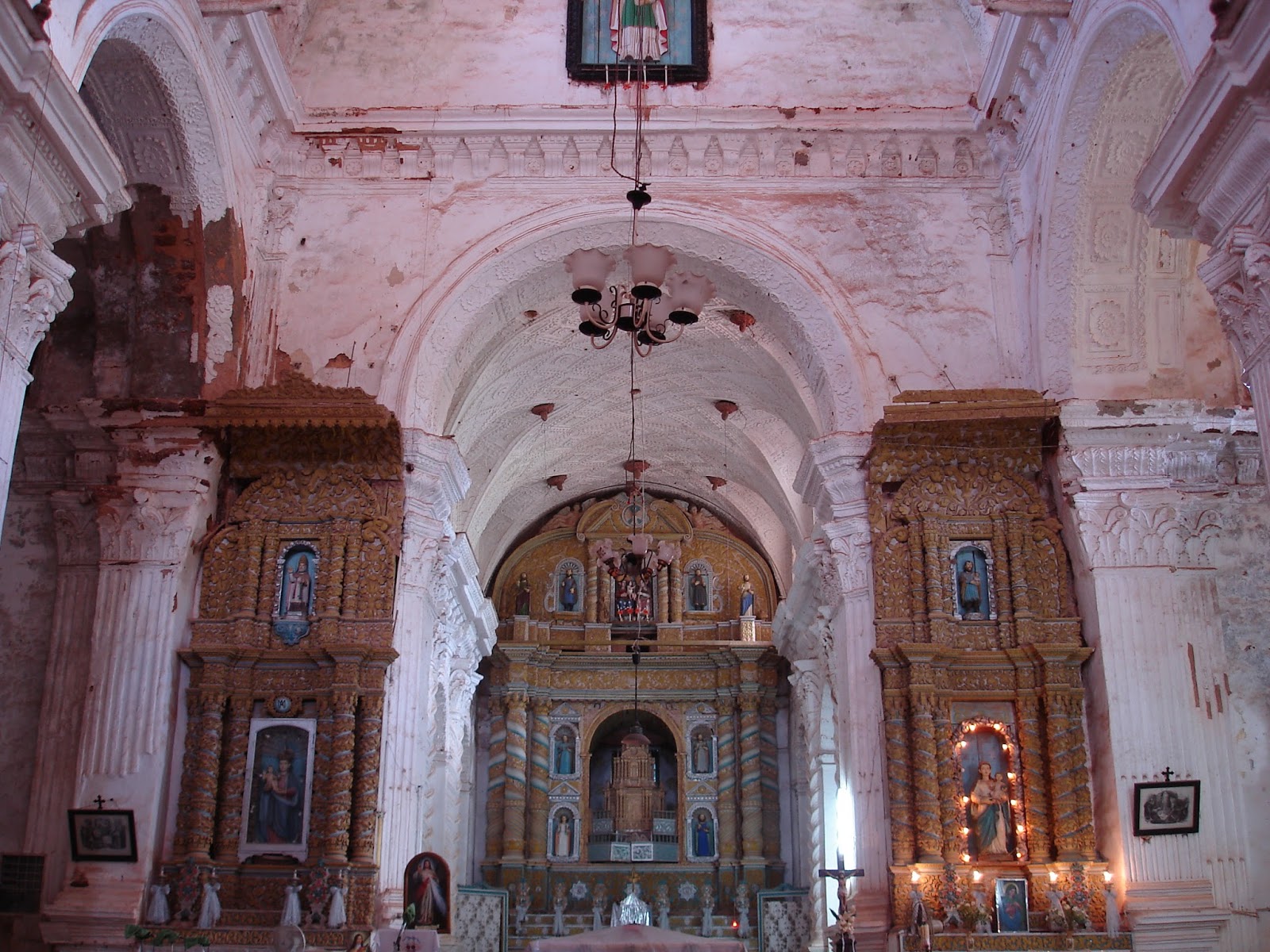
CONSERVATION OF SANTANA CHURCH, TALAULIM: A HERITAGE UPDATE


On the 29th of May, 2008 the restoration work on the St. Anne’s (Santana) church had commenced under the aegis of INTACH. This team of INTACH comprised of Arun Gupta, advisor of Heritage Tourism Department and Prof R C Agarwal, Director, Architectural Heritage Division, along with many of their workers. The Archaeological Survey of India (ASI) in 1998 had approached the Worlds Monuments Fund (WMF) requesting them to nominate the church as endangered monument of world heritage.

Subsequently, the WMF included the church in the ‘World Monuments Watch 2000 List of 100 Most Endangered Sites’. This photo feature aims to acquaint the reader with the restoration work completed till July, 2009 vis-à-vis the church before restoration a year ago in May 2008.

A brief history of the church

Santana Church was founded in 1577 and reconstructed ultimately to be completed circa 1681-89. Declared a national monument during the Portuguese era, the church stands 110 ½ feet high, 147 feet in length and 105 feet in breadth.

The church is dedicated to St. Anne, Jesus’ Grandma. Legend has it that a villager Bartalomeu Marchona witnessed the Apparition of St. Anne. His testimony was further authenticated by another lady. Word of mouth reached the village priest, who interpreted it as divine intervention and hence dedicated this church in honour of St. Anne.

Constructed in the Baroque style of architecture, the church has Indian architectural traits merged with Western motifs such as lotuses, tropical fruits and palm leaves. Perhaps the most ingenious feature of the church is the hollow walls that have passages to reach the confessional box and the pulpit.

The Project, according to official sources, is expected to be complete in 3 years since its commencement.

(The text is prepared from a report in GT dt. 27 May, 2008 ‘Hail St. Anne’s Church’ and my own article, ‘Talaulim Church– Grandeur and Neglect’, of the same day.).


May 2008: The Gallery above the main entrance

July 2009: The Gallery above the main entrance
***
May 2008: A view of the main altar and side altars

July 2009: A view of the main altar and side altars
***
May 2008: A closer look at one of the side altars

July 2009: A closer look at one of the side altars
***
May 2008: The altar dedicated to St. Anthony

July 2009: The altar dedicated to St. Anthony
***
May 2008: A view of the damaged tower

July 2009: A view of the damaged tower
***
May 2008: The façade

July 2009: The façade
***
May 2008: The crack in the tower

July 2009: The crack in the tower

(This photo feature first appeared on Gomantak Times, dt: 24 July, 2009)