Thursday, March 15, 2012

CONTRADICTIONS AND DILEMMAS OF THE POST-COLONIAL WORLD


Peter Nazareth, the African writer of Goan origin is well known as a novelist and a literary critic. He has written several essays and book reviews in leading international journals and has also edited a few anthologies. In a Brown Mantle was his first novel. Peter Nazareth was one of the earliest Goan-origin writers from Africa to have written novels in English. This review will focus on his second novel The General is Up. Published by Writers Workshop and hand-bound by Tulamiah Mohiuddeen with cotton handloom sari cloth, the review will try to place his work in a wider post-colonial world with its changing politics, issues of domination, emancipation and alienation and the hopes and aspirations of a diasporic Goan community that seems to be forever on the move.
            The General is Up is set in the fictitious country of Damibia at a time when a despotic military General comes to power with the help of vested Western interests and orders all the East Indians (Indians and Goans) to leave the country by “the next moon”. Peter Nazareth obviously is making an allusion to the real country of Uganda when Idi Amin drove out most of the Indians from that country. One wonders why Peter Nazareth chose to churn out a fictitious country rather than make a direct reference to Uganda itself, especially because a disclaimer to that effect is also issued by the author. Peter Nazareth describes the plight and pathos of the Indian community and most importantly the Goan community facing deportation. Interestingly as one reads the novel, one realizes that although most of the characters face deportation, they have no other country to enter as refugees.
            Much of the novel is unfolds in the Goan club where all Goans come to unwind and enjoy the company of fellow Goans after a hard day of work. Through gossip and political discussions, Peter Nazareth shows how the club becomes a meeting place for a diasporic community as well as a symbol through which a collective identity that is different from the larger society is asserted. The club becomes the nerve center of the political life of the Goan community, because as the times change, a native Damibian is elected the Vice-President of the Goan club setting aside the taboo of racial intermingling.
            David D’Costa, a high profile civil servant, emerges as a protagonist of the novel. But because of the transfer of power from the British to the native Damibian, David has problems in proving his citizenship of Damibia, though in his heart he feels very much like a Damibian citizen. David has to run from pillar to post to secure citizenship for himself, his wife and his children but due to several bureaucratic hurdles and red-tapism in the concerned Damibian ministry, he has to leave the country and migrate to Canada. Apparently, no other country (including India) apart from Canada is ready to accept these new stateless people. Of course, Canada’s generosity is not motivated by a humanitarian spirit but to selfishly gain from the ample pool of efficient and trained civil servants, doctors, lawyers, etc that the crisis in Damibia creates. The whole novel takes place in an environment of suspicion – by the British, Damibian and Indian governments – and as such owning a passport not only means affluence and international mobility but also having a state and a government to protect you.
            We can see the work of Peter Nazareth as a comment (or perhaps even critique) on the effects of colonialism and the consequences of the process of decolonization and also how colonialism in a somewhat modified form is still persisting in “post-colonial” societies. For instance, observe this brief excerpt: “Only a fool, a simple, brutal, childish fool would not have known that the presence of the East Indians in Damibia was part of the game. To imagine that the colonial rulers would be willing to just hand over independence! Hah! After all, their entire economies had been built up out of their empires. No, they were far-sighted. Wherever they went, they brought in a buffer, scapegoat middle-class, usually from another part of the empire. So when Independence came, the people would be made in a thousand ways to blame these foreign scapegoats as the real cause of the continued problems facing the people…When the price of clothing went up, let the people blame the Indian shopkeeper – the people would not know that the European-owned banks had raised the overdraft charges.” (pp. 78-9)
            Though politically most of the world is freed from colonialism, the vested interests of the white Western world still dictate terms to the “underdeveloped” third world. In this regard, I recall the noteworthy essay that Anne McClintock wrote. Titled “The Angel of Progress: Pitfalls of the Term ‘Post-Colonialism”, she argues that for a lot of countries and people there is nothing ‘post’ about the term “Post-Colonialism”. She goes a step further in criticizing the usage of the term itself: “…‘post-colonialism’ is arguably more palatable and less foreign-sounding to sceptical deans than ‘Third World Studies.’ It also has a less accusatory ring than ‘Studies In Neocolonialism,’ say, or ‘Fighting Two Colonialisms.’ It is more global, and less fuddy-duddy, than ‘Commonwealth Studies’,” she notes.
            The book ends in America where one of the characters who had migrated to Canada and then the US ends up leaving the manuscript of his novel about Africa to the person who gave him a lift to New York. The American (ironically a son of a Lebanese immigrant) says that an “exotic” novel about Africa was left behind by the hitchhiker. Though the word exotic is used, there is no elaborate description about the beauty and rawness of the African landscape, a feature abundantly common in the books and colour-saturated films produced by the West about Africa. In admiring nature and beauty we very often forget that humans are the ones who are suffering and secondly, by not describing in detail the African wilds, Peter Nazareth has refused to accept and repeat the same old orientalist clichés about African exotica.
            Peter Nazareth does discuss the racial segregation and feeling of superiority which exist among all the races and tribes of Damibia. One native tribe cannot sit at the same table amicably with another native tribe; similarly Goans considered themselves separate from other Indian communities and the native Africans. How the black Damibian natives react to the racist attitudes of the East Indian community is not really seen in the book, though many of the Goan characters are known to patronize and sleep with black women and prostitutes. Black African characters do not play a major role. This seems to be a drawback as this novel is not exclusively about the Goan/Indian community but about all the population of Damibia. What exactly drives this racism is a question that could have been probed in much detail.
            Another issue that comes up when we talk about the Goan communities in Africa is that of their interaction with caste. Though one of the reasons why people migrated to East Africa was to escape the torture of the caste system, we find that the caste hierarchy in Africa – and particularly in the clubs – was very rigid. To read the suffering and discrimination propagated by caste – and race - can be a good political strategy and force us to ask new questions about the exploitation. Peter does not include caste in his overall narrative and analysis. To be fair, the Goan community had only about a week to leave the country and in such circumstances, an institution like caste may be cast in the background by people in such testing times to forge togetherness and support-systems.
            The novel ends with the General getting assassinated by his rivals and a majority of the East Indian community either migrating to Canada or India. An uneasy void of power is created in the wake of the General’s assassination. But though the novel ends, it seems that the story has just begun for a migration-prone community that has been shifted to another locale by the fateful hand of history.

The General is Up, by Peter Nazareth (Calcutta: Writers Workshop), 1984; pp. 190, Rs. 150

(A version of this article appeared on Gomantak Times, dt: March 16, 2012)

Monday, March 5, 2012

TAMING THE SNAKES


SNAKE! This monosyllabic word has the capacity to send terror and a bolt of electricity down our spines. I am sure all of us, one way or another, have encountered these creepy crawlers. We detest any type of snake – poisonous and non-poisonous – as much as we fear them. But despite our fear, it is said that in Goa everybody has a snake story – whether fictitious or real – to tell. (I remember Venita Coelho once remarking about the same in the Indian Express). As a boy, any news about a snake in the vicinity of where I lived would fill me with fear. (I don’t like to accept it, but they still terrify me…just a bit!).
Rahul Alvares, the author of Free From School, has come out with a collection of stories – or rather reminisces – about his various stories that involve catching and rescuing snakes called The Call of the Snake. “No two snake calls are alike. Some end up funny. Some even end up sad. Almost every call holds a surprise. This is a reason why I am always willing to drop whatever I am doing, get into my jeans and boots, grab the snake stick and the zippered bag – my tools of trade, as it were – and rush out to answer the call. If only people knew that the call of the snake is more irresistible than their anxiety-ridden phone calls, they really wouldn’t have to lie so often,” says Rahul in the Introduction, explaining why he gets so excited in receiving any distressed snake calls.
            Rahul’s stories are told in a humorous, tongue-in-cheek and relaxed manner. Surely he enjoys doing what he does and hence the narration flows very smoothly. It seems that Rahul was not only meant to catch snakes and rescue them but also write about his myriad adventures with the easy flourish of a mature writer. As much as Rahul can easily hop on and off roofs, climb down wells and rummage through heaps of rubble and junk to locate the snakes, he can also sit down and write about them.
            But in writing down his experiences and reminisces, Rahul is also trying to make a case for the protection of snakes and also to allay the unnecessary fears that the generic public have about snakes: “Thanks to the false portrayal of snakes by movie makers – intentionally done to add action and drama to a film – as well as the inexplicable willingness on the part of educated people to deliberately keep themselves in ignorance about these creatures, the public by and large continue to believe that snakes are waiting to attack them, that they are always revengeful and perpetually spoiling for a fight. Nothing is further from the truth. The simple fact is that snakes are cowards and would much rather run away than attack a person, any person, big or small.”
            One chapter is solely dedicated to bust the many myths about snakes that cloud and clutter our minds. In doing so, this book tries to create a discourse about how shabbily we misunderstand these reptiles. For instance, while talking about snake-charmers, Rahul enlightens, “Some snake charmers – to add excitement – have a mongoose at hand as well. The mongoose is the natural enemy of the snake. The animal is made to fight the same cobra at every show. The teeth of the mongoose are broken as well, but the cobra obviously does not know this. All the while it believes that it is about to be attacked by its mortal enemy and therefore remains in an agitated and alert state of self defence. But the cobra has no fangs either. Does this sound charming to anyone at all?”
            However, one of the most amazing and exciting story of all is found in Getting Bitten. Luke, a friend of Rahul, accidently gets bitten by a Russell’s viper (a very poisonous snake). How Rahul and another friend, Aaron run from pillar to post to get the antivenin that is required for healing their poisoned friend makes interesting reading. What is also worth marveling at is the manner in which Rahul, Aaron and even Luke handle the situation during such a time of crisis.
            Rahul’s experience in learning to catch the King cobra also makes interesting reading. King cobra is the largest venomous snake in the world and nowhere in India is the King cobra antivenin produced, so a bite could effectively prove to be fatal. Of course Rahul learnt to catch the King not in India but in Malaysia and Thailand. The thrill, exhilaration and fear that Rahul felt while handling the King for the first time, is beautifully brought out in recounting this memory.
            Mention also needs to be made of the illustrator who has designed the cover as well as provided the lively and colorful sketches to the book. So kudos to Nicky Thomas for a job well done!
           At the end of the book there are appendices of useful information regarding snakes and also some easy-to-take precautions. For instance: How to avoid getting bitten by snakes, how to prevent snakes from entering your house and how to deal with a snake bite. A list of public health centers which stock antivenin is also given along with the contact details of many snake-catchers and protectors across Goa.
            I would like to wrap up this review by reproducing a reassuring quote from Rahul, “Always remember that snake bites give you plenty of time to get to a hospital. And that antivenin can always save your life. More important, Goa’s hospitals and PHCs have enough stocks of the antidote.”


The Call of the Snake: Real life stories by a young snake catcher from Goa, 2nd edn by Rahul Alvares (Mapusa: Other India Press), 2006; pp. xii + 153, Rs. 125 [ISBN: 81-85569-57-6]


(A version of this article appeared on Gomantak Times, dt: March 6, 2012)

Thursday, February 23, 2012

SHANTIES AND THE CITY


The sprouting of slums is concomitant with the development of small and big cities. The slums are appalling and they stand as a sore thumb on the seemingly beautiful, developed landscape of our cities: the glass and sparkling steel against a clear blue sky. We extrapolate the degree of development and progress from the height of the skyscrapers and other markers of wealth and prosperity are the basis for our claims of a progressive and happy nation. But in all of these eulogistic discourses of how India is progressing, we overlook (or give superficial attention to) the millions of poor in the rural hinterlands and the slums of the city.
            Delia Maria Knaebel, the Pune-based researcher and activist who has some roots in Goa, is the author of a self-published book – a novel to be precise – set in Chavanagar, a slum in Pune. Delia personally handed me a copy of her book when I met her a few months ago in Pune and also confided in me that the book was primarily published to help other social workers and NGOs working to alleviate the problems of the slum dwellers, particularly the issues concerning women. In the foreword of her novel Delia says, “This novel depicts what it was in the India of 80s and 90s for a woman living in an urban slum. This is told through the story of Lata, a woman who faces multiple oppressions; poverty, handicap, caste, colour prejudice and discrimination, both domestic and in the working (sic) place. There are thousands of such women in the country whose stories are similar but have not been written.”
            Many of the women of Chavanagar work as domestic help in middle-class flats/bungalows where the mistresses are very exploitative and unyielding. “In many ways the middle classes were more communal minded than the poor, though many labeled them backward as (sic) narrow-minded,” Delia informs when she talks about the encounters of slum women with middle class women. Along with the main characters – Lata and Tara – this novel also tries to weave the stories of other women whose lives cross paths with the central characters.
There is a genuine concern that Delia has for the slum dwelling women and certainly, her voice is valuable. However, this is Delia’s first book and that too self-published and hence in the writing and presentation this book does reflect a certain rawness.
           Though it is claimed that Lata is the protagonist of the novel, her role is just marginal in the novel. Lata, the protagonist and her sympathetic middle-class friend, Tara themselves flit in and out of the book. Tara and Lata take an active part in an NGO working for the slum-dwelling women but we are not told anything about Tara’s background and the reasons that move her to sympathy for the slum dwelling women. In trying to pack as many stories of slum women in the book, the central plot and the flow of narration is lost.
However, if one considers just the story of Lata in isolation, then Delia has done a very good job of crafting this character for there is nothing amiss in her prose. Delia had great scope to develop her characters in greater detail so that the finer subtleties and nuances of what it means to be a low caste slum dweller (and particularly a woman) would be clearer and would also act as a terse political statement against elitist mentalities. Though the point that Delia tries to make is a very valid one and most welcome in terms of the politics of gender, caste and class one cannot help but notice that this point tends to be lost in the pages of the book.
Delia prefers to identify her slum dwelling women as “working class women”. In India, more than our class we are stratified in caste which has a direct bearing on whether we are going to enjoy better life chances or not. My disagreement here is that if a woman is financially and sexually exploited, it is not just because of her position as a woman but a large measure of her oppression would/could result from her caste position. The same happens when the slum-dwelling, low-caste women encounter middle-class women who belong to a particular caste (arguably upper) and who bicker and bargain for every paisa and benefit that the domestic help from the slum ask from their employers.
         The reason why caste needs to be included in the discourse of such subalterns as Delia’s slum-dwelling women who are trapped in a world of poverty, abusive and drunken husbands and exploitative in-laws along with class is because caste is not theorized enough. Bharat Patankar writing for Kafila.org (Caste and Exploitation in Indian History translated by Gail Omvedt) says, “Class has beentheorized extensively in terms of exploitation; to some extent gender also, butnot caste. Exploitation as (sic)women in various forms has also been a reality for thousands of years; thisalso is not through ‘class’. This reality from throughout the world gives ablow to the idea that exploitation can only be class exploitation.”
Rather than a novel Delia could have presented her stories as an anthology of short-stories celebrating the resolute spirit of women oppressed due to financial, sexual and caste exploitation. And before I end, I would like to reiterate something that I have said in the past elsewhere. It is not easy to self-publish a book. My heart and thoughts go out to people like Delia who are engaged in such enterprises. 

The River Weeps: Life and Sexuality in a City Slum by Delia Maria Knaebel (Pune: Self Published), 2011; pp. 153, Rs. 99 [ISBN: 978-81-8465-344-1]
e-mail: shalom2000@rediffmail.com

(A version of this article appeared on Gomantak Times, dt: February 24, 2012)

Tuesday, February 14, 2012

AN INTERVIEW WITH BERNADETTE D’SOUZA, New Orleans’ First Family Court Judge

“My client was gunned down by her husband in my presence after a court proceeding.  I truly believe that God had spared my life and so I became purpose driven to make a difference in the lives of the victims and their children.”
Bernadette D’Souza, originally hailing from Vhoddlem Bhatt, Quepem, Goa, has created waves in the American as well as the Indian press for being elected for the New Orleans’ first Family Court judgeship in the first week of February. Fondly known as “Busha” to her relatives in Quepem, Bernadette D’Souza won the elections when two of her rivals, Kris Kiefer and Janet Ahern dropped out of the race. In her victory statement D’Souza says, “I thank all the members of our community, who have entrusted me with this historic opportunity to shape the role of this new Family Court in our judicial system, including my worthy opponents, Attorneys Janet Ahern and Kris Kiefer, who have allowed me to begin the important work of this court immediately by withdrawing from this race. I want everyone to know how seriously I take that responsibility. I pledge to make you proud of my service as your first Family Court Judge.”
Recipient of numerous awards and honours, D’Souza is a graduate of the Bombay University and Tulane University Law School in New Orleans.  She moved to the U.S. in 1978 and joins the ranks of Keith Vaz, Bobby Jindal, Sunita Williams etc. who have made it big in the West.  
In a very personal and frank chat Bernadette D’Souza talks about her ambitions, childhood, Bombay and Quepem – her home during her childhood years.

Tell us about your childhood in Quepem, Goa and also about your father Tony Gomes, who was a renowned musician of yesteryears.
I was born in Goa to loving parents Anthony (Tony) and Esmeralda Gomes. I have fond memories of my childhood in Quepem. Every summer holidays in May, we would visit with our grandparents, Joao and Anamaria Gomes. We had a fun time visiting with relatives. My parents often entertained friends and relatives in our home. The feast days were special.  There was so much excitement around the house.  To raise funds for a worthy cause, my father arranged for a New Year’s Eve dance in the Quepem Municipal Garden.  I remember going to see him perform.  It was well-attended and the people of Quepem appreciated his kindness.  It was such a proud moment for me as his daughter. My father never hesitated to give a helping hand to those in need.
My father was a well renowned musician in Bollywood.  My early childhood was spent in Mumbai because of my father’s employment.  He was the primary influence in my life and was my role model.  He would take me to the film recording studios, where I watched him play his guitar.  Many of my leadership traits were taken from the examples of my father.  He was the first Indian musician to introduce the electric guitar in Hindi movies. I remember being introduced to the music directors and other musicians that he worked with, and was in awe of his greatness.  His untimely death left a sudden void in my life and compelled me to carry on his message of striving to achieve my full potential.  His outstanding legacy will always be a part of my life.

As a Catholic girl from Goa, how was it like for you growing up in Bombay? 
We lived in an area that was predominantly Goan Catholics.  I attended a nearby Catholic school in my early years. As the oldest child of 8 children, my father wanted me to have a good education and sent me to a convent boarding school in Siolim, Goa. My father always emphasized on how important an education was and had great expectations of me.  I thrived while there and was the head girl of my class. I came back to Bombay to attend college and graduated from the University of Bombay with a degree in Psychology (with Honors).
With husband Dr. Terence D'Souza

You moved to the U.S. in 1978. Was it primarily because of academic reasons or were there any other reasons?
I came to the United States in 1978, as a young bride having married my husband, Dr. Terence D’Souza of Cuncolim, Goa.  He came to the US to do a medical residency in Neurology.  I chose to stay home and raise our 3 wonderful children, Lloyd, Vanessa and Christine.  When our youngest entered kindergarten, I decided to go back to school and was admitted to Tulane University Law School in New Orleans.  I graduated in 1992 with a Juris Doctor (JD) degree. In 2002, I was appointed as an adjunct professor to teach a course at Tulane Law School.

How was your initial experience in the U.S.? Did you encounter racial discrimination?
My initial experience in the U.S. was a lot easier.  Both my husband and I adapted very easily to the culture of New Orleans.  New Orleans is a great city and the people are welcoming and hospitable.  New Orleans is a city very much like the cities in Goa, with Spanish and French influences.  It is predominantly Catholic with lots of old churches.  We quickly made friends and became a part of the community that we live in.  We did not experience any racial discrimination. Our accomplishments as a physician and a lawyer helped break any cultural barriers.

What motivates you in taking up public service?
As a public interest lawyer, I worked at a non-profit law firm and represented the indigent population of our city.  People who could not afford a lawyer obtained free legal services. I was the managing attorney of the family law and domestic violence unit.  Representing the poor of our city gave me an understanding of the need to offer myself for public service.
With Chief Justice Caloger and Louisiana State Bar Association President Guy de Laup after receiving the Career Public Interest Award in 2008

Why is the issue of domestic violence so close to your heart?
In 2000 I was the board president of the Young Christian Women’s Association (YWCA). The YWCA had the premier battered women’s program in the city.  The incidents of domestic violence were growing.  I saw a need for representation of victims of domestic violence and through my law firm applied for funding to the Department of Justice to represent the victims in civil court.  I established the unit at Southeast Louisiana Legal Services and began my work. The issue of domestic violence is so close to my heart because of an incident that occurred outside the courthouse.  My client was gunned down by her husband in my presence after a court proceeding.  I truly believe that God had spared my life and so I became purpose driven to make a difference in the lives of the victims and their children. 

Having being brought up as a Catholic Goan girl, to what extent did it influence your personality and outlook on life?
I attended a Catholic boarding school in Siolim, Goa where the emphasis was on education and leadership. The nuns in the boarding school also instilled in me a strong desire to help the needy. “To those whom much is given, much is expected,” is a quote from John F. Kennedy.  I have continued to be involved in the Archdiocese of New Orleans, having served as a pastoral council member in my parish.  I also serve as a lector and Eucharistic minister. 
With her entire family

Can share with our readers some interesting anecdotes or incidents that you experienced in the process of your amalgamation in American society, in the sense of being accepted in America?
My career path in public interest law has been a gratifying and rewarding experience.  I thank God, my wonderful husband and children, who have been my source of strength and grace that has enabled me to continue the work I do for my community. I have been honored by the community in New Orleans having received numerous awards and recognitions, and most recently honored as the 2011 Women of the Year by City Business, a local newspaper.  The American society recognizes success and excellence, and acceptance has not been a problem.  In addition my children have also been finding success in their own careers.  My son Lloyd is a writer director in Hollywood, my daughter Vanessa (Michael DePetrillo) is a Patent Attorney in New Orleans and my daughter Christine is Director of International Sales and Acquisitions at Preferred Content in Los Angeles.  We are proud grandparents of Aidan Michael DePetrillo.

Email: bdsouza54@gmail.com
            Web: www.bernadettedsouza.com

(A version of this interview appeared on Gomantak Times, dt: February 15, 2012)

For the Konknni translation see here.

Sunday, February 5, 2012

WHITEWASH, RED STONE AND THE JESUIT HERITAGE

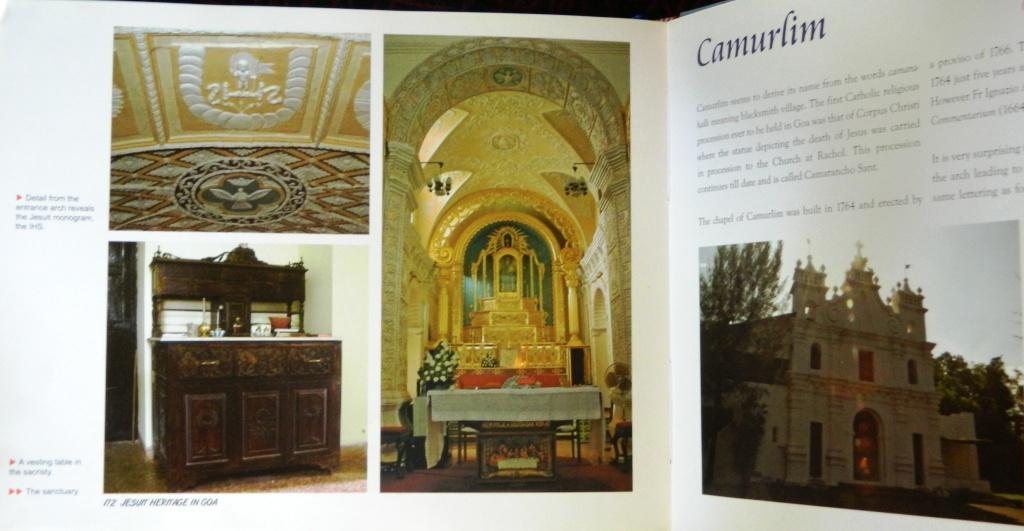
The Society of Jesus has come a long way from the time the first Jesuit missionary had landed on the shores of Goa. Taking an initiative into scholarly work, the Jesuits, right from the start have actively compiled dictionaries/grammars for Konknni as well as other languages. Involving themselves actively in the spread of Christianity, among other things, required the construction of churches and chapels. A new book on the Jesuit-built churches in Goa (thank you, Francisco “Xik” Dias of Dramapur for gifting me your copy!) gives one the impression that throughout the five centuries that the order has been here, the Jesuits have been as busy as the bees.
            Most of the magnificent churches – the brilliant white façade against a lush green background – that we are so used to in any Goan landscape and which we believe to be our cultural heritage, were built by the Jesuits. One of the simplest ways to recognize a church built by the Jesuits is to spot the insignia, IHS, which is displayed in a very prominent place in the church. Listed in this book are nearly 80 churches (and some chapels too) that were built by the Jesuits. Jesuit Heritage in Goa by Savio Rodrigues SJ is a coffee-table book with photographs by Rinald D’Souza SJ and Shannon Pereira SJ.
This book is dedicated to Fr. Moreno de Souza who had immersed himself in researching about Goan churches and whose four volumes in Konknni (Bardezcheo, Saxtticheo (2 Vols.) and Tiswaddecheo Igorzo) are a testament to his scholarly work. In his dedication Savio Rodrigues says, “Fr. Moreno could not wait to see the publication of this book, which has now seen the light of the day, thanks to the insights he shared with us. We gratefully acknowledge his willingness to accompany us on a tour of the churches of Ilhas, just three months before God called him to Himself. His long hours of research, revealing interviews, and finally his books on the churches in Goa have contributed immensely to the publication of this book.”
            This book briefly tries to acquaint the reader with each of the churches that the Jesuits built using history (not exactly the hardcore one), anecdotes and traditional lore. The pages of this book are full of photographs and anybody who needs quick and concise information about a particular church can profitably refer to this book. Though informative, the prose sometimes lacks the delightfulness of a coffee-table book. More revisions could have been certainly welcome. Interesting traditions associated with a particular church could have been woven in the text to make the overall prose more delightful. One just needs to browse through a Mario Cabral e Sa authored coffee-table book on Goa to understand what I am talking about.
             The layout and printing of this book is neatly and artistically done. I must give it to the two photographers who provided the images for this book. There are some stunning pictures in this book and credit should be given to Rinald and Shannon for their dedicated effort. But some of the photos did not capture the beauty and detail of the churches. Like the photos of the detail of the façade of the College of St. Paul bearing the Jesuit monogram (p. 17) and the sanctuary of the Church of Our Lady of Hope (p. 119).
            This book did raise a question in my mind: why did the Jesuits of today feel the need to publish a book about their own heritage? The answer is that, maybe, they want to reclaim their heritage and remind us of their legacy. Due to the Pombaline reforms the Jesuits, along with other religious orders, were driven out of Goa. The Jesuits were the most affected because they possessed enormous amount of property and, as this book has shown, some of the biggest churches were built by them. Though they have lost control over their material property, their intellectual heritage and legacy cannot be forgotten. Perhaps, the Jesuits are trying to assert this point. “Suppressed and expelled centuries ago, some Jesuit legacies refuse to remain repressed. They remain alive in the people. Probably prior to the rock-strong foundations of stone, the Jesuits first built faith-foundations among the people themselves,” Savio Rodrigues says in the opening few lines on the Colva Church.
             One of the most interesting vignettes in this book is the one on the Ponte de Linhares, the bridge that connects Panjim to Ribandar. This is a Jesuit contribution to a secular building. “The Ponte de Linhares was built by the Portuguese Viceroy, Count of Linhares, Dom Miguel de Noronha, between 1632-1633. It was meant to link Panjim with Ribandar and the City of Goa. The Portuguese sought the technical expertise of the Jesuits of the College of Saint Paul (Paulistas) in 1632 to build the massive bridge that was to be the longest in the whole East. The 3,026 metres long bridge was built on alluvial soils after stabilising it with solid trunks of local timber known as zambo,” Savio Rodrigues informs. All this while I was always under the impression that the Portuguese were responsible for the construction of this bridge. A couple of days after reading the book and while travelling on this very bridge, I recall thinking, “Hey, the Jesuits helped!” 
              Another interesting piece of information comes from the Our Lady of Pilar Church, Seraulim: “The Church of Our Lady of Pilar at Seraulim contains a huge side altar dedicated to Saint Sebastian, the patron of soldiers. The Portuguese royal insignia that rules the altar appears quite striking at first sight. The altar subtly illustrates the rule of the Crown even over the Church.”
            Because the text of this book is very brief and simple, perhaps the same could be used to make small video clips and made accessible to the public on the internet. A tech-savvy person like Fr. Rinald D’Souza could use his expertise.

Jesuit Heritage in Goa, by Savio Rodrigues SJ (Panjim: Goa Jesuits), 2009; pp. 184, Price not mentioned [ISBN: 978-81-906554-0-8]

(A version of this article appeared on Gomantak Times, dt: February 6, 2012)

Tuesday, January 31, 2012

MANGOES, TOURISM AND OTHER BLAH

We all love the mango. The sweet and succulent meat of the King of Fruits is hard to resist. So when a book titled Mango Mood was spotted in a bookshop in distant Baroda (Gujarat), which contained satirical articles that discussed Goa and which claimed to be like the soft flesh on the outside with a hard core within, it proved very hard for me to resist purchasing it. Though, it took me a few months to actually open and read it!
           Sharmila Kamat, the author of the book, is a very established writer having published in major national and international mastheads as well as Goan publications. But most importantly she is an astrophysicist who “studies the constitution of the Universe, particularly what makes the hidden mass we call dark matter.” Reading through the book, more than the actual essays, I felt I should rather dwell at length on the two introductions to the first and second editions of this book. For one feels that these two introductions can be much more useful to understand Sharmila and her writings than the actual ‘pieces’ themselves.
            Sharmila earnestly tries to move us away from the whole sun-sand-surf-fenni-bikini-hedonism Goa, and as such a major chunk of her book is taken up in discussing tourism. The next major theme is the local politics: the horse-trading that Goa became known for post ’90s as well as the communalism that has seeped in contemporary political life and the docking of the casinos.
           One major problem that I have with everyone and anyone who claim to take us away from the tourism brochure-produced image of Goa is that they themselves, in the bargain, reinforce this image. For instance, Sharmila starts her first edition introduction and many of the essays with the oft-repeated sun-kissed beaches, palm-trees, natural beauty, paradise and such blah-blah-blah. The cover of her book uses a picture of a “sun-kissed” seashore. In other print spaces, the columns and features which try to do the same are, ironically, named “Beachside” or would have pictures of white men and women accompanying the text. Now I do understand that not everything is in the hands of the author, especially when national and multi-national publishers and newsmagazines are concerned where one’s work needs to pass through the hands of many editors. But I digress…
            In this long introduction, Sharmila makes some statements and comments that on one level could have been done away with (or at least written in a smarter way) and at other times these statements and comments could prove highly politically problematic and shows the author’s inability to assess the political situations that she is commenting on. In trying to retell the story (or rather the history) of Goa, Sharmila not surprisingly falls back on the Lord Parashurama myth. I am not comfortable when the authority of brahmanical texts is invoked (even in a lighter vein) and passed as history for the simple reason that they are myths having their own elitist agenda and by no stretch of imagination can they be called history.
            And then, in this retelling of history we come to the time of the Portuguese. “Like all colonial rulers,” Sharmila says, “the Portuguese came uninvited, and then proceeded to dig themselves into the woodwork for the next 451 years.” Nothing could be further away from the truth! Sharmila fails to recognize the complicity of the native upper-caste elite in the colonial projects; be they British or Portuguese. It is through statements like these that the reading and retelling of Goa’s history (which the blurb call pièce de résistance) by Sharmila is very facile. Clearly Sharmila’s book has reached a wider audience than a paper or book on Goan history can ever hope to enjoy such readership. In repeating the same old clichés, myths and images we are not really moving away from a conception and idea of Goa that is very upper-caste, orientalist and biased.
           In the introduction to the second edition, Sharmila talks about the linguistic politics surrounding Konkani. “Around the time of the first edition of the book, they [Goans] were out on the streets protesting against the second-class treatment meted out to the mother tongue of most Goans – Konkani. No sooner was this grave error rectified than the protestors were back on the streets – to hyperventilate over the first class treatment meted out to Konkani,” she says. Again, the issue here is too simplified and too watered down. Protagonists of Konkani (or Konknni/Concani) in the Roman script (who are sometimes branded as anti-nationals, agents of the Portuguese etc. by extremists of the one-script-one-language persuasion) are protesting against the step-motherly treatment meted out to “their” Konkani. Are these the same people who are “hyperventilating” against the “first class treatment meted out to Konkani” or are they somebody else? Whether they are the same people or not, the issue about the complexity and diversity of the linguistic politics of Goa is something that is not reflected in the understanding and conception of Sharmila’s Goa.
            There is one article that I really enjoyed titled “Special Topics in Calamity Physics”. Being a big fan of the American sitcom The Big Bang Theory, and enjoying to the core the remarkably funny moments produced by the use of physical and other scientific references to portray the life of four nerds, I found in the abovementioned article, moments when one could say that the astrophysicist in Sharmila is now really speaking! Coming back to the cover, apart from my complaint that it reinforced the whole “sun-sand-surf…hedonism narrative” of Goa, it is also badly done.
            So henceforth when we talk about Goa – anything about Goa – what do we look for and what do we give our readers and audience? Certainly not the old, anachronistic rubbish. How about something new, something that is – even if we are trying to be funny – boldly iconoclastic?


Mango Mood, 2nd edn. by Sharmila Kamat (New Delhi: Rupa & Co.), 2011; pp. xli + 166, Rs. 195/- [ISBN: 978-81-291-1722-9]
Web: www.rupapublications.com

(A version of this article appeared on Gomantak Times, dt: January 31, 2012)

Thursday, December 29, 2011

FROM THE ATTIC TO THE MANSION


Tales from the Attic was the debut novel of the Carmona based writer, Savia Viegas. One may recall the review I had done of the same in this very newspaper a few months ago. Five years after her first novel, Savia Viegas has returned with another novel called Let me tell you about Quinta. The rigors and travails of self publishing, it seems, has taught an unforgettable lesson to Savia as her first book did reflect a certain rawness in its binding and printing. But her second book is published by a multi-national publisher is neatly packaged. Publishing matters apart, Let me tell you about Quinta would be welcomed by all the Goan bookworms!
            Savia’s second book on some levels seems to be a sequel to the first and at other times gives the impression of being a prequel. Call it a sequel, a prequel or whatever; this novel fills in the many gaps from the previous one. Tales from the Attic, it was noticed, ended abruptly. Quinta seems to be making up for every detail that was left out in the first book.
            In the true sense of the term, there is no protagonist in the story. Mari (spelt Marri in the first book) is no longer the main character (which is why I doubt this book is a sequel). Some parts of her second novel will only be understood clearly if the reader has acquainted him/herself with Savia’s first book. However, a sprawling mansion called ‘Quinta’ is where the whole story unfolds. If one may be permitted to expand the scope of the definition of ‘protagonist’, then Quinta, in a way, becomes the ‘protagonist’. It is an old, dilapidated house that is mired in litigation for many years. Yet the crumbling edifice does not lose its monetary value for there are repeated attempts to buy/appropriate the property.
             The book opens with the arrival of California, Mari’s son Suraj’s Russian-American wife, to Carmona. In connivance with Suraj (or Sun as he is known), she arrives with a hope to usurp Quinta along with the property, which Queirozito (same as Tito of the previous book) had so painfully won through litigation. The role of California just seems to be a very short one being that of a usurper with no major consequence on the overall story. Since she fails in circumventing the alert Queirozito, she flies back to America empty-handed.
            In this novel, the genealogy of the maternal and paternal family of Mari is explored in greater detail. Quinta brings all the skeletons in the cupboard and sins of the landed family in the open. The conflict between the bhatkars and the mundkars is a theme that is constantly running through the novel. Although attempts are being made to bring this theme to life, enough, it is felt, is not done by the narrative. A critique of the position that the bhatkars and the mundkars occupied could have been woven in the narrative. Tish Ximeao, a bhatkar, laments about the mundkars not tilling their lands and going off to the Gulf to clean the “…toilets of Arabs.” We all hear such tirades, in one form or the other against the migrating Goans, a major chunk of who were presumably from the lower-caste Catholics. And this resentment could be located to emanate from this class of landed, upper-caste bhatkars. This binary division of a village society into a landed class and a non-landed, tilling class leaves out the caste factor that influenced (historically speaking) the acquisition – or rather – the usurpation of land in the first place. It is this caste equation that had the scope of being discussed in this novel.
            There are a host of lovable and quirky characters in this book – some continuing from the old book and others newly introduced. It is when Savia constructs the characters of this novel and while describing the natural beauty and features of the village of Carmona that the writer is at her literary best. The book is actually a series of sections where the biography of each major character is discussed and there are these moments (just a few!) when one cannot help but notice some raw spots in the book. But because Savia has a way with words, one does not feel that the narrative drags or falls short in the literary department.
            This novel also touches upon all the major political events that occurred in the last hundred or so years. There is the mention of Fanchu Loyola, the ‘nationalist’ who fought for Goa’s independence from Salazar’s dictatorship, the liberation of Goa, the Tenancy Act whereby the landed class lost its power and finally to more recent times: the land grabbing by the rich and fat builders from the north and the metros. It is only the elite characters who are seen reacting to these political changes. But to me, the illnesses and eccentricities of the characters is what takes the novel forward rather than the immense political changes providing the reader with subtle, humorous moments.
            At the end of the novel, Robby the son of Piedade who was a mestiço orphan brought by Mari’s maternal grand-mother from an orphanage, returns back to Carmona, takes active part in local politics and goes on to win (with the ardent help of Preciosa, the mother of Mari) the panchayat polls! Robby is faced with conflicting situations where he is expected to check the many irregularities that take place in the village and comes out as a deeply disturbed and confused person. It is in the last few pages the author seems to lose her grip on some of the characters and their actions become hard to understand.          
But, all said and done, I enjoyed reading Let me tell you about Quinta for the way it is written. The prose and tasteful descriptions of the picturesque village can be an added incentive for a lazy Sunday afternoon.                                                                                                         

Let me tell you about Quinta by Savia Viegas (New Delhi: Penguin), 2011; pp. 254, Rs. 299/- [ISBN: 9781-0-143-41522-0] Web: www.penguinbooksindia.com 

(A version of this article appeared on Gomantak Times, dt: December 30, 2011)

Monday, December 26, 2011

RAMAYANAS, RAMANUJAN AND ENGROSSING NARRATIVES


Succumbing to political pressures for allegedly hurting religious sentiments, the Delhi University scrapped an essay by A. K. Ramanujan from its undergraduate history syllabus a month or so ago. This move sparked widespread protests not only from Universities in Delhi, but also elsewhere. The essay in question was titled Three Hundred Ramayanas: Five Examples andThree Thoughts on Translation. As the title suggests Ramanujan discusses the various versions of the Ramayana, which he likes to call ‘tellings’, as well as the issues that crop up when this particular text is translated so many times.
             Ramanujan was a versatile scholar, donning the hat of author, poet, translator and folklorist. Initially teaching at the Maharaja Sayajirao University of Baroda for eight years, he later moved to the U. S. 
 The whole trend and culture of banning/censoring books, film, paintings etc. that we witness in India – of which the Ramanujan fiasco is only the latest – has demonstrated how the precarious condition of the ideal of Free Speech is standing on shaky ground and also a gloomy future is facing not only the students of history (like my self) but to the whole country at large. The reason why I am deeply disturbed after the fiasco at Delhi University is because an attempt is being made to suppress the many voices of history, which in a way implies that there is only one possible way to interpret history in the world.
            The news of the removal of the essay made me curious andurged me to explore the nature and content of the essay as well the politics ofbanning/censoring. I was skeptical whether I could locate a digital copy on the internet. But as luck had it, I could find it very easily. Talk about asking a child not to play with fire!  In this essay, easily downloadable via the internet, Ramanujan tries “...to sort out for myself, and hope for others, how these hundreds of tellings of a story in different cultures, languages and religious traditions relate to each other: what gets translated, transplanted and transposed (italics mine).” Ramanujan prefers the term ‘tellings’ because in his opinion there is no such thing as an original Ramayana and the use of terms like ‘versions’ and ‘variants’ imply that there is an original text from which all subsequent texts emanated.
            Kumkum Roy, a historian of Ancient India at the Jawarharlal Nehru University, writing for the Economic and Political Weekly says that “Ramanujan is an engrossing writer, drawing attention to a range of narratives related to the epic from Sanskrit to Kannada and Thai. Most importantly, he uses the different tellings of the Rama story as cultural artifacts that shape and are in turn shaped by our daily existence. Why then should young adult learners be prevented from learning about them?”
             Ramanujan’s mastery over words as well as the subject over which he is elaborating, draws the reader immediately into the text. For instance, citing the example of Jain traditions, Ramanujan says, “When we enter the world of Jain tellings, the Rama story no longer carries Hindu values. Indeed the Jain text expresses the feeling that the Hindus, especially the brahmans, have maligned Ravana, made him into a villain.” When the Jains tell the Rama story therefore, Ravana comes off as a tragic hero, moving us to sympathy.
            At this point it would be worthwhile to recall the animated movie Sita Sings the Blues. In this film, the narrative of Ramayana is woven with the personal story of Nina Paley, the artist who made the film (which can be downloaded for free). Like the unfortunately fateful essay of Ramanujan, Nina Paley’s delightful movie too had the spectre of ‘banning’ hanging over its head initiated by radical Hindu groups.
            One thing that would strike anybody who has or will watch the movie is the brilliant animation to the accompaniment of jazz music. Like Ramanujan’s essay, this film too, engrosses the viewer in its narrative. What was striking about this film was the depth with which it interrogated the actions of the characters in the Ramayana. Questions that have no easy answers, not because they are entrenched in some profound and deep metaphysics, but simply because the contemporary political ramifications can be ugly. It was the only movie (as far as I know), where, at the end of the credits a list of recommended readings scrolled up one’s screen!
          Kumkum Roy gets it right when she says, “If anything, young adult learners (the average undergraduate students) need to be encouraged to understand and appreciate these differences rather than be prevented from learning about them. The dangers of suppressing the text in particular and the implications of a policy of suppression of dissent in general are far more threatening than any comments Ramanujan makes about Indra and Hanuman.”
            If the sole intention of banning the essay was to make students – particularly of the arts – read, then kudos to the fundamentalists! But clearly this is not the issue. The issue is about control. What is sickening is to note that, not only is an attempt made to control what we do or say, but also what and how we ‘think’. For the control of the mind is the easiest way to subjugate the masses. We can’t allow ourselves to be passive dupes who would accept anything that dominant ideologues and groups tell us to believe.

(A version of this article appeared on Gomantak Times, dt: December 27, 2011)

Wednesday, November 30, 2011

COLONIAL HISTORY, POST-COLONIAL INTERPRETATIONS


Teotonio R. de Souza is an authority on Indo-Portuguese history.  The doctoral dissertation he had submitted to the University of Poona was published in 1979 as Medieval Goa: A Socio-Economic History.  Thirty years later, a second edition of the book was published thereby displaying its usefulness and academic merit. This text was widely distributed and read. It sought to “…get closer to the common man’s reality [and]…replace the myth of a ‘Golden Goa’”. There was such a need because, “During colonial times, Portuguese studies were concentrated largely on the history of navigation and expansion of Christianity by the Portuguese in the East. They do merit attention and their long-term consequences can hardly be ignored. However, following the end of colonial era, it was necessary to maintain the historiographic balance and to question the exaggerated myths about the ‘Discoveries’ and ‘Civilizing Mission’ of Portugal, and the playing down of, or ignoring, the harmful consequences that accompanied and followed those feats and mentality.”
            I had read this book a few months ago and had always hesitated to write a review because I feared that I might not be able to evaluate the book properly. But as a student of history I have tried to read whatever Dr. de Souza has written. This review is written mustering much courage and much effort to marshal my thoughts in the right direction.
            Medieval Goa focuses mainly on the ordinary people of the urban areas and the country side, which included native as well as Portuguese commoners who had suffered and were victimized by the policies and excesses of colonialism. Dr. de Souza’s work marks the first formal and best known effort in Goa to write histories that are not dynastic in nature and by including the race and caste relations of the rulers and the natives Dr. de Souza has moved away from the Nationalist paradigm of giving us conflict-free and sanitized accounts of the past. Just as the noted historian of Ancient Indian history, Romila Thapar has credited the writings of the Marxist historian D. D. Kosambi as a watershed moment in Indian history writing, Dr. de Souza’s work can also be termed as a watershed moment in the history writing of Goa.
            The influence of Marxism on the work of Dr. de Souza can also be observed in the pages of this book. Shifting the focus from the (suspected) greatness of the rulers of the past to the socio-economic conditions is a major Marxist contribution to Indian historiography. Besides, Dr. de Souza also uses words like ‘Praxis’ which brings to mind the Italian philosopher Antonio Gramsci who reinterpreted Marx and his ideas and who was jailed during the fascist regime of Mussolini referring to Marxism in his prison notebooks as ‘philosophy of praxis’ to escape the prison censors. Praxis means a set of examples for practice.
            A major contribution of this book is the recognition that native elements had actively collaborated in the empire-building activity of the Portuguese. I shall reproduce a few excerpts below:
…when the Portuguese captured Goa, the success of the Portuguese was made possible by the native Hindu population which fought side by side with the Portuguese to defeat their former Muslim overlords (p. 6).
After 1656, when the Bijapuris had to grapple with both the Mughals and the Marathas, they had no energy to spare for further conflict with the Portuguese. However, the latter was not free from embroilment in the politics of these powers since many of these provincial officials, the desais, had revolted against their masters and sought frequent refuge in the Portuguese territory. The Portuguese secretly favoured the guerilla movements of these desais to keep the powers concerned distracted with campaigns to bring the rebels to book (p. 12).  
The Hindus in Goa were not just shopkeepers and tax-farmers. They were in every kind of trade and profession, and were much appreciated not only by their common clients but every religious and State official (p. 84).”
            Caste and racial prejudices seeping into the Christian realm in medieval Goa can be observed by the following excerpt, for many of us are generally of the naïve opinion that caste does not exist in Christianity: “Where social integration was concerned the Christian preaching of brotherhood and equality of all men did not prevent the missionaries from establishing religious confraternities (confrarias) based on castes: and, just as their doctrinal wealth failed to promote greater social cohesion, their vast income and unlimited political influence did not achieve proportionate results in raising the standard of living of their native converts. Even in admissions in their own ranks, religious orders, particularly the Jesuits, maintained strict racial qualifications during the period covered by this study.”
            The work of Dr. de Souza by his own admission “left many loose ends than it has succeeded in tying up.” It threw up a lot of new questions for future students to dwell upon. How far these questions have been taken up as topics of research is in itself an important question to ask. Scouring the internet for scholarly material published in journals and other publications on Goa written by Goan academics returns minimal results. Because there are many loose ends, it gives us an opportunity to think about the past in many different ways and also to hear the many voices of history. Dr. de Souza’s work potentially can break an elitist narrative of the past that prevails amidst us and makes us see who benefits and why from a particular type of rendering of history. Dr. de Souza acknowledges his intellectual debt to D. D. Kosambi, who stopped us from treating the history of India and Goa “as an episode of colonial historiography” and that our history has a much more distant past and a promising future. This hope of a “promising future” is yet to materialize.
I would like to end by a cautionary quote from Dr. de Souza’s valuable work, “Willingness on the part of the native subjects to collaborate was not lacking, but this factor is being misinterpreted in the wake of Goa's liberation from colonialism, threatening thereby to continue the evils of colonialism and the exploitation of one section of population by another.”

Medieval Goa: A Socio-Economic History, 2nd edn by Teotonio R de Souza (Saligão, Goa: Broadway Book Centre & Goa 1556), 2009; pp. xviii+265, Rs. 395/- [ISBN: 978-81-905682-6-5]
Web: goa1556.goa-india.org, www.flipkart.com

(A version of this article appeared on Gomantak Times, dt: November 30, 2011)