Showing posts with label Eric Ozario. Show all posts

Tuesday, January 6, 2015

THE MIGRATION MYTH AND THE KONKANI ACTIVIST


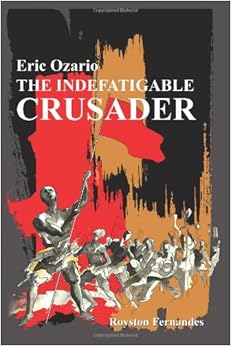
Eric Ozario, the noted Konkani language activist from Mangalore, is perhaps one of the few and fortunate activists to have his biography written while still alive. Titled Eric Ozario: The Indefatigable Crusader, Ozario’s biography is written by the Mangalore-based engineer Royston Fernandes. The biography is a no-holds-barred account of his life as a child growing up in the Jeppu compound, a ghetto for the depressed caste groups of Mangalore who had converted to Catholicism, his days as a trade union leader, and lastly his life as an activist of the Konkani language.

Ozario’s biography reproduces a popular and status quo narrative of the history of the Konkani language: of widespread religious suppression and oppression, with a concomitant loss of the Konkani language and culture, in the wake of the arrival of the Portuguese. Most of Konkani language activism, especially one that is driven by upper-caste interests, situates itself within this narrative. Ozario’s biography allows us to see how this narrative operates in Konkani activism, even if this activism emerges from a location outside that of the upper-caste. Though it reads like a hagiography rather than an objective narrative, the value of Ozario’s biography lies not only in its no-holds-barred revelations, but also in what it can tell us about Konkani activists and activism.

Life for those in the Jeppu compound was as hard as it was pathetic. There was poverty and caste discrimination and Ozario’s childhood was spent in such harsh conditions. His parents originally were Tulu-speakers, but they made their children speak in Konkani. This was because despite Latin being the liturgical language of the Catholic church until the mid 1960s, Konkani reigned as the non-liturgical language. We are also told that Ozario’s parents were devout Catholics and raised their children as such. Yet, for Ozario, the story of the adoption of Konkani by the inhabitants of the Jeppu compound is a story of absolute suppression and loss of cultural identity. He states that the inhabitants of the Jeppu compound “were not only religiously converted, but were forcibly culturally uprooted. A new language (Konkani) was thrust on them in place of their mother tongue Tulu. No efforts were made to teach them the new language”. Ozario does not tell us what this culture that was lost on conversion was. The assumption here is that whatever was lost was good, thus glossing over the fact of the entrenchment of these cultural practices in caste.

Ozario’s appraisal of the conditions of the Jeppu compound as a total suppression of culture of its inhabitants occupies an uneasy position with his tacit acknowledgement of conversion to Christianity as a way out of poverty and caste. Though Christianity provided a way out of caste, the discrimination based on caste never stopped. Thus, the root of the problem which is located in the structure of caste is seen solely as a problem of conversion (forced or otherwise). It becomes clear that what Ozario understands today as an absolute loss of culture was not similarly understood by his parents who had converted to Christianity and had, as a result, adopted the Konkani language.

Yet, one cannot downplay the shame and humiliation that the young Ozario had to undergo for being “forced to speak a horribly grammarless and accented ‘Konkani’ during his entire childhood” and the various conflicts that he has with the church authorities. Thus, he stayed as far away from Konkani language and culture in his youth as possible.  Though not comparable in an equal measure with the humiliation that Roman script-users and tiatrists face for not knowing ‘proper’ Konkani, Ozario’s childhood experiences are not isolated from many other Konkani-speaking groups.
Rather than recognize this fact and use the childhood experiences to tell the story of his Konkani activism, Ozario plugs his life and engagement with the Konkani language into the popular and dominant narrative of forced conversions, migrations, suppression, and a loss of culture. For instance, while discussing his project of reviving the tradition of playing gumott among the Mangalorean Catholics, Ozario falls back on the story of how the Portuguese state and the Inquisition had suppressed the playing of the gumott. But the migration of “[o]ur forefathers” from Goa during this time allowed the gumott to be played without restrictions in areas of Mangalore.

The problem with this kind of understanding is the fact that Ozario’s parents did not migrate from Portuguese-controlled Goa. Further, such a narrative of migration wherein there are only pure victims and pure oppressors is one that is largely peddled by upper-caste groups across the Konkan and Malabar. While this history of oppression may be true for these upper-caste Hindu groups, the same cannot be said for the Christian groups in Kanara or for later converts to Catholicism. One can ask as to how Ozario – and his life and activism – fits into this migration narrative given that Ozario’s family was not converted during the first few centuries of Portuguese rule. Ozario is not the first to uncritically repeat the persecution and migration myth. More recently, Gopalkrishna Pai, the Cochin-based author of the Kannada novel Swapna Saraswat, asserted at the Goa Arts and Literature Fest, 2014 that nearly 22,000 Hindu families fled Goa after conversions began.

The question here is why does Ozario’s story shift from a personal experience of shame and humiliation due to Konkani in the Jeppu compound to an impersonal experience of persecution of Konkani-speaking migrants from Goa? Why does the blame shift entirely on Portuguese colonialism (something ‘external’) rather than also seriously thinking about how the violence of casteism operated within the Konkani society? The answer to this lies not so much in the history of Portuguese religious policies but in the manner in which individuals exert themselves to escape shame and humiliation. One can either distance oneself from the object of shame and humiliation (like Ozario did in his youth by distancing himself from Konkani) or try to be recognized within the structures that cause this shame and humiliation as Ozario’s subsequent Konkani activism indicates.

Ozario’s biography indicates to us not just the problems in uncritically using the persecution and migration narrative, but it also tells us how the very narrative is not challenged adequately by activists of the Konkani language. Challenging this narrative would allow us to see that within the Konkani language there are multiple ways of being and living. That the experiences of the Jeppu compound, the Roman script, and the tiatrists, to name a few, are legitimately part of the history of Konkani, despite the fact of not fitting into the ‘persecution-migration’ narrative. Confining to the popular and dominant narrative would mean to define the politics and vision for the Konkani language in narrow terms.

(First published in  O Heraldo, dt: 7 January, 2015)

Tuesday, March 20, 2012

SCRIPTING A NEW FUTURE: Towards an Inclusive Progress of Konkani

The two-day national seminar organized by Jagotik Konkani Songhotton (Global Konkani Organization) – JKS for short - at Kalaangann, Mangalore last week on ‘Scripts & Languages of Modern India, with Special Reference to Konkani’ brought into sharp focus the issue of nagri hegemony over other Konkani scripts (Roman, Kannada, Malayalam and Perso-Arabic) and the realization that positive political actions would only be forthcoming if the strategies were changed. Held on 10th and 11th March, 2012, the seminar was organized to gain from intellectuals and academics while trying to situate the unique problem of Konkani in a wider context of study areas such as linguistics, literature, linguistic politics, power, dominance and justice.
Led by dynamic JKS leaders such as Tomazinho Cardozo (also the president of the Tiatr Academy of Goa) and Eric Ozario (also the Gurukar of the Mangalore-based Mandd Sobhann)  the seminar had an impressive line-up of academics: Mangalore’s very own Dr. Valerian Rodrigues, professor at the Centre of Political Studies, Jawarharlal Nehru University (JNU) was the chairperson while other resource persons included Dr. Anvita Abbi, professor of linguistics, JNU, Dr. Alok Rai, professor of English, Delhi University, Dr. Asha Sarangi, also from JNU, Dr. Pratap Naik, the former director of Thomas Stephens Konknni Kendr and Dr. Madhavi Sardesai, professor of Konkani, Goa University.
            In his signature style of being brief, clear and to-the-point, Eric Ozario made five assertions at the beginning of the seminar. Some of the key elements of these assertions are: a) The issue of ‘dialect’ is directly linked with the issue of ‘script. b) Many a time, while attempting to impose a particular script, what is really sought to be imposed is a particular dialect. c) A firm belief that unity among any people (including Konkani) can be achieved only by respecting all varieties and not by imposing one and destroying other. d) The slogan – ‘ek bhas, ek lipi, ek sahitya, ek samaz…’ smacks of fascism and is very dangerous for the future of Konkani.
Dr. Valerian Rodrigues
             The well-organized and well-attended seminar did prove to give a lot of insights and food for thought. During the discussions, one got the impression that the issue of scripts had caused a lot of hurt and resentment among the Konkanivadis who were not of the nagri camp. Time and again the chicanery of the Official Language Act and the back-stabbing indulged in by the nagri lobby came to the fore. Ironically, nobody from the ‘nagri camp’ attended the seminar. We sent invitations, reminded Eric bab who went one step further and said that there was nothing ‘godly’ about devnagri and that ‘dev’ was only added to give a false sanctification and halo to this script.
            Delivering his keynote address, Dr. Rodrigues said, “Script issue or script controversy is not confined to Konkani alone. It’s a much larger issue. It bedevils several languages and script communities.” Trying to view the script issue through the lenses of power, dominance and policy formation, the political scientist from JNU stated, “The script controversy is deeply mired in political contentions. The Saraswats, Gaud Saraswats and a section of the Catholics have come to believe that their genealogical roots lie at the banks of the Saraswati river in the north. The Sangh Parivar is a major presence in the entire Konkani-speaking belt today, particularly in Goa and Karnataka coast. The devnagri script reinforces a specific kind of dominance…” The script issue should also force us to think about what kind of India we wanted, he stressed, in the sense of a nation-state.
            Dr. Anvita Abbi (Script and Language: Relationship and Contention), amongst others, raised the issue of rendering people illiterate overnight if they were forced to switch from one script to another or an entirely new script was invented. She argued that Brahmi is the progenitor of all the contemporary Indian scripts and hence nagri was better suited to represent the sounds of Konkani. But her argument ultimately appeared to boil down to ‘purity and pollution’ where what is perceived to be Indian is considered ‘pure’ and what is perceived to be foreign is relegated to second-class position.
Dr. Alok Rai
          Dr. Alok Rai (Language, Script and Dominance in India), who used the analogy of the Urdu-Hindi controversy, an area where he has worked extensively and wrote his classic book Hindi Nationalism, asked some pointed questions: what happens when (a) a language and (b) a script dies and (c) What is killed when a script is killed. (Interestingly, in the discussion, Dr. Abbi put forth the view that scripts never die, but are always killed). He also shifted our focus from the factors that are visible for the scripts controversy to the ones that are not, saying that we need to focus on those factors that really drive the movement forward. Similarly, Dr. Asha Sarangi (Language and Territory: Issues of Rights and Identities) argued that along with viewing scripts and languages aiding the production of literature, we should also include the production of knowledge in the sense of social sciences.
            Though Dr. Madhavi Sardesai (The Case for a Single Script for Konkani) could not make it to the seminar for health reasons, her paper was nevertheless read in her absence and discussed. She made four main arguments (as summed up by the chairperson), which were debunked by some of the participants as well as Dr. Pratap Naik who presented the next paper. Dr. Sardesai argued that from the late 19th century there has been a strong advocacy of the nagri script by stalwarts of Konkani. Such resolutions were passed in the numerous Parishads or Conferences before and after the Liberation of Goa. It was however counter-argued that such conferences were only attended by the nagri lobbyists and those sympathetic to the nagri cause and hence there was no democratic representation. Secondly, Dr. Sardesai felt that since Konkani in nagri could produce books on scientific topics, it was better developed. Frederick Noronha from Goa challenged this assertion saying that the number of such books were not significant and that Konkani – whether in romi or nagri – was not able to produce any original ideas so far.
            Using nagri, Dr. Sardesai further said, would enable Konkani speakers to acquire language skills in other languages that use nagri, such as Marathi and Hindi. If this be true, then why restrict us to nagri alone, why not Kannada and other south Indian scripts? Multiple scripts have also hindered the emergence of literary criticism, asserted Dr. Sardesai. But as Frederick Noronha pointed out, by making such an argument we were only barking up the wrong tree. Literary criticism can happen in any language. Personally I feel, English can be a good option as the issue of script, dialect etc. is circumvented and the required intellectual rigor can also be inculcated in the same.
Dr. (Fr.) Pratap Naik
             Dr. Pratap Naik stuck to the bare facts and debunked myth after myth that the protagonists of one-script-one-language had created and so lovingly tended to all these years. Since Dr. Madhavi Sardesai made a case for a single script for Konkani, Dr. Pratap Naik felt the need to argue otherwise (The Case for Multi-Scripts for Konkani). Using his personal experiences as well as his vast knowledge on matters of Konkani literature and linguistics Dr. Pratap accused the one-script protagonists as “…only interested in…power and money.”
            Though the seminar had no speaker to analyze all the issues mentioned above in a purely historical context and try to theorize about the problems from the archival material and other published material, the seminar nonetheless was a success. There was a tiny bit of detail that I could not overlook during the two-day long seminar. The backdrop on the stage had a vast banner that had Romi, Nagri and Kannada scripts but no Malayalam and Perso-Arabic, thus in a way not giving these scripts the deserved representation. The challenge from here on is to create a discourse that is all inclusive and also to systematically generate arguments that would deconstruct the nagri hegemony over the production of Konkani writings as well as the access to resources that become available to the speakers of a particular language.

(A version of this article appeared on Gomantak Times, dt: March 21, 2012)