The sprouting of slums is concomitant with the development of small and big cities. The slums are appalling and they stand as a sore thumb on the seemingly beautiful, developed landscape of our cities: the glass and sparkling steel against a clear blue sky. We extrapolate the degree of development and progress from the height of the skyscrapers and other markers of wealth and prosperity are the basis for our claims of a progressive and happy nation. But in all of these eulogistic discourses of how India is progressing, we overlook (or give superficial attention to) the millions of poor in the rural hinterlands and the slums of the city.
Delia Maria Knaebel, the Pune-based researcher and activist who has some roots in Goa, is the author of a self-published book – a novel to be precise – set in Chavanagar, a slum in Pune. Delia personally handed me a copy of her book when I met her a few months ago in Pune and also confided in me that the book was primarily published to help other social workers and NGOs working to alleviate the problems of the slum dwellers, particularly the issues concerning women. In the foreword of her novel Delia says, “This novel depicts what it was in the India of 80s and 90s for a woman living in an urban slum. This is told through the story of Lata, a woman who faces multiple oppressions; poverty, handicap, caste, colour prejudice and discrimination, both domestic and in the working (sic) place. There are thousands of such women in the country whose stories are similar but have not been written.”
Many of the women of Chavanagar work as domestic help in middle-class flats/bungalows where the mistresses are very exploitative and unyielding. “In many ways the middle classes were more communal minded than the poor, though many labeled them backward as (sic) narrow-minded,” Delia informs when she talks about the encounters of slum women with middle class women. Along with the main characters – Lata and Tara – this novel also tries to weave the stories of other women whose lives cross paths with the central characters.
There is a genuine concern that Delia has for the slum dwelling women and certainly, her voice is valuable. However, this is Delia’s first book and that too self-published and hence in the writing and presentation this book does reflect a certain rawness.
Though it is claimed that Lata is the protagonist of the novel, her role is just marginal in the novel. Lata, the protagonist and her sympathetic middle-class friend, Tara themselves flit in and out of the book. Tara and Lata take an active part in an NGO working for the slum-dwelling women but we are not told anything about Tara’s background and the reasons that move her to sympathy for the slum dwelling women. In trying to pack as many stories of slum women in the book, the central plot and the flow of narration is lost.
However, if one considers just the story of Lata in isolation, then Delia has done a very good job of crafting this character for there is nothing amiss in her prose. Delia had great scope to develop her characters in greater detail so that the finer subtleties and nuances of what it means to be a low caste slum dweller (and particularly a woman) would be clearer and would also act as a terse political statement against elitist mentalities. Though the point that Delia tries to make is a very valid one and most welcome in terms of the politics of gender, caste and class one cannot help but notice that this point tends to be lost in the pages of the book.
Delia prefers to identify her slum dwelling women as “working class women”. In India, more than our class we are stratified in caste which has a direct bearing on whether we are going to enjoy better life chances or not. My disagreement here is that if a woman is financially and sexually exploited, it is not just because of her position as a woman but a large measure of her oppression would/could result from her caste position. The same happens when the slum-dwelling, low-caste women encounter middle-class women who belong to a particular caste (arguably upper) and who bicker and bargain for every paisa and benefit that the domestic help from the slum ask from their employers.
The reason why caste needs to be included in the discourse of such subalterns as Delia’s slum-dwelling women who are trapped in a world of poverty, abusive and drunken husbands and exploitative in-laws along with class is because caste is not theorized enough. Bharat Patankar writing for Kafila.org (Caste and Exploitation in Indian History translated by Gail Omvedt) says, “Class has beentheorized extensively in terms of exploitation; to some extent gender also, butnot caste. Exploitation as (sic)women in various forms has also been a reality for thousands of years; thisalso is not through ‘class’. This reality from throughout the world gives ablow to the idea that exploitation can only be class exploitation.”
Rather than a novel Delia could have presented her stories as an anthology of short-stories celebrating the resolute spirit of women oppressed due to financial, sexual and caste exploitation. And before I end, I would like to reiterate something that I have said in the past elsewhere. It is not easy to self-publish a book. My heart and thoughts go out to people like Delia who are engaged in such enterprises.
The River Weeps: Life and Sexuality in a City Slum by Delia Maria Knaebel (Pune: Self Published), 2011; pp. 153, Rs. 99 [ISBN: 978-81-8465-344-1]
e-mail: shalom2000@rediffmail.com
(A version of this article appeared on Gomantak Times, dt: February 24, 2012)
“My client was gunned down by her husband in my presence after a court proceeding. I truly believe that God had spared my life and so I became purpose driven to make a difference in the lives of the victims and their children.”
Bernadette D’Souza, originally hailing from Vhoddlem Bhatt, Quepem, Goa, has created waves in the American as well as the Indian press for being elected for the New Orleans’ first Family Court judgeship in the first week of February. Fondly known as “Busha” to her relatives in Quepem, Bernadette D’Souza won the elections when two of her rivals, Kris Kiefer and Janet Ahern dropped out of the race. In her victory statement D’Souza says, “I thank all the members of our community, who have entrusted me with this historic opportunity to shape the role of this new Family Court in our judicial system, including my worthy opponents, Attorneys Janet Ahern and Kris Kiefer, who have allowed me to begin the important work of this court immediately by withdrawing from this race. I want everyone to know how seriously I take that responsibility. I pledge to make you proud of my service as your first Family Court Judge.”
Recipient of numerous awards and honours, D’Souza is a graduate of the Bombay University and Tulane University Law School in New Orleans. She moved to the U.S. in 1978 and joins the ranks of Keith Vaz, Bobby Jindal, Sunita Williams etc. who have made it big in the West.
In a very personal and frank chat Bernadette D’Souza talks about her ambitions, childhood, Bombay and Quepem – her home during her childhood years.
Tell us about your childhood in Quepem, Goa and also about your father Tony Gomes, who was a renowned musician of yesteryears.
I was born in Goa to loving parents Anthony (Tony) and Esmeralda Gomes. I have fond memories of my childhood in Quepem. Every summer holidays in May, we would visit with our grandparents, Joao and Anamaria Gomes. We had a fun time visiting with relatives. My parents often entertained friends and relatives in our home. The feast days were special. There was so much excitement around the house. To raise funds for a worthy cause, my father arranged for a New Year’s Eve dance in the Quepem Municipal Garden. I remember going to see him perform. It was well-attended and the people of Quepem appreciated his kindness. It was such a proud moment for me as his daughter. My father never hesitated to give a helping hand to those in need.
My father was a well renowned musician in Bollywood. My early childhood was spent in Mumbai because of my father’s employment. He was the primary influence in my life and was my role model. He would take me to the film recording studios, where I watched him play his guitar. Many of my leadership traits were taken from the examples of my father. He was the first Indian musician to introduce the electric guitar in Hindi movies. I remember being introduced to the music directors and other musicians that he worked with, and was in awe of his greatness. His untimely death left a sudden void in my life and compelled me to carry on his message of striving to achieve my full potential. His outstanding legacy will always be a part of my life.
As a Catholic girl from Goa, how was it like for you growing up in Bombay?
We lived in an area that was predominantly Goan Catholics. I attended a nearby Catholic school in my early years. As the oldest child of 8 children, my father wanted me to have a good education and sent me to a convent boarding school in Siolim, Goa. My father always emphasized on how important an education was and had great expectations of me. I thrived while there and was the head girl of my class. I came back to Bombay to attend college and graduated from the University of Bombay with a degree in Psychology (with Honors).
With husband Dr. Terence D'Souza
You moved to the U.S. in 1978. Was it primarily because of academic reasons or were there any other reasons?
I came to the United States in 1978, as a young bride having married my husband, Dr. Terence D’Souza of Cuncolim, Goa. He came to the US to do a medical residency in Neurology. I chose to stay home and raise our 3 wonderful children, Lloyd, Vanessa and Christine. When our youngest entered kindergarten, I decided to go back to school and was admitted to Tulane University Law School in New Orleans. I graduated in 1992 with a Juris Doctor (JD) degree. In 2002, I was appointed as an adjunct professor to teach a course at Tulane Law School.
How was your initial experience in the U.S.? Did you encounter racial discrimination?
My initial experience in the U.S. was a lot easier. Both my husband and I adapted very easily to the culture of New Orleans. New Orleans is a great city and the people are welcoming and hospitable. New Orleans is a city very much like the cities in Goa, with Spanish and French influences. It is predominantly Catholic with lots of old churches. We quickly made friends and became a part of the community that we live in. We did not experience any racial discrimination. Our accomplishments as a physician and a lawyer helped break any cultural barriers.
What motivates you in taking up public service?
As a public interest lawyer, I worked at a non-profit law firm and represented the indigent population of our city. People who could not afford a lawyer obtained free legal services. I was the managing attorney of the family law and domestic violence unit. Representing the poor of our city gave me an understanding of the need to offer myself for public service.
With Chief Justice Caloger and Louisiana State Bar Association President Guy de Laup after receiving the Career Public Interest Award in 2008
Why is the issue of domestic violence so close to your heart?
In 2000 I was the board president of the Young Christian Women’s Association (YWCA). The YWCA had the premier battered women’s program in the city. The incidents of domestic violence were growing. I saw a need for representation of victims of domestic violence and through my law firm applied for funding to the Department of Justice to represent the victims in civil court. I established the unit at Southeast Louisiana Legal Services and began my work. The issue of domestic violence is so close to my heart because of an incident that occurred outside the courthouse. My client was gunned down by her husband in my presence after a court proceeding. I truly believe that God had spared my life and so I became purpose driven to make a difference in the lives of the victims and their children.
Having being brought up as a Catholic Goan girl, to what extent did it influence your personality and outlook on life?
I attended a Catholic boarding school in Siolim, Goa where the emphasis was on education and leadership. The nuns in the boarding school also instilled in me a strong desire to help the needy. “To those whom much is given, much is expected,” is a quote from John F. Kennedy. I have continued to be involved in the Archdiocese of New Orleans, having served as a pastoral council member in my parish. I also serve as a lector and Eucharistic minister.
With her entire family
Can share with our readers some interesting anecdotes or incidents that you experienced in the process of your amalgamation in American society, in the sense of being accepted in America?
My career path in public interest law has been a gratifying and rewarding experience. I thank God, my wonderful husband and children, who have been my source of strength and grace that has enabled me to continue the work I do for my community. I have been honored by the community in New Orleans having received numerous awards and recognitions, and most recently honored as the 2011 Women of the Year by City Business, a local newspaper. The American society recognizes success and excellence, and acceptance has not been a problem. In addition my children have also been finding success in their own careers. My son Lloyd is a writer director in Hollywood, my daughter Vanessa (Michael DePetrillo) is a Patent Attorney in New Orleans and my daughter Christine is Director of International Sales and Acquisitions at Preferred Content in Los Angeles. We are proud grandparents of Aidan Michael DePetrillo.
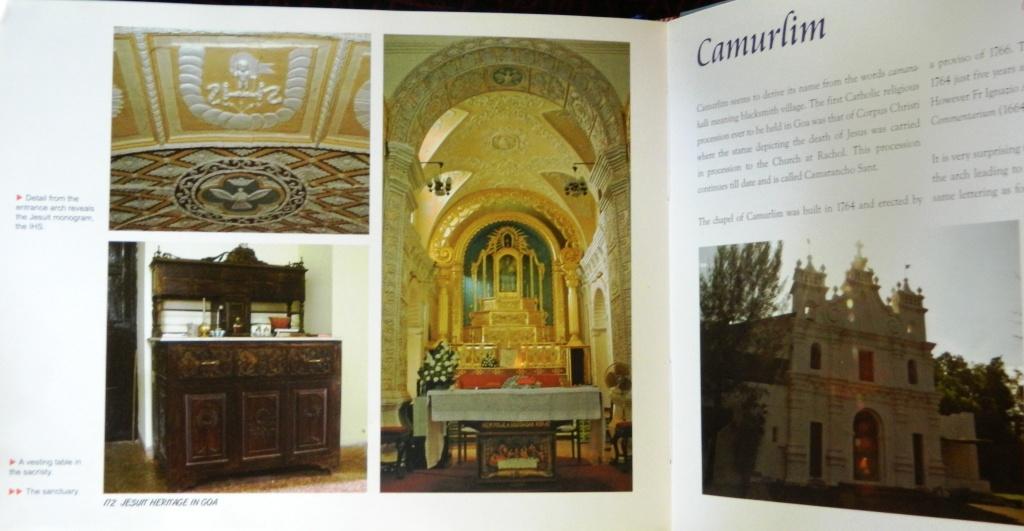
The Society of Jesus has come a long way from the time the first Jesuit missionary had landed on the shores of Goa. Taking an initiative into scholarly work, the Jesuits, right from the start have actively compiled dictionaries/grammars for Konknni as well as other languages. Involving themselves actively in the spread of Christianity, among other things, required the construction of churches and chapels. A new book on the Jesuit-built churches in Goa (thank you, Francisco “Xik” Dias of Dramapur for gifting me your copy!) gives one the impression that throughout the five centuries that the order has been here, the Jesuits have been as busy as the bees.
Most of the magnificent churches – the brilliant white façade against a lush green background – that we are so used to in any Goan landscape and which we believe to be our cultural heritage, were built by the Jesuits. One of the simplest ways to recognize a church built by the Jesuits is to spot the insignia, IHS, which is displayed in a very prominent place in the church. Listed in this book are nearly 80 churches (and some chapels too) that were built by the Jesuits. Jesuit Heritage in Goa by Savio Rodrigues SJ is a coffee-table book with photographs by Rinald D’Souza SJ and Shannon Pereira SJ.
This book is dedicated to Fr. Moreno de Souza who had immersed himself in researching about Goan churches and whose four volumes in Konknni (Bardezcheo, Saxtticheo (2 Vols.) and Tiswaddecheo Igorzo) are a testament to his scholarly work. In his dedication Savio Rodrigues says, “Fr. Moreno could not wait to see the publication of this book, which has now seen the light of the day, thanks to the insights he shared with us. We gratefully acknowledge his willingness to accompany us on a tour of the churches of Ilhas, just three months before God called him to Himself. His long hours of research, revealing interviews, and finally his books on the churches in Goa have contributed immensely to the publication of this book.”
This book briefly tries to acquaint the reader with each of the churches that the Jesuits built using history (not exactly the hardcore one), anecdotes and traditional lore. The pages of this book are full of photographs and anybody who needs quick and concise information about a particular church can profitably refer to this book. Though informative, the prose sometimes lacks the delightfulness of a coffee-table book. More revisions could have been certainly welcome. Interesting traditions associated with a particular church could have been woven in the text to make the overall prose more delightful. One just needs to browse through a Mario Cabral e Sa authored coffee-table book on Goa to understand what I am talking about.
The layout and printing of this book is neatly and artistically done. I must give it to the two photographers who provided the images for this book. There are some stunning pictures in this book and credit should be given to Rinald and Shannon for their dedicated effort. But some of the photos did not capture the beauty and detail of the churches. Like the photos of the detail of the façade of the College of St. Paul bearing the Jesuit monogram (p. 17) and the sanctuary of the Church of Our Lady of Hope (p. 119).
This book did raise a question in my mind: why did the Jesuits of today feel the need to publish a book about their own heritage? The answer is that, maybe, they want to reclaim their heritage and remind us of their legacy. Due to the Pombaline reforms the Jesuits, along with other religious orders, were driven out of Goa. The Jesuits were the most affected because they possessed enormous amount of property and, as this book has shown, some of the biggest churches were built by them. Though they have lost control over their material property, their intellectual heritage and legacy cannot be forgotten. Perhaps, the Jesuits are trying to assert this point. “Suppressed and expelled centuries ago, some Jesuit legacies refuse to remain repressed. They remain alive in the people. Probably prior to the rock-strong foundations of stone, the Jesuits first built faith-foundations among the people themselves,” Savio Rodrigues says in the opening few lines on the Colva Church.
One of the most interesting vignettes in this book is the one on the Ponte de Linhares, the bridge that connects Panjim to Ribandar. This is a Jesuit contribution to a secular building. “The Ponte de Linhares was built by the Portuguese Viceroy, Count of Linhares, Dom Miguel de Noronha, between 1632-1633. It was meant to link Panjim with Ribandar and the City of Goa. The Portuguese sought the technical expertise of the Jesuits of the College of Saint Paul (Paulistas) in 1632 to build the massive bridge that was to be the longest in the whole East. The 3,026 metres long bridge was built on alluvial soils after stabilising it with solid trunks of local timber known as zambo,” Savio Rodrigues informs. All this while I was always under the impression that the Portuguese were responsible for the construction of this bridge. A couple of days after reading the book and while travelling on this very bridge, I recall thinking, “Hey, the Jesuits helped!”
Another interesting piece of information comes from the Our Lady of Pilar Church, Seraulim: “The Church of Our Lady of Pilar at Seraulim contains a huge side altar dedicated to Saint Sebastian, the patron of soldiers. The Portuguese royal insignia that rules the altar appears quite striking at first sight. The altar subtly illustrates the rule of the Crown even over the Church.”
Because the text of this book is very brief and simple, perhaps the same could be used to make small video clips and made accessible to the public on the internet. A tech-savvy person like Fr. Rinald D’Souza could use his expertise.
Jesuit Heritage in Goa,by Savio Rodrigues SJ (Panjim: Goa Jesuits), 2009; pp. 184, Price not mentioned [ISBN: 978-81-906554-0-8]
We all love the mango. The sweet and succulent meat of the King of Fruits is hard to resist. So when a book titled Mango Mood was spotted in a bookshop in distant Baroda (Gujarat), which contained satirical articles that discussed Goa and which claimed to be like the soft flesh on the outside with a hard core within, it proved very hard for me to resist purchasing it. Though, it took me a few months to actually open and read it!
Sharmila Kamat, the author of the book, is a very established writer having published in major national and international mastheads as well as Goan publications. But most importantly she is an astrophysicist who “studies the constitution of the Universe, particularly what makes the hidden mass we call dark matter.” Reading through the book, more than the actual essays, I felt I should rather dwell at length on the two introductions to the first and second editions of this book. For one feels that these two introductions can be much more useful to understand Sharmila and her writings than the actual ‘pieces’ themselves.
Sharmila earnestly tries to move us away from the whole sun-sand-surf-fenni-bikini-hedonism Goa, and as such a major chunk of her book is taken up in discussing tourism. The next major theme is the local politics: the horse-trading that Goa became known for post ’90s as well as the communalism that has seeped in contemporary political life and the docking of the casinos.
One major problem that I have with everyone and anyone who claim to take us away from the tourism brochure-produced image of Goa is that they themselves, in the bargain, reinforce this image. For instance, Sharmila starts her first edition introduction and many of the essays with the oft-repeated sun-kissed beaches, palm-trees, natural beauty, paradise and such blah-blah-blah. The cover of her book uses a picture of a “sun-kissed” seashore. In other print spaces, the columns and features which try to do the same are, ironically, named “Beachside” or would have pictures of white men and women accompanying the text. Now I do understand that not everything is in the hands of the author, especially when national and multi-national publishers and newsmagazines are concerned where one’s work needs to pass through the hands of many editors. But I digress…
In this long introduction, Sharmila makes some statements and comments that on one level could have been done away with (or at least written in a smarter way) and at other times these statements and comments could prove highly politically problematic and shows the author’s inability to assess the political situations that she is commenting on. In trying to retell the story (or rather the history) of Goa, Sharmila not surprisingly falls back on the Lord Parashurama myth. I am not comfortable when the authority of brahmanical texts is invoked (even in a lighter vein) and passed as history for the simple reason that they are myths having their own elitist agenda and by no stretch of imagination can they be called history.
And then, in this retelling of history we come to the time of the Portuguese. “Like all colonial rulers,” Sharmila says, “the Portuguese came uninvited, and then proceeded to dig themselves into the woodwork for the next 451 years.” Nothing could be further away from the truth! Sharmila fails to recognize the complicity of the native upper-caste elite in the colonial projects; be they British or Portuguese. It is through statements like these that the reading and retelling of Goa’s history (which the blurb call pièce de résistance) by Sharmila is very facile. Clearly Sharmila’s book has reached a wider audience than a paper or book on Goan history can ever hope to enjoy such readership. In repeating the same old clichés, myths and images we are not really moving away from a conception and idea of Goa that is very upper-caste, orientalist and biased.
In the introduction to the second edition, Sharmila talks about the linguistic politics surrounding Konkani. “Around the time of the first edition of the book, they [Goans] were out on the streets protesting against the second-class treatment meted out to the mother tongue of most Goans – Konkani. No sooner was this grave error rectified than the protestors were back on the streets – to hyperventilate over the first class treatment meted out to Konkani,” she says. Again, the issue here is too simplified and too watered down. Protagonists of Konkani (or Konknni/Concani) in the Roman script (who are sometimes branded as anti-nationals, agents of the Portuguese etc. by extremists of the one-script-one-language persuasion) are protesting against the step-motherly treatment meted out to “their” Konkani. Are these the same people who are “hyperventilating” against the “first class treatment meted out to Konkani” or are they somebody else? Whether they are the same people or not, the issue about the complexity and diversity of the linguistic politics of Goa is something that is not reflected in the understanding and conception of Sharmila’s Goa.
There is one article that I really enjoyed titled “Special Topics in Calamity Physics”. Being a big fan of the American sitcom The Big Bang Theory, and enjoying to the core the remarkably funny moments produced by the use of physical and other scientific references to portray the life of four nerds, I found in the abovementioned article, moments when one could say that the astrophysicist in Sharmila is now really speaking! Coming back to the cover, apart from my complaint that it reinforced the whole “sun-sand-surf…hedonism narrative” of Goa, it is also badly done.
So henceforth when we talk about Goa – anything about Goa – what do we look for and what do we give our readers and audience? Certainly not the old, anachronistic rubbish. How about something new, something that is – even if we are trying to be funny – boldly iconoclastic?
Mango Mood,2nd edn.by Sharmila Kamat (New Delhi: Rupa & Co.), 2011; pp. xli + 166, Rs. 195/- [ISBN: 978-81-291-1722-9]
Web: www.rupapublications.com
(A version of this article appeared on Gomantak Times, dt: January 31, 2012)
Tales from the Attic was the debut novel of the Carmona based writer, Savia Viegas. One may recall the review I had done of the same in this very newspaper a few months ago. Five years after her first novel, Savia Viegas has returned with another novel called Let me tell you about Quinta. The rigors and travails of self publishing, it seems, has taught an unforgettable lesson to Savia as her first book did reflect a certain rawness in its binding and printing. But her second book is published by a multi-national publisher is neatly packaged. Publishing matters apart, Let me tell you about Quinta would be welcomed by all the Goan bookworms!
Savia’s second book on some levels seems to be a sequel to the first and at other times gives the impression of being a prequel. Call it a sequel, a prequel or whatever; this novel fills in the many gaps from the previous one. Tales from the Attic, it was noticed, ended abruptly. Quinta seems to be making up for every detail that was left out in the first book.
In the true sense of the term, there is no protagonist in the story. Mari (spelt Marri in the first book) is no longer the main character (which is why I doubt this book is a sequel). Some parts of her second novel will only be understood clearly if the reader has acquainted him/herself with Savia’s first book. However, a sprawling mansion called ‘Quinta’ is where the whole story unfolds. If one may be permitted to expand the scope of the definition of ‘protagonist’, then Quinta, in a way, becomes the ‘protagonist’. It is an old, dilapidated house that is mired in litigation for many years. Yet the crumbling edifice does not lose its monetary value for there are repeated attempts to buy/appropriate the property.
The book opens with the arrival of California, Mari’s son Suraj’s Russian-American wife, to Carmona. In connivance with Suraj (or Sun as he is known), she arrives with a hope to usurp Quinta along with the property, which Queirozito (same as Tito of the previous book) had so painfully won through litigation. The role of California just seems to be a very short one being that of a usurper with no major consequence on the overall story. Since she fails in circumventing the alert Queirozito, she flies back to America empty-handed.
In this novel, the genealogy of the maternal and paternal family of Mari is explored in greater detail. Quinta brings all the skeletons in the cupboard and sins of the landed family in the open. The conflict between the bhatkars and the mundkars is a theme that is constantly running through the novel. Although attempts are being made to bring this theme to life, enough, it is felt, is not done by the narrative. A critique of the position that the bhatkars and the mundkars occupied could have been woven in the narrative. Tish Ximeao, a bhatkar,laments about the mundkars not tilling their lands and going off to the Gulf to clean the “…toilets of Arabs.” We all hear such tirades, in one form or the other against the migrating Goans, a major chunk of who were presumably from the lower-caste Catholics. And this resentment could be located to emanate from this class of landed, upper-caste bhatkars. This binary division of a village society into a landed class and a non-landed, tilling class leaves out the caste factor that influenced (historically speaking) the acquisition – or rather – the usurpation of land in the first place. It is this caste equation that had the scope of being discussed in this novel.
There are a host of lovable and quirky characters in this book – some continuing from the old book and others newly introduced. It is when Savia constructs the characters of this novel and while describing the natural beauty and features of the village of Carmona that the writer is at her literary best. The book is actually a series of sections where the biography of each major character is discussed and there are these moments (just a few!) when one cannot help but notice some raw spots in the book. But because Savia has a way with words, one does not feel that the narrative drags or falls short in the literary department.
This novel also touches upon all the major political events that occurred in the last hundred or so years. There is the mention of Fanchu Loyola, the ‘nationalist’ who fought for Goa’s independence from Salazar’s dictatorship, the liberation of Goa, the Tenancy Act whereby the landed class lost its power and finally to more recent times: the land grabbing by the rich and fat builders from the north and the metros. It is only the elite characters who are seen reacting to these political changes. But to me, the illnesses and eccentricities of the characters is what takes the novel forward rather than the immense political changes providing the reader with subtle, humorous moments.
At the end of the novel, Robby the son of Piedade who was a mestiço orphan brought by Mari’s maternal grand-mother from an orphanage, returns back to Carmona, takes active part in local politics and goes on to win (with the ardent help of Preciosa, the mother of Mari) the panchayat polls! Robby is faced with conflicting situations where he is expected to check the many irregularities that take place in the village and comes out as a deeply disturbed and confused person. It is in the last few pages the author seems to lose her grip on some of the characters and their actions become hard to understand.
But, all said and done, I enjoyed reading Let me tell you about Quinta for the way it is written. The prose and tasteful descriptions of the picturesque village can be an added incentive for a lazy Sunday afternoon.
Let me tell you about Quinta by Savia Viegas (New Delhi: Penguin), 2011; pp. 254, Rs. 299/- [ISBN: 9781-0-143-41522-0] Web: www.penguinbooksindia.com
(A version of this article appeared on Gomantak Times, dt: December 30, 2011)
Succumbing to political pressures for allegedly hurting religious sentiments, the Delhi University scrapped an essay by A. K. Ramanujan from its undergraduate history syllabus a month or so ago. This move sparked widespread protests not only from Universities in Delhi, but also elsewhere. The essay in question was titled Three Hundred Ramayanas: Five Examples andThree Thoughts on Translation. As the title suggests Ramanujan discusses the various versions of the Ramayana, which he likes to call ‘tellings’, as well as the issues that crop up when this particular text is translated so many times.
Ramanujan was a versatile scholar, donning the hat of author, poet, translator and folklorist. Initially teaching at the Maharaja Sayajirao University of Baroda for eight years, he later moved to the U. S.
The whole trend and culture of banning/censoring books, film, paintings etc. that we witness in India – of which the Ramanujan fiasco is only the latest – has demonstrated how the precarious condition of the ideal of Free Speech is standing on shaky ground and also a gloomy future is facing not only the students of history (like my self) but to the whole country at large. The reason why I am deeply disturbed after the fiasco at Delhi University is because an attempt is being made to suppress the many voices of history, which in a way implies that there is only one possible way to interpret history in the world.
The news of the removal of the essay made me curious andurged me to explore the nature and content of the essay as well the politics ofbanning/censoring. I was skeptical whether I could locate a digital copy on the internet. But as luck had it, I could find it very easily. Talk about asking a child not to play with fire! In this essay, easily downloadable via the internet, Ramanujan tries “...to sort out for myself, and hope for others, how these hundreds of tellings of a story in different cultures, languages and religious traditions relate to each other: what gets translated, transplanted and transposed (italics mine).” Ramanujan prefers the term ‘tellings’ because in his opinion there is no such thing as an original Ramayana and the use of terms like ‘versions’ and ‘variants’ imply that there is an original text from which all subsequent texts emanated.
Kumkum Roy, a historian of Ancient India at the Jawarharlal Nehru University, writing for the Economic and Political Weekly says that “Ramanujan is an engrossing writer, drawing attention to a range of narratives related to the epic from Sanskrit to Kannada and Thai. Most importantly, he uses the different tellings of the Rama story as cultural artifacts that shape and are in turn shaped by our daily existence. Why then should young adult learners be prevented from learning about them?”
Ramanujan’s mastery over words as well as the subject over which he is elaborating, draws the reader immediately into the text. For instance, citing the example of Jain traditions, Ramanujan says, “When we enter the world of Jain tellings, the Rama story no longer carries Hindu values. Indeed the Jain text expresses the feeling that the Hindus, especially the brahmans, have maligned Ravana, made him into a villain.” When the Jains tell the Rama story therefore, Ravana comes off as a tragic hero, moving us to sympathy.
At this point it would be worthwhile to recall the animated movie Sita Sings the Blues. In this film, the narrative of Ramayana is woven with the personal story of Nina Paley,the artist who made the film (which can be downloaded for free). Like the unfortunately fateful essay of Ramanujan, Nina Paley’s delightful movie too had the spectre of ‘banning’ hanging over its head initiated by radical Hindu groups.
One thing that would strike anybody who has or will watch the movie is the brilliant animation to the accompaniment of jazz music. Like Ramanujan’s essay, this film too, engrosses the viewer in its narrative. What was striking about this film was the depth with which it interrogated the actions of the characters in the Ramayana. Questions that have no easy answers, not because they are entrenched in some profound and deep metaphysics, but simply because the contemporary political ramifications can be ugly. It was the only movie (as far as I know), where, at the end of the credits a list of recommended readings scrolled up one’s screen!
Kumkum Roy gets it right when she says, “If anything, young adult learners (the average undergraduate students) need to be encouraged to understand and appreciate these differences rather than be prevented from learning about them. The dangers of suppressing the text in particular and the implications of a policy of suppression of dissent in general are far more threatening than any comments Ramanujan makes about Indra and Hanuman.”
If the sole intention of banning the essay was to make students – particularly of the arts – read, then kudos to the fundamentalists! But clearly this is not the issue. The issue is about control. What is sickening is to note that, not only is an attempt made to control what we do or say, but also what and how we ‘think’. For the control of the mind is the easiest way to subjugate the masses. We can’t allow ourselves to be passive dupes who would accept anything that dominant ideologues and groups tell us to believe.
(A version of this article appeared on Gomantak Times, dt: December 27, 2011)
Teotonio R. de Souza is an authority on Indo-Portuguese history. The doctoral dissertation he had submitted to the University of Poona was published in 1979 as Medieval Goa: A Socio-Economic History. Thirty years later, a second edition of the book was published thereby displaying its usefulness and academic merit. This text was widely distributed and read. It sought to “…get closer to the common man’s reality [and]…replace the myth of a ‘Golden Goa’”. There was such a need because, “During colonial times, Portuguese studies were concentrated largely on the history of navigation and expansion of Christianity by the Portuguese in the East. They do merit attention and their long-term consequences can hardly be ignored. However, following the end of colonial era, it was necessary to maintain the historiographic balance and to question the exaggerated myths about the ‘Discoveries’ and ‘Civilizing Mission’ of Portugal, and the playing down of, or ignoring, the harmful consequences that accompanied and followed those feats and mentality.”
I had read this book a few months ago and had always hesitated to write a review because I feared that I might not be able to evaluate the book properly. But as a student of history I have tried to read whatever Dr. de Souza has written. This review is written mustering much courage and much effort to marshal my thoughts in the right direction.
Medieval Goa focuses mainly on the ordinary people of the urban areas and the country side, which included native as well as Portuguese commoners who had suffered and were victimized by the policies and excesses of colonialism. Dr. de Souza’s work marks the first formal and best known effort in Goa to write histories that are not dynastic in nature and by including the race and caste relations of the rulers and the natives Dr. de Souza has moved away from the Nationalist paradigm of giving us conflict-free and sanitized accounts of the past. Just as the noted historian of Ancient Indian history, Romila Thapar has credited the writings of the Marxist historian D. D. Kosambi as a watershed moment in Indian history writing, Dr. de Souza’s work can also be termed as a watershed moment in the history writing of Goa.
The influence of Marxism on the work of Dr. de Souza can also be observed in the pages of this book. Shifting the focus from the (suspected) greatness of the rulers of the past to the socio-economic conditions is a major Marxist contribution to Indian historiography. Besides, Dr. de Souza also uses words like ‘Praxis’ which brings to mind the Italian philosopher Antonio Gramsci who reinterpreted Marx and his ideas and who was jailed during the fascist regime of Mussolini referring to Marxism in his prison notebooks as ‘philosophy of praxis’ to escape the prison censors. Praxis means a set of examples for practice.
A major contribution of this book is the recognition that native elements had actively collaborated in the empire-building activity of the Portuguese. I shall reproduce a few excerpts below:
…when the Portuguese captured Goa, the success of the Portuguese was made possible by the native Hindu population which fought side by side with the Portuguese to defeat their former Muslim overlords (p. 6).
After 1656, when the Bijapuris had to grapple with both the Mughals and the Marathas, they had no energy to spare for further conflict with the Portuguese. However, the latter was not free from embroilment in the politics of these powers since many of these provincial officials, the desais, had revolted against their masters and sought frequent refuge in the Portuguese territory. The Portuguese secretly favoured the guerilla movements of these desais to keep the powers concerned distracted with campaigns to bring the rebels to book (p. 12).
The Hindus in Goa were not just shopkeepers and tax-farmers. They were in every kind of trade and profession, and were much appreciated not only by their common clients but every religious and State official (p. 84).”
Caste and racial prejudices seeping into the Christian realm in medieval Goa can be observed by the following excerpt, for many of us are generally of the naïve opinion that caste does not exist in Christianity: “Where social integration was concerned the Christian preaching of brotherhood and equality of all men did not prevent the missionaries from establishing religious confraternities (confrarias) based on castes: and, just as their doctrinal wealth failed to promote greater social cohesion, their vast income and unlimited political influence did not achieve proportionate results in raising the standard of living of their native converts. Even in admissions in their own ranks, religious orders, particularly the Jesuits, maintained strict racial qualifications during the period covered by this study.”
The work of Dr. de Souza by his own admission “left many loose ends than it has succeeded in tying up.” It threw up a lot of new questions for future students to dwell upon. How far these questions have been taken up as topics of research is in itself an important question to ask. Scouring the internet for scholarly material published in journals and other publications on Goa written by Goan academics returns minimal results. Because there are many loose ends, it gives us an opportunity to think about the past in many different ways and also to hear the many voices of history. Dr. de Souza’s work potentially can break an elitist narrative of the past that prevails amidst us and makes us see who benefits and why from a particular type of rendering of history. Dr. de Souza acknowledges his intellectual debt to D. D. Kosambi, who stopped us from treating the history of India and Goa “as an episode of colonial historiography” and that our history has a much more distant past and a promising future. This hope of a “promising future” is yet to materialize.
I would like to end by a cautionary quote from Dr. de Souza’s valuable work, “Willingness on the part of the native subjects to collaborate was not lacking, but this factor is being misinterpreted in the wake of Goa's liberation from colonialism, threatening thereby to continue the evils of colonialism and the exploitation of one section of population by another.”
Medieval Goa: A Socio-Economic History, 2nd ednby Teotonio R de Souza (Saligão, Goa: Broadway Book Centre & Goa 1556), 2009; pp. xviii+265, Rs. 395/- [ISBN: 978-81-905682-6-5]
Web: goa1556.goa-india.org, www.flipkart.com
(A version of this article appeared on Gomantak Times, dt: November 30, 2011)
The northeast was, so far, the only region (broadly speaking) of India, that I had never travelled to. So, when an opportunity in the form of a generous travel grant from the Sahitya Akademi came my way, without any second thoughts I decided to travel to Shillong, the capital of Meghalaya.
The Umiam reservoir, on the way to the airport
The northeast comprises of seven different states. So why did I zoom in on Shillong, Meghalaya? My interest in the Khasi tradition and practices (for the Khasis are a dominant group in Meghalaya) was sparked by a paper written by Tiplut Nongbri on the Khasi kinship system. I had studied this paper as an under-graduate student of sociology. The nuances, workings and politics of the matrilineal system had fascinated me.
Secondly, I decided to travel to the northeast because I had a feeling that, if not all, at least a few of these states, shared many things in common with Goa and trying to understand these commonalities could give us Goans some fresh perspectives on our own problems. This was a hypothesis that I wanted to test.
Like Goa, many of the states in the northeast were not a part of the Indian Union in 1947. All of these states though larger in area than Goa have very little representation in the Lok Sabha and the Rajya Sabha (Meghalaya can be a case in point: Lok Sabha – 2 seats, Rajya Sabha – 1 seat). I also wanted to know, first hand, whether being on the geographical fringes of the country, do the people of the northeast also feel that they are on the political fringes of India? A question that Goa faces time and again. I must concede that such issues are not overtly discussed and they surface only sporadically.
What I intend to do with the experiences and inputs received during my stay in Shillong is to produce a narrative that, while briefly acquainting the reader with the Khasi literature, politics, literati and the socio-political realms, will also try to place Goa in a comparative, if not a centrally dominating frame.
The teashop I would frequent in the morning
Since the money for this journey entirely comes from the tax-payers’ (one half was provided by the government and the other half by my parents who by the way, pay taxes!) the reader would, I hope, find a sincere and serious effort done by a very young writer.
Shillong
After approximately six hours and changing as many as three flights, I finally started descending into Meghalaya, flying above a thick blanket of clouds. There wasn’t a more fitting way to enter a state that boasts of being the Abode of the clouds!
Since it was late afternoon by the time I reached my hotel, I decided to spend my time exploring the city. Two of the most crowded areas of Shillong are the Police Bazaar and the Bara Bazaar (also known as Iewduh), separated by walking distance. This is where the mass of humanity throngs for anything ranging from groceries to medicines to a quick cup of tea or coffee. The central part of the city is a junction called the Police Point. From here, the streets radiate out in all directions. One can find transport in the form of cabs and buses here proceeding to other parts of the city.
A house with the old-style half-timber architecture
The main area of Shillong is heavily concretized. I was a bit disappointed as the types of houses and buildings that befit a cold-clime town (or a city) like Shillong were hard to find. The half-timber architecture was rare and I had to walk some very confusing alleys and streets to locate some of these houses. Most of the streets of Shillong are interconnected like Panjim. So if one keeps on walking, say about for an hour, one would reach the same spot from which one had started the walk! But stick to the streets that are interconnected, seriously!
Due to the influx of people from other parts of India to Shillong, the demographic character is rapidly changing. In order to get a feel of the change, I will reproduce some excerpts from an essay by Bikika Laloo Tariang in her book Shillong Vignettes: Not Your Regular Travel Guide: “The Bengalis and Assamese are scattered all over the city…owning pharmacies to running publishing houses, they are everywhere! ...The ‘Khar Madras’ [South Indians] are mostly concentrated in the teaching, computers and nursing professions. …Many of the North Indians serve in the University in various capacities. There are a lot of Punjabi goldsmiths. …The Marwaris own many of the big cloth shops in the fashion market of the city…The Nepalese, Tibetans and Bhutanese are concentrated in the Mawprem and Barapathar areas. …Think Bihari in Shillong and one has visions of daily wage labourers and milkmen. …And there are many many Mizos mostly concentrated in the Madanrting and Happy Valley areas.”
But this is not a journey of hardcore travel writing per se, so I’ll stop right here. My intention was to meet writers and academics, understand them and their culture and in no circumstances and in no way be judgmental of them. I spent the remainder of my days in Shillong interacting with the literati.
‘Scripting’ a New Understanding
If you speak to a Khasi writer about the Khasi Language and literature, the first thing one will hear is that, initially Khasi had no written script.
The issue of the script came up during my conversation with Dr. Streamlet Dkhar, the representative of the Sahitya Akademi in Meghalaya and also a professor of Khasi at the Department of Khasi, North Eastern Hill University (NEHU). All the while when she was speaking about the script for the Khasi language, the much boiling Romi-Nagri issue was always at the back of my mind.
Dr. Streamlet Dkhar
Dressed elegantly in a light purple jainsem (a traditional Khasi garment, 2 ½ meters in length draped and pinned on both the shoulders), I met Dr. Streamlet in her office which provided a view of some trees from the window. She informed me that way back in 1813, the Serampore Baptist Mission tried to make the Khasis write in the Bengali script. But this enterprise proved to be unsuccessful.
I asked her why the effort ran into troubled waters. A relationship based on trust could not be established by the Bengalis with the Khasis. A Khasi is hard pressed to trust a Bengali because a Bengali is viewed as a cunning person. The written version of the Khasi language was primarily required for the purpose of trade. The case of the Khasi language is interesting and might potentially give us some insights on Konkani written in Roman script because the Roman alphabet is used in writing the Khasi language.
Thomas Jones I, head of the Welsh Calvinist Mission, arrived in 1841 and introduced the Roman alphabet to the Khasi language. The people took to it as if it was the most natural thing to do. The distrust of the Bengali was the reason why the Roman script received acceptance.
While discussing the issue of the script, the focus shifted to Goa. Dr. Streamlet, being associated with the Sahitya Akademi is quite aware about the Romi-Nagri script controversy. She informed me that last year (she could not remember exactly when) she attended a meeting in Panjim which discussed the abovementioned controversy. “Is there anything wrong, in your opinion, if a language has two or more scripts?” I asked.
“There is no harm,” she said, “as long as your language spreads far and wide.”
“Scripts only represent the sounds of a language,” Dr. Sylvanus Lamare told me when I placed the Romi-Nagri issue in front of him. Dr. Sylvanus is the Principal of St. Edmund’s College, a beautiful campus perched on a hillock in Shillong. He was also a member of the General Council of the Sahitya Akademi a few years ago.
Seated in his impeccable and organized office, Dr. Sylvanus told me that the Sahitya Akademi has enough funds for Konkani which can be utilized for the publication of books thereby reducing the financial strain on the authors.
A street vendor selling momos
When we talk about government bodies funding the publication of the books, in the case of Konkani, a very important issue needs to be addressed: that of Konkani in the Roman (and also other) scripts. Since the government only recognizes Konkani written in the Devnagri script, wouldn’t it leave out a large section of writers in enjoying what is proverbially known as a piece of the pie?
“The Konkani board [of the Sahitya Akademi],” maintained Dr. Sylvanus, “is not insisting on utilizing the fund allotted by the government.”
The Khasi Literature
Mrs. Sweetymon Rynjah, an elderly matriarch with a wizened face and a short stature is one of the widely respected Khasi writers in Meghalaya and is also considered an authority on matters Khasi. She has so far written 10 books. I paid a visit to her house. Since I had to run a lot in circles and make innumerable phone calls to get to her house, seeing me she clapped her hands in glee and her face broke into a warm and welcoming smile.
Mrs. Sweetymon Rynjah
It was Mrs. Rynjah who first introduced me briefly to the literature of the Khasis. Since script was introduced fairly recently, the written word is only about 200 years old. Rabon Singh was the first Khasi writer. Mrs. Rynjah provided a small biographical sketch of Rabon Singh and laid emphasis that in his writings, the Khasi ethics and etiquettes are abundantly found.
Since Khasi literature is predominantly based on folklore, I asked Mrs. Rynjah why folklore is so important to a Khasi. “When a man can’t write, Nature becomes his first tutor. So, Nature was used to learn and teach,” she explained. Further she added that because stories were woven around mountains, rivers, lakes etc. the children who heard these stories would never forget to narrate them to their own children.
The element of fear also needs to be added when we are trying to explain why folk stories keep on being told time and again. “The Khasis believe that something bad will befall them or their families, if the ethics and codes embedded in the stories are violated,” Mrs. Rynjah explained.
The ‘Seng Khasi’ was an organization established immediately after the coming of Christianity. The indigenous population (who did not convert to Christianity) realized the threat posed by Christianity to the indigenous culture. To counter the effects of Christianity, the elders of the Seng Khasi organization began publishing the oral tradition, as Dr. Desmond Kharmawphlang, Head, Department of Cultural and Creative Studies, NEHU, informed. He also felt that the effort of the Seng Khasi in documenting the oral tradition was quite “revolutionary”.
With Dr. Sylvanus Lamare
Novels in Khasi literature are relatively recent. Dr. Sylvanus disclosed that novels started appearing from the 1970s onwards. Since the Khasis are a “people of music”, there is a lot of poetry available, though with a rigid metre and rhyme scheme. “But nowadays people prefer to write poetry in English and not Khasi,” lamented Dr. Sylvanus.
Though dramas are staged frequently, they are not published because, traditionally, the dramas have no scripts.
Myth and Reality
Being a student of history, I am always very curious to know how myths are analyzed and historical data is culled out of them, how they give a community a common past and identity and their impact on present day politics. Why are myths so important and necessary to the Khasi community?
“If you want to keep the race alive, you cannot allow the myth to die,” Dr. Sylvanus said.
“Myth is important,” Dr. Desmond agreed, “because of two reasons: due to its cultural association and due to its religious association. Both these factors combine to give a sense of identity.”
Dr. Desmond Kharmawphlang
When folklore is analyzed, Dr. Sylvanus is of the opinion that reinterpretation using modern theories kill the essence of the stories. The myths and folklore cannot fit into any particular theory, he said. On the other hand, academics like Dr. Desmond are engaged in bringing a theoretical understanding to the study of folklore. “I don’t see anything wrong in new methods. These new approaches will only add to the study,” Dr. Desmond, who uses psycho-analytical approaches in his own work, opined. Along with theories that come from the West, scholars like Dr. Desmond have also developed their own methodology in trying to study and understand the cultural phenomenon.
But what I really wanted to know, where myth was concerned, was that whether the telling of myths has any political ramifications. I put forth this question to Thomas Lim, editor of Meghalaya Times. Thomas Lim is an ebullient person, always ready to break into a charming smile. He boasts of having a sizeable collection of Konkani CDs. “I don’t see it [myth] playing a part in politics,” he said.
On Christianity
Before travelling to Shillong, I had done some reading and had also zeroed in on some issues on which I would dwell upon. The acceptance and impact of Christianity was something that was not on my list.
With Rev. Lyngdoh
But time and again I found myself speaking about Christianity with nearly everyone I met. I never had made a conscious choice to talk about Christianity but the issue of Christianity snuck up on me. It was really not possible for me to ignore the impact of Christianity owing to my own position as a Christian. The feeling I got from interacting with people is that there is an overwhelming acceptance of Christianity but there is also a strong resistance to the changes that Christianity had and is ushering in, though on an intellectual level.
On my visit to the All Saints’ Cathedral, five minutes’ drive from the Police Bazaar, I had the opportunity to briefly interact with Rev. P. B. Lyngdoh, the vicar as well as the Principal of the school that is run by the Church of North India. The congregation is Anglican.
The All Saints’ Cathedral is a very beautiful building surrounded by well manicured lawns and a garden. The architectural style is that of the half-timber variety and the wooden interiors are neatly polished. The church has four stained-glass panels which form a part of the altar.
Rev. Lyngdoh was a busy priest, but it was my good fortune that I could briefly interact with him. On asked why Christianity spread so much in Meghalaya, Rev. Lyngdoh pointed out, “The Khasis believe in one God. The indigenous Khasis still expect a Messiah. So when the missionaries came, they told the people that the Messiah had already arrived!” He also pointed out that there were some similarities between Khasi religion and Judaism. On the other hand, Dr. Desmond told me that, “The Khasis collectively are not waiting for a savior.”
The All Saints' Cathedral
I told Mrs. Sweetymon Rynjah that many argue that the coming of Christianity brought in changes in the traditional Khasi society. At this point she clapped her hands to emphasize her point, “Christianity or not, nothing has changed!” Mrs. Rynjah also claimed that evangelization was a failure.
On a visit to the Don Bosco Center for Indigenous Culture’s (DBCIC) museum, I had a chance to interact with Sr. Bernadeth Kropi, Deputy Director of the museum: a truly modern and impressive seven storeyed building, each for the seven states comprising the northeast. The coming of Christianity brought with it education, she explained. The scope of getting government jobs also increased due to education. To the formulation of Sr. Bernadeth, Dr. Desmond’s “healthcare” can be added as well, which reached the remotest of remote areas. “Christianity did provide an opportunity for upward mobility and Khasi religion is steeped in ritual and ceremonies like Roman Catholicism,” Dr. Desmond said, a Roman Catholic himself.
But conversion is not a very simple issue to discuss. It can be best described as a touchy and sensitive topic: a part of our history that is fiercely contested. A growing trend in Goa is trying to see conversion as something demonic and an attempt is made to stigmatize the present Catholic population. Against this background I wanted to know, if put on a scale, what will outweigh what: the good or the bad consequences of conversion to Christianity. Dr. Sylvanus said, “The good things are more than the bad things.”
With Sr. Bernadeth
I was fortunate to get the perspectives of such a wide spectrum of people. An Anglican priest, an indigenous lady writer, a Roman Catholic nun and a professor and laypeople. Club them all together and one gets a picture of how a community is trying to negotiate its way in an ever changing society.
On the Publishing Scene
Since literature cannot flourish without a strong network of printing and distribution of books, I wanted to find out about the publishing scene in Khasi and English. Sumar Sing Sawian is a veteran writer and journalist. He is also the author of a very well received book, Golden Vine of Ri Hynñietwerp, The Khasi Heritage.
Sumar Sing Sawian
“Almost all the writers face financial difficulties in publishing. The government is not of much help,” he said while playing with a kwai (pán for a Khasi) between his fingers. But on the other side of the issue is Mrs. Minimon Laloo, writing from 1989 onwards, who has published a staggering 54 books so far and three are in the pipeline. She maintained that she has never faced any serious financial difficulties in getting her work published.
Shillong is the place where much of the market for books is concentrated.
On ‘Fringes’
At the beginning of this essay I had mentioned that I wanted to find out whether people of the northeast felt that they are on the political and geographical fringes of the country. My thinking was moved in this direction by an article on the northeast that I had read, an excerpt of which is produced below (curiously this article also mentioned Goa):
India’s eight troubled north-eastern states are geographically remote and economically underdeveloped. As a result, they remain little understood and often ignored by the rest of India. For half a century, the region has spawned rebel groups and violent conflicts that have claimed thousands of lives. Complaining that their states are being exploited for their rich mineral resources but being ignored developmentally, the insurgents are fighting for more attention and, usually, for sovereignty… Tripura, Nagaland and Meghalaya are relatively insignificant in national politics, because they lag far behind the larger, more populous states in their capacity to influence national elections and therefore the formation of India’s governments.
Bad results in state election for India’s biggest party in THE ECONOMIST: 13 March 2008
Sumar Sing Sawian agreed that the people felt that they are placed on the ‘fringes’. “People feel that the Centre does not fully understand the situation prevailing here,” he said. The government at the Centre is not doing much. The northeast cannot trade freely with Bangladesh and Southeast Asia. And the foreign tourists are not easily given permits to visit the northeast, Dr. Sylvanus informed.
Another interesting issue also came my way while discussing the politics of the northeast. Thomas Lim enlightened, “It is a practical requirement that the people [of Meghalaya] vote for a national party.” The funds that are required for development need to come from the Centre and as such a cordial understanding is required between the state government and the central government.
Goa and Meghalaya has an absence of a strong regional party. One reason can be the practicality of voting for a national party and second, the regional parties have failed to make good their promises.
Culture Shock
In Shillong we are all good looking,
Dressed all hip, our lives all rocking
Excerpt from In Shillong by Bikika Laloo Tariang
I think it is a part of travel that a traveller gets a culture shock. While walking on the streets of Shillong and in the most chaotic and dirty bazaars, one couldn’t miss the presence of extremely well-dressed girls and women. I kid you not when I say that it seemed as if the latest cuts from Paris, New York and Milan had directly landed in Shillong! A girl in fishnet stocking in the middle of Police Bazaar completely stumped me!
I wanted to know what makes the women of Shillong put so much effort and thought in their attire. The timing of my visit coincided with the celebrations of “days” in colleges as well as the Durga Puja celebrations.
“Shillong is a very fashionable place,” explained Thomas Lim. And with a hint of mischief and a sly smile on his face he said, “You’ve come at the right time in Shillong!”
Generally this well-dressed outlook is reserved for Sunday Church and parties. Just like in Goa. And what about the dressing sense of men in Shillong? Well, I guess men will always be men! No culture shock necessary there!
Returning home without tasting and sampling some authentic Khasi food was something that I did not wanted to do. So I searched a restaurant that served only Khasi food in a Khasi neighbourhood called Mawkhar.
With Thomas Lim
I went in and sat down in this narrow restaurant. The seating arrangement is such that all have to sit facing each other in two rows. There were only three people, besides me: a mother and her little girl and a young man of around 25 years.
I ordered BEEF and rice. Everyone stared and started murmuring with each other. The waitress was smiling…she seemed a little embarrassed, too. Finally the young man who was sitting in the opposite direction asked, “So…are you Christian?”
I said, “Yes. Don’t you find people like me frequenting this place?”
“We hardly have any…” he said. The surprise was very palpable.
Only Regret
I was in touch with the Shillong Chamber Choir for over a month before setting out for Shillong. This group had created waves in the national media after winning last years’ India’s Got Talent show. Unfortunately, due to some urgent work the entire cast and crew were out shooting in Bombay. I could not meet the charismatic leader of the choir, Mr. Neil Nongkynrih. But I did enjoy the friendly communications with the publicity managers, Rishila and Kynsai.
Epilogue
Home is a place one can get to anytime one pleases. Being in Shillong was like being home. Almost. Whilst taking my leave from Thomas Lim I was categorically told that the next time I am in Shillong there is no need to check into a hotel. “You now have a home here,” Thomas Lim said. 3000 or so kilometers away, I know I have another home…I just hope that I can go there one more time!
Acknowledgement
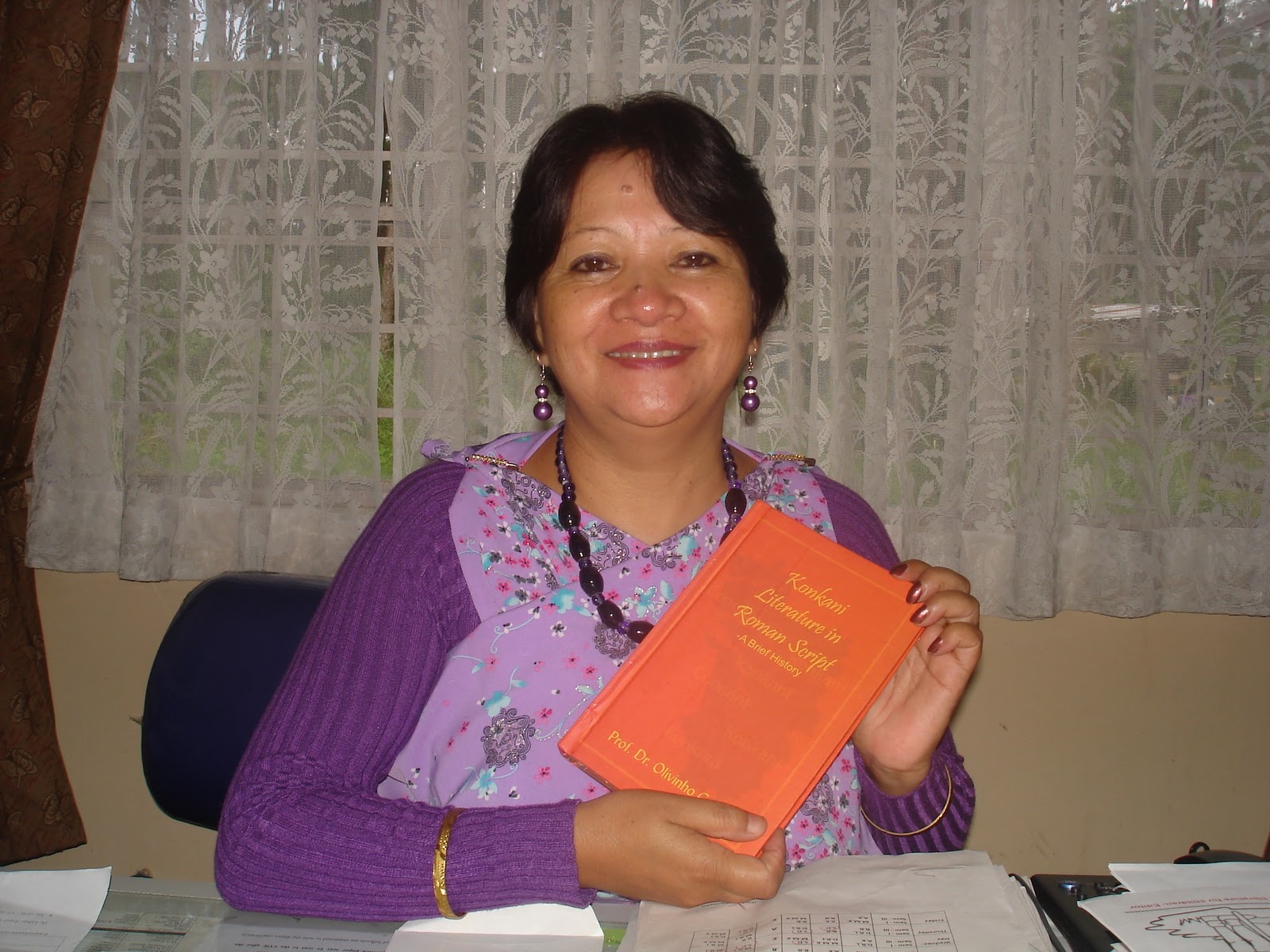
I would like to thank the Sahitya Akademi for the generous travel grant which enabled me to travel to Shillong. Thanks to my parents for the rest of the money! But most importantly thanks for your emotional support. Dev borem korum to Willy Goes and Fr. Kelwin Monteiro. For your time and inputs thanks to Dr. Streamlet Dkhar, Dr. Sylvanus Lamare, Dr. Desmond Kharmawphlang, Rev. P. B. Lyngdoh, Rev. Spencer Reade, S. S. Sawian, Mrs. Sweetymon Rynjah, Sr. Bernadeth Kropi of DBCIC, Mrs. Minimon Laloo, Rishila and Kynsai (Shillong Chamber Choir) and finally to Thomas Lim. Thank you to Larissa, my very concerned travel agent. Thanks to the President and members of the Dalgado Konknni Akademi for providing copies of Konkani Literature in Roman Script – A Brief History by Olivinho Gomesand Mando (Goenchem Lok Git) by Tomazinho Cardozo &Joaozinho (Johnson) Carvalho to be presented to the writers and academics that I met in Shillong.
Interesting books for travel in Shillong and rest of Meghalaya:
Lonely Planet: India by Sarina Singh et al (Eds.) (13th Ed.) (London, California, Victoria: Lonely Planet Publications), 2009; pp. 1244, Rs. 1350/- [ISBN: 978-1-74179-151-8]
Shillong Vignettes: Not Your Regular Travel Guide by Bikika Laloo Tariang (Shillong: Self Published), 2009; pp. 155, Rs. 300/-
Khasi Traditional Dancing Ornaments by Sweetymon Rynjah (Shillong: Ri Khasi Book Agency), 2011; pp. 76, Rs. 85/-
Shillong and Sohra: Tourist Paradise by Emanuel Paul Philimon (Shillong: Mrs. A. S. Wahlang Publishers), 2010; pp. 43, Rs. 35/-
Golden Vine of Ri Hynñietwerp, The Khasi Heritage by Sumar Sing Sawian (Guwahati: Vivekanand Kendra Institute of Culture), 2011; pp. 91, Rs. 250/-
The North East Umbrella: Cultural-Historical Interaction and Isolation of the Tribes in the Region (Pre-History to 21st Century) by Marco Mitri and Desmond Kharmawphlang (Eds.) (Shillong: Don Bosco Center for Indigenous Culture Publications), 2011; pp. 198, Rs. 150/- [ISBN: 81-85-408-00-54]
(A version of this essay was serialized on Gomantak Times, dt: October 11 & 12, 2011)