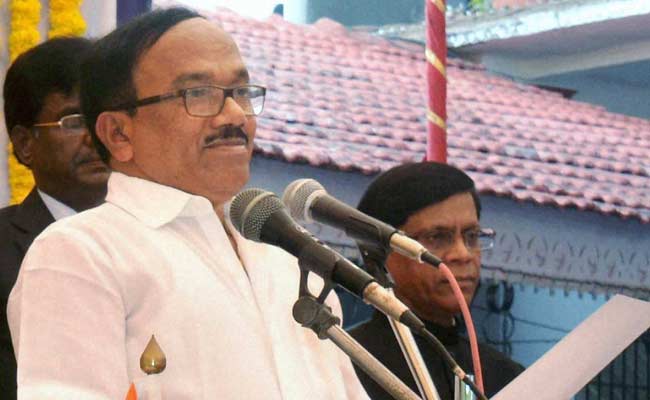
Goa’s Chief Minister, Laxmikant Parsekar, has been
receiving flak ever since he took charge from November 2014. Not simply due to
the faulty policies that his government seems eager to force down the throats
of the Goan people, but also due to controversial and sometimes silly
comments in the media.
However, over the last several months we have been
witness to a modicum of clarity and good sense displayed by the same Parsekar
on the issue of consumption of beef in Goa. In March this year, Parsekar issued
a statement saying
that there cannot be a beef-ban in Goa, as
beef is part of the diet of a lot of people in the state. Since the issue of
whether Muslims, Dalits, Christians, and Adivasis living in India should or should not consume
beef is being raked up with alarming frequency, Parsekar did not shy away from issuing
another statement earlier this month. Modifying his views a bit due to the
existing political climate in North India and the debates surrounding the ‘rise
of intolerance’ in India,
Parsekar said,
“I don’t feel the people of a community eat or use beef to hurt sentiments of
others. It is part of their cuisine or preparation and we also accept the fact…”
What one can also add to Parsekar’s statement is that rather than offending
anybody, many Catholics (for example) feel quite awkward and embarrassed to
serve pork and beef dishes at their own functions, thanks to a desire to accommodate
the sentiments of their Muslim and Hindu friends. One can see that Parsekar is
quite consistent in his views on beef-eating vis-à-vis the minoritized
communities and to state something as plainly as he did is frankly quite
remarkable.
But Parsekar did not stop at asserting that there
was no intent for hurting sentiments by the consumption of beef. The problems
in Parsekar’s comments arise when he tried to link the current situation of
intolerance in rest of India
to the tolerant ethos of Goa, which many
believe existed for centuries. He said, “This maybe a tiny state, but our
speciality is that Hindus, Catholics and Muslims can live together in harmony
and peace. We know the importance of respecting each others’ feelings.
Therefore, such issues are never blown out of proportion as in other state”.
Reading such a view one should be ideally left with a few wrinkles on one’s
forehead.
The question is how valid is the idea that Goa was always tolerant? While raising this question,
allow me to also stress that Goa seems to
witness a relatively ‘peaceful’ atmosphere as the ‘othering’ of minoritized
groups like Christians and Muslims operate through means that appear as not
overtly violent.
If we consider the politics of the Konkani language
organized around the legitimization of the Nagri script as the official and de facto script of the culture and
language of Goa, this vision of Goa having a long tradition of tolerance
immediately fractures. By now it is common knowledge that a sizable population
of the Catholic community has been excluded from the Goan public sphere. What’s
more is that the people who asserted the right of Roman-scripted Konkani as
legitimate in the Goan cultural and political sphere were (and are) frequently
at the receiving end of vicious hate speech. Though I have said that this is
common knowledge, yet it does not seem to have seeped into the common-sensical
understanding of many prominent intellectuals and politicians in Goa. For why else would many in Goa celebrate the fact
that many Nagri writers threatened to return their Sahitya Akademi awards,
despite the fact that these very same people have presided over a regime that
continues to marginalize and impose savarna hegemony over bahujan Hindus and
various Catholic groups?
To further focus on the harmonious existence of various
religious communities in Goa, one can ask about
the extent to which Muslims are represented in Goan politics. Although there
are many Goan Muslims, there is hardly any representation of that community in
Goan politics from 1961. In a sense, one can observe the invisibilization of
the Muslim population in Goa, as, right from
1961, the leadership of the community is solely in the hands of others. I think
this is very serious as there is hardly anyone who will represent the needs and
interests of the community, as for example in the fields of education,
employment, and food habits. And since we are on the topic of political
representation, I am reminded of the Pratap Singh Rane cabinet of 1980, wherein
a sizable number of key posts were given to Christian MLAs, and apparently the
mood prevailing then in Goa was that the government had turned into a
Christian-controlled one (Kristanvancho
sorkar). That a significant number of Goans at that time (which is not that
long ago) felt uncomfortable with so many Christian MLAs in the Legislative
Assembly, should ideally make us realize that the narrative about Goa’s harmony is a wee bit farcical. One would find many more
such incidents.
So while Parsekar is absolutely right in
asserting that consumption of beef is not linked to any desire to offend, the
rising tide of ‘intolerance’ should not be viewed as an aberration to the
normally tolerant and harmonious ethos, whether in Goa or India. In fact, if we
think hard enough one will be confronted with a longer history of small and big
incidents by which minoritized communities have been consistently and systematically
subjected to discrimination. To not recognize this history is to miss a chance
at furthering a truly egalitarian society.
(First published in O Heraldo, dt: 11 November, 2015)
Please also see a reaction to this article by Vikas Kamat and my rebuttal to it here.
By JASON KEITH FERNANDES, DALE LUIS MENEZES, AMITA KANEKAR, VISHVESH KANDOLKAR,
and KAUSTUBH NAIK
In the context of a number of
Sahitya Akademi awardees across India returning their respective awards in
protest against the growing intolerance in India, in Goa around fourteen
Sahitya Akademi awardees together with Padmashri awardees Maria Aurora Couto
and Amitav Ghosh came together and issued a joint statement on 15 October,
2015. One would be struck by the hypocrisy contained in their press note
released were it not for the fact that their politics of intolerance is so
blatantly displayed all over the same note.
In their statement these local
notables condemn “the rising trend of intolerance in the country which threatens
freedom of expression…[and] the age-old liberal and all-encompassing
philosophical traditions of this country.” One would take this concern
seriously were it not for the fact many of these notables have been complicit
not only in acts of intolerance themselves, but also physical violence.
For some years now there have been
demands from many quarters that Konkani literature written in the Roman script
also be given governmental recognition. But Sahitya Akademi awardees like
Pundalik Naik and N. Shivdas, who have presided over the Goa Konkani Academy,
have not felt it necessary to take up this cause and ensure that a Konkani
tradition with a longer history than that in the Nagari script one is
recognised. On the contrary, all of these protesting SahityaAkademi awardees
and Padmashri Couto have watched silently while Roman-scriptKonkani has been
officially ignored and excluded from all kind of state recognition, including
awards and grants.
In addition, these persons have
maintained a studious silence while their associates, such as Uday Bhembre and
Nagesh Karmali, have engaged in the most vicious hate speech against the
Catholic community in the course of the Medium of Instruction controversy (that
has raged from 2011), when Goan parents demanded the right to determine the
manner in which their children are educated. Where was their concern for the
alleged liberal traditions, and traditional bonhomie, of Goa then?
To make matters worse, these same
notables watched silently when in 2005 Naguesh Karmali, a member of this
verygroup of protestors, led a violent mob in destroying public and private
property on the grounds that such property was encouraging Portuguese (read as
Catholic) culture in Goa.Given that Goa has had a long and historical relationship
with Portugal, doesn’t the violent smashing of manifestations of this
relationship amount to an act of the very same rabid communalism that these
worthies profess to protest against?
In light of these inconsistencies,
and the equally amusing announcement that they will hold on to their awards
until the meeting of the executive committee of the Sahitya Akademi, it appears
that these awardees seem more interested on jumping onto the bandwagon of
political trendiness, than for any desire to stand against the growing
intolerance in the country, and indeed, Goa itself.
We would like to stress that while
it is true that the government of Mr. Modi has definitely presided over a rise
in intolerance in the country, the roots of this intolerance lie deeper in the
country’s history. As we have already pointed out, a number, if not all, of
these Goan awardees are complicit in this intolerance. Their complicity is
further evident in the manner in which they phrase their protest within the
language of Hindutva. Why, for example, are the recent acts compared to
‘talibanism’, instead of calling them Hindutva, or Hindu nationalism?
Talibanism is a phenomenon situated outside the country, when Hindutva is the
problem actually at hand, given that Kalbargi, Pansare and Dabholkar lost their
lives as a result of their opposition to this ideology. Indeed, Hindu
nationalism has been a problem since before Indian independence. In referencing
the Taliban, these awardees continue the refusal to recognize Hindu nationalism
as the single greatest cause of concern in this country since 1947.
In conclusion, we would be more
convinced of the genuine concerns of these state awardees from Goa if we heard
them also protest the exclusion of Konkani in the Roman script from legislative
recognition, also the violent condemnation of the Goans who are simply asking
for English as a state-supported medium of instruction
for their children, and also the lack of implementation of constitutional
guarantees for education and jobs to historically discriminated-against Goan
communities. Such protests would go further in establishing norms for the
respect of fundamental rights, and the establishment of law and order in our
state and country.
(First published in DNAIndia(Web) on 23 October, 2015)
The northeast was, so far, the only region (broadly speaking) of India, that I had never travelled to. So, when an opportunity in the form of a generous travel grant from the Sahitya Akademi came my way, without any second thoughts I decided to travel to Shillong, the capital of Meghalaya.
The Umiam reservoir, on the way to the airport
The northeast comprises of seven different states. So why did I zoom in on Shillong, Meghalaya? My interest in the Khasi tradition and practices (for the Khasis are a dominant group in Meghalaya) was sparked by a paper written by Tiplut Nongbri on the Khasi kinship system. I had studied this paper as an under-graduate student of sociology. The nuances, workings and politics of the matrilineal system had fascinated me.
Secondly, I decided to travel to the northeast because I had a feeling that, if not all, at least a few of these states, shared many things in common with Goa and trying to understand these commonalities could give us Goans some fresh perspectives on our own problems. This was a hypothesis that I wanted to test.
Like Goa, many of the states in the northeast were not a part of the Indian Union in 1947. All of these states though larger in area than Goa have very little representation in the Lok Sabha and the Rajya Sabha (Meghalaya can be a case in point: Lok Sabha – 2 seats, Rajya Sabha – 1 seat). I also wanted to know, first hand, whether being on the geographical fringes of the country, do the people of the northeast also feel that they are on the political fringes of India? A question that Goa faces time and again. I must concede that such issues are not overtly discussed and they surface only sporadically.
What I intend to do with the experiences and inputs received during my stay in Shillong is to produce a narrative that, while briefly acquainting the reader with the Khasi literature, politics, literati and the socio-political realms, will also try to place Goa in a comparative, if not a centrally dominating frame.
The teashop I would frequent in the morning
Since the money for this journey entirely comes from the tax-payers’ (one half was provided by the government and the other half by my parents who by the way, pay taxes!) the reader would, I hope, find a sincere and serious effort done by a very young writer.
Shillong
After approximately six hours and changing as many as three flights, I finally started descending into Meghalaya, flying above a thick blanket of clouds. There wasn’t a more fitting way to enter a state that boasts of being the Abode of the clouds!
Since it was late afternoon by the time I reached my hotel, I decided to spend my time exploring the city. Two of the most crowded areas of Shillong are the Police Bazaar and the Bara Bazaar (also known as Iewduh), separated by walking distance. This is where the mass of humanity throngs for anything ranging from groceries to medicines to a quick cup of tea or coffee. The central part of the city is a junction called the Police Point. From here, the streets radiate out in all directions. One can find transport in the form of cabs and buses here proceeding to other parts of the city.
A house with the old-style half-timber architecture
The main area of Shillong is heavily concretized. I was a bit disappointed as the types of houses and buildings that befit a cold-clime town (or a city) like Shillong were hard to find. The half-timber architecture was rare and I had to walk some very confusing alleys and streets to locate some of these houses. Most of the streets of Shillong are interconnected like Panjim. So if one keeps on walking, say about for an hour, one would reach the same spot from which one had started the walk! But stick to the streets that are interconnected, seriously!
Due to the influx of people from other parts of India to Shillong, the demographic character is rapidly changing. In order to get a feel of the change, I will reproduce some excerpts from an essay by Bikika Laloo Tariang in her book Shillong Vignettes: Not Your Regular Travel Guide: “The Bengalis and Assamese are scattered all over the city…owning pharmacies to running publishing houses, they are everywhere! ...The ‘Khar Madras’ [South Indians] are mostly concentrated in the teaching, computers and nursing professions. …Many of the North Indians serve in the University in various capacities. There are a lot of Punjabi goldsmiths. …The Marwaris own many of the big cloth shops in the fashion market of the city…The Nepalese, Tibetans and Bhutanese are concentrated in the Mawprem and Barapathar areas. …Think Bihari in Shillong and one has visions of daily wage labourers and milkmen. …And there are many many Mizos mostly concentrated in the Madanrting and Happy Valley areas.”
But this is not a journey of hardcore travel writing per se, so I’ll stop right here. My intention was to meet writers and academics, understand them and their culture and in no circumstances and in no way be judgmental of them. I spent the remainder of my days in Shillong interacting with the literati.
‘Scripting’ a New Understanding
If you speak to a Khasi writer about the Khasi Language and literature, the first thing one will hear is that, initially Khasi had no written script.
The issue of the script came up during my conversation with Dr. Streamlet Dkhar, the representative of the Sahitya Akademi in Meghalaya and also a professor of Khasi at the Department of Khasi, North Eastern Hill University (NEHU). All the while when she was speaking about the script for the Khasi language, the much boiling Romi-Nagri issue was always at the back of my mind.
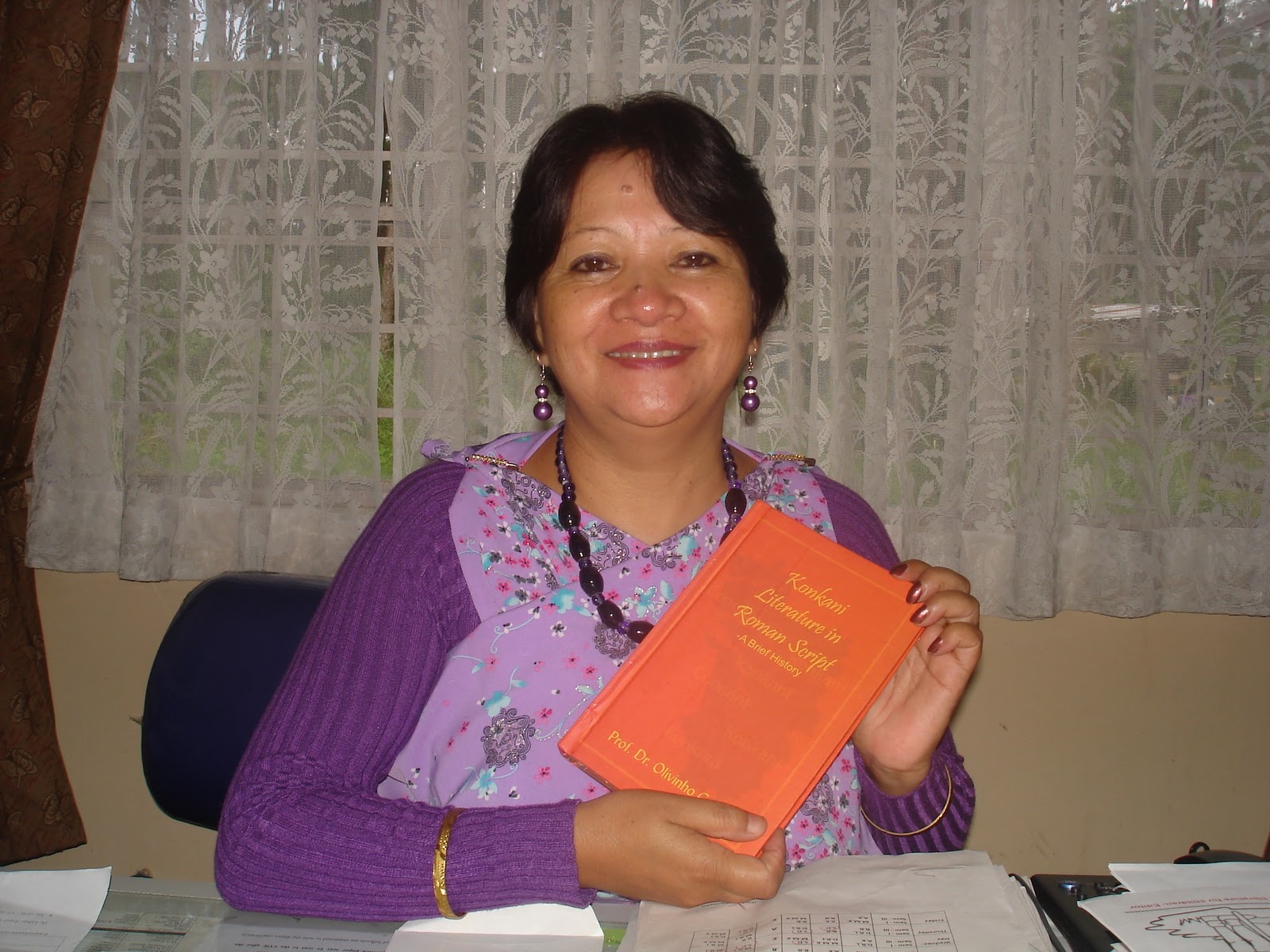
Dr. Streamlet Dkhar
Dressed elegantly in a light purple jainsem (a traditional Khasi garment, 2 ½ meters in length draped and pinned on both the shoulders), I met Dr. Streamlet in her office which provided a view of some trees from the window. She informed me that way back in 1813, the Serampore Baptist Mission tried to make the Khasis write in the Bengali script. But this enterprise proved to be unsuccessful.
I asked her why the effort ran into troubled waters. A relationship based on trust could not be established by the Bengalis with the Khasis. A Khasi is hard pressed to trust a Bengali because a Bengali is viewed as a cunning person. The written version of the Khasi language was primarily required for the purpose of trade. The case of the Khasi language is interesting and might potentially give us some insights on Konkani written in Roman script because the Roman alphabet is used in writing the Khasi language.
Thomas Jones I, head of the Welsh Calvinist Mission, arrived in 1841 and introduced the Roman alphabet to the Khasi language. The people took to it as if it was the most natural thing to do. The distrust of the Bengali was the reason why the Roman script received acceptance.
While discussing the issue of the script, the focus shifted to Goa. Dr. Streamlet, being associated with the Sahitya Akademi is quite aware about the Romi-Nagri script controversy. She informed me that last year (she could not remember exactly when) she attended a meeting in Panjim which discussed the abovementioned controversy. “Is there anything wrong, in your opinion, if a language has two or more scripts?” I asked.
“There is no harm,” she said, “as long as your language spreads far and wide.”
“Scripts only represent the sounds of a language,” Dr. Sylvanus Lamare told me when I placed the Romi-Nagri issue in front of him. Dr. Sylvanus is the Principal of St. Edmund’s College, a beautiful campus perched on a hillock in Shillong. He was also a member of the General Council of the Sahitya Akademi a few years ago.
Seated in his impeccable and organized office, Dr. Sylvanus told me that the Sahitya Akademi has enough funds for Konkani which can be utilized for the publication of books thereby reducing the financial strain on the authors.
A street vendor selling momos
When we talk about government bodies funding the publication of the books, in the case of Konkani, a very important issue needs to be addressed: that of Konkani in the Roman (and also other) scripts. Since the government only recognizes Konkani written in the Devnagri script, wouldn’t it leave out a large section of writers in enjoying what is proverbially known as a piece of the pie?
“The Konkani board [of the Sahitya Akademi],” maintained Dr. Sylvanus, “is not insisting on utilizing the fund allotted by the government.”
The Khasi Literature
Mrs. Sweetymon Rynjah, an elderly matriarch with a wizened face and a short stature is one of the widely respected Khasi writers in Meghalaya and is also considered an authority on matters Khasi. She has so far written 10 books. I paid a visit to her house. Since I had to run a lot in circles and make innumerable phone calls to get to her house, seeing me she clapped her hands in glee and her face broke into a warm and welcoming smile.
Mrs. Sweetymon Rynjah
It was Mrs. Rynjah who first introduced me briefly to the literature of the Khasis. Since script was introduced fairly recently, the written word is only about 200 years old. Rabon Singh was the first Khasi writer. Mrs. Rynjah provided a small biographical sketch of Rabon Singh and laid emphasis that in his writings, the Khasi ethics and etiquettes are abundantly found.
Since Khasi literature is predominantly based on folklore, I asked Mrs. Rynjah why folklore is so important to a Khasi. “When a man can’t write, Nature becomes his first tutor. So, Nature was used to learn and teach,” she explained. Further she added that because stories were woven around mountains, rivers, lakes etc. the children who heard these stories would never forget to narrate them to their own children.
The element of fear also needs to be added when we are trying to explain why folk stories keep on being told time and again. “The Khasis believe that something bad will befall them or their families, if the ethics and codes embedded in the stories are violated,” Mrs. Rynjah explained.
The ‘Seng Khasi’ was an organization established immediately after the coming of Christianity. The indigenous population (who did not convert to Christianity) realized the threat posed by Christianity to the indigenous culture. To counter the effects of Christianity, the elders of the Seng Khasi organization began publishing the oral tradition, as Dr. Desmond Kharmawphlang, Head, Department of Cultural and Creative Studies, NEHU, informed. He also felt that the effort of the Seng Khasi in documenting the oral tradition was quite “revolutionary”.
With Dr. Sylvanus Lamare
Novels in Khasi literature are relatively recent. Dr. Sylvanus disclosed that novels started appearing from the 1970s onwards. Since the Khasis are a “people of music”, there is a lot of poetry available, though with a rigid metre and rhyme scheme. “But nowadays people prefer to write poetry in English and not Khasi,” lamented Dr. Sylvanus.
Though dramas are staged frequently, they are not published because, traditionally, the dramas have no scripts.
Myth and Reality
Being a student of history, I am always very curious to know how myths are analyzed and historical data is culled out of them, how they give a community a common past and identity and their impact on present day politics. Why are myths so important and necessary to the Khasi community?
“If you want to keep the race alive, you cannot allow the myth to die,” Dr. Sylvanus said.
“Myth is important,” Dr. Desmond agreed, “because of two reasons: due to its cultural association and due to its religious association. Both these factors combine to give a sense of identity.”
Dr. Desmond Kharmawphlang
When folklore is analyzed, Dr. Sylvanus is of the opinion that reinterpretation using modern theories kill the essence of the stories. The myths and folklore cannot fit into any particular theory, he said. On the other hand, academics like Dr. Desmond are engaged in bringing a theoretical understanding to the study of folklore. “I don’t see anything wrong in new methods. These new approaches will only add to the study,” Dr. Desmond, who uses psycho-analytical approaches in his own work, opined. Along with theories that come from the West, scholars like Dr. Desmond have also developed their own methodology in trying to study and understand the cultural phenomenon.
But what I really wanted to know, where myth was concerned, was that whether the telling of myths has any political ramifications. I put forth this question to Thomas Lim, editor of Meghalaya Times. Thomas Lim is an ebullient person, always ready to break into a charming smile. He boasts of having a sizeable collection of Konkani CDs. “I don’t see it [myth] playing a part in politics,” he said.
On Christianity
Before travelling to Shillong, I had done some reading and had also zeroed in on some issues on which I would dwell upon. The acceptance and impact of Christianity was something that was not on my list.
With Rev. Lyngdoh
But time and again I found myself speaking about Christianity with nearly everyone I met. I never had made a conscious choice to talk about Christianity but the issue of Christianity snuck up on me. It was really not possible for me to ignore the impact of Christianity owing to my own position as a Christian. The feeling I got from interacting with people is that there is an overwhelming acceptance of Christianity but there is also a strong resistance to the changes that Christianity had and is ushering in, though on an intellectual level.
On my visit to the All Saints’ Cathedral, five minutes’ drive from the Police Bazaar, I had the opportunity to briefly interact with Rev. P. B. Lyngdoh, the vicar as well as the Principal of the school that is run by the Church of North India. The congregation is Anglican.
The All Saints’ Cathedral is a very beautiful building surrounded by well manicured lawns and a garden. The architectural style is that of the half-timber variety and the wooden interiors are neatly polished. The church has four stained-glass panels which form a part of the altar.
Rev. Lyngdoh was a busy priest, but it was my good fortune that I could briefly interact with him. On asked why Christianity spread so much in Meghalaya, Rev. Lyngdoh pointed out, “The Khasis believe in one God. The indigenous Khasis still expect a Messiah. So when the missionaries came, they told the people that the Messiah had already arrived!” He also pointed out that there were some similarities between Khasi religion and Judaism. On the other hand, Dr. Desmond told me that, “The Khasis collectively are not waiting for a savior.”
The All Saints' Cathedral
I told Mrs. Sweetymon Rynjah that many argue that the coming of Christianity brought in changes in the traditional Khasi society. At this point she clapped her hands to emphasize her point, “Christianity or not, nothing has changed!” Mrs. Rynjah also claimed that evangelization was a failure.
On a visit to the Don Bosco Center for Indigenous Culture’s (DBCIC) museum, I had a chance to interact with Sr. Bernadeth Kropi, Deputy Director of the museum: a truly modern and impressive seven storeyed building, each for the seven states comprising the northeast. The coming of Christianity brought with it education, she explained. The scope of getting government jobs also increased due to education. To the formulation of Sr. Bernadeth, Dr. Desmond’s “healthcare” can be added as well, which reached the remotest of remote areas. “Christianity did provide an opportunity for upward mobility and Khasi religion is steeped in ritual and ceremonies like Roman Catholicism,” Dr. Desmond said, a Roman Catholic himself.
But conversion is not a very simple issue to discuss. It can be best described as a touchy and sensitive topic: a part of our history that is fiercely contested. A growing trend in Goa is trying to see conversion as something demonic and an attempt is made to stigmatize the present Catholic population. Against this background I wanted to know, if put on a scale, what will outweigh what: the good or the bad consequences of conversion to Christianity. Dr. Sylvanus said, “The good things are more than the bad things.”
With Sr. Bernadeth
I was fortunate to get the perspectives of such a wide spectrum of people. An Anglican priest, an indigenous lady writer, a Roman Catholic nun and a professor and laypeople. Club them all together and one gets a picture of how a community is trying to negotiate its way in an ever changing society.
On the Publishing Scene
Since literature cannot flourish without a strong network of printing and distribution of books, I wanted to find out about the publishing scene in Khasi and English. Sumar Sing Sawian is a veteran writer and journalist. He is also the author of a very well received book, Golden Vine of Ri Hynñietwerp, The Khasi Heritage.
Sumar Sing Sawian
“Almost all the writers face financial difficulties in publishing. The government is not of much help,” he said while playing with a kwai (pán for a Khasi) between his fingers. But on the other side of the issue is Mrs. Minimon Laloo, writing from 1989 onwards, who has published a staggering 54 books so far and three are in the pipeline. She maintained that she has never faced any serious financial difficulties in getting her work published.
Shillong is the place where much of the market for books is concentrated.
On ‘Fringes’
At the beginning of this essay I had mentioned that I wanted to find out whether people of the northeast felt that they are on the political and geographical fringes of the country. My thinking was moved in this direction by an article on the northeast that I had read, an excerpt of which is produced below (curiously this article also mentioned Goa):
India’s eight troubled north-eastern states are geographically remote and economically underdeveloped. As a result, they remain little understood and often ignored by the rest of India. For half a century, the region has spawned rebel groups and violent conflicts that have claimed thousands of lives. Complaining that their states are being exploited for their rich mineral resources but being ignored developmentally, the insurgents are fighting for more attention and, usually, for sovereignty… Tripura, Nagaland and Meghalaya are relatively insignificant in national politics, because they lag far behind the larger, more populous states in their capacity to influence national elections and therefore the formation of India’s governments.
Bad results in state election for India’s biggest party in THE ECONOMIST: 13 March 2008
Sumar Sing Sawian agreed that the people felt that they are placed on the ‘fringes’. “People feel that the Centre does not fully understand the situation prevailing here,” he said. The government at the Centre is not doing much. The northeast cannot trade freely with Bangladesh and Southeast Asia. And the foreign tourists are not easily given permits to visit the northeast, Dr. Sylvanus informed.
Another interesting issue also came my way while discussing the politics of the northeast. Thomas Lim enlightened, “It is a practical requirement that the people [of Meghalaya] vote for a national party.” The funds that are required for development need to come from the Centre and as such a cordial understanding is required between the state government and the central government.
Goa and Meghalaya has an absence of a strong regional party. One reason can be the practicality of voting for a national party and second, the regional parties have failed to make good their promises.
Culture Shock
In Shillong we are all good looking,
Dressed all hip, our lives all rocking
Excerpt from In Shillong by Bikika Laloo Tariang
I think it is a part of travel that a traveller gets a culture shock. While walking on the streets of Shillong and in the most chaotic and dirty bazaars, one couldn’t miss the presence of extremely well-dressed girls and women. I kid you not when I say that it seemed as if the latest cuts from Paris, New York and Milan had directly landed in Shillong! A girl in fishnet stocking in the middle of Police Bazaar completely stumped me!
I wanted to know what makes the women of Shillong put so much effort and thought in their attire. The timing of my visit coincided with the celebrations of “days” in colleges as well as the Durga Puja celebrations.
“Shillong is a very fashionable place,” explained Thomas Lim. And with a hint of mischief and a sly smile on his face he said, “You’ve come at the right time in Shillong!”
Generally this well-dressed outlook is reserved for Sunday Church and parties. Just like in Goa. And what about the dressing sense of men in Shillong? Well, I guess men will always be men! No culture shock necessary there!
Returning home without tasting and sampling some authentic Khasi food was something that I did not wanted to do. So I searched a restaurant that served only Khasi food in a Khasi neighbourhood called Mawkhar.
With Thomas Lim
I went in and sat down in this narrow restaurant. The seating arrangement is such that all have to sit facing each other in two rows. There were only three people, besides me: a mother and her little girl and a young man of around 25 years.
I ordered BEEF and rice. Everyone stared and started murmuring with each other. The waitress was smiling…she seemed a little embarrassed, too. Finally the young man who was sitting in the opposite direction asked, “So…are you Christian?”
I said, “Yes. Don’t you find people like me frequenting this place?”
“We hardly have any…” he said. The surprise was very palpable.
Only Regret
I was in touch with the Shillong Chamber Choir for over a month before setting out for Shillong. This group had created waves in the national media after winning last years’ India’s Got Talent show. Unfortunately, due to some urgent work the entire cast and crew were out shooting in Bombay. I could not meet the charismatic leader of the choir, Mr. Neil Nongkynrih. But I did enjoy the friendly communications with the publicity managers, Rishila and Kynsai.
Epilogue
Home is a place one can get to anytime one pleases. Being in Shillong was like being home. Almost. Whilst taking my leave from Thomas Lim I was categorically told that the next time I am in Shillong there is no need to check into a hotel. “You now have a home here,” Thomas Lim said. 3000 or so kilometers away, I know I have another home…I just hope that I can go there one more time!
Acknowledgement
I would like to thank the Sahitya Akademi for the generous travel grant which enabled me to travel to Shillong. Thanks to my parents for the rest of the money! But most importantly thanks for your emotional support. Dev borem korum to Willy Goes and Fr. Kelwin Monteiro. For your time and inputs thanks to Dr. Streamlet Dkhar, Dr. Sylvanus Lamare, Dr. Desmond Kharmawphlang, Rev. P. B. Lyngdoh, Rev. Spencer Reade, S. S. Sawian, Mrs. Sweetymon Rynjah, Sr. Bernadeth Kropi of DBCIC, Mrs. Minimon Laloo, Rishila and Kynsai (Shillong Chamber Choir) and finally to Thomas Lim. Thank you to Larissa, my very concerned travel agent. Thanks to the President and members of the Dalgado Konknni Akademi for providing copies of Konkani Literature in Roman Script – A Brief History by Olivinho Gomesand Mando (Goenchem Lok Git) by Tomazinho Cardozo &Joaozinho (Johnson) Carvalho to be presented to the writers and academics that I met in Shillong.
Interesting books for travel in Shillong and rest of Meghalaya:
Lonely Planet: India by Sarina Singh et al (Eds.) (13th Ed.) (London, California, Victoria: Lonely Planet Publications), 2009; pp. 1244, Rs. 1350/- [ISBN: 978-1-74179-151-8]
Shillong Vignettes: Not Your Regular Travel Guide by Bikika Laloo Tariang (Shillong: Self Published), 2009; pp. 155, Rs. 300/-
Khasi Traditional Dancing Ornaments by Sweetymon Rynjah (Shillong: Ri Khasi Book Agency), 2011; pp. 76, Rs. 85/-
Shillong and Sohra: Tourist Paradise by Emanuel Paul Philimon (Shillong: Mrs. A. S. Wahlang Publishers), 2010; pp. 43, Rs. 35/-
Golden Vine of Ri Hynñietwerp, The Khasi Heritage by Sumar Sing Sawian (Guwahati: Vivekanand Kendra Institute of Culture), 2011; pp. 91, Rs. 250/-
The North East Umbrella: Cultural-Historical Interaction and Isolation of the Tribes in the Region (Pre-History to 21st Century) by Marco Mitri and Desmond Kharmawphlang (Eds.) (Shillong: Don Bosco Center for Indigenous Culture Publications), 2011; pp. 198, Rs. 150/- [ISBN: 81-85-408-00-54]
(A version of this essay was serialized on Gomantak Times, dt: October 11 & 12, 2011)