Showing posts with label Dayanand Bandodkar. Show all posts

Thursday, November 8, 2018

FRAGILE POLITICAL ALLIANCES IN GOA


The political developments in the last 30 days may have surely given Goans a sense of déjà vu. With BJP’s Laxmikant Parsekar appearing to revolt, and two Congress MLAs joining the BJP, Goans may have remembered the decades of political instability from the 1970s. The logical question to ask, therefore, is why has Goa witnessed such fragile political regimes? Is there something deeper than merely opportunism and avarice in Goan politics?

If one looks at the earliest elections held in Goa under Indian rule, primordial ties of caste and sub-castes determined the outcomes of elections. They still do, of course. Religion played a part too in the propaganda, but underlying the religious propaganda were the intricate tentacles of caste and sub-caste alliances. Goa’s first chief minister, Dayanand Bandodkar and his MGP came to power by routing a largely Saraswat caste-led Indian National Congress. While the defeat was humiliating for the Congress, for Bandodkar and his MGP, the victory heralded a new configuration of political power and reforms. Bandodkar’s regime was made up of a conglomeration of bahujan castes positioned against upper caste interests, which in due course of time, as Goa University’s Parag Porobo writes in India’s First Democratic Revolution (2015), started disintegrating as the alliance partners, sub-castes within a larger bahujan class, vied for power with each other.

The manner in which Bandodkar’s MGP fragmented due to internal schisms and how politics was structured post-Bandodkar teaches us a thing or two about Goan politics. Recent events suggest that the age-old pattern of fragile political alliances is firmly in place. One can suggest that the fragmented nature of the society allows dominant caste groups to form strategic alliances with one or two of these bahujan sub-castes, in the absence of a consolidated bahujan class. ‘Catholics’ and ‘Muslims’ can also work in a similar way in certain circumstances. For a small state like Goa, within the Indian electoral system of simple majorities, this caste and sub-caste alliances mean that governments can be toppled with one or two ‘rebel’ MLAs.

The rot goes deeper as the social, economic, and political power is concentrated in the hands of a few. Those who already have money and social privilege have been the most successful in capturing political power and also concentrating it in the hands of their coteries. After all, even Bandodkar could mobilize such support because he had the means to; he was an established businessman in the mining sector. Essentially, if we are to understand the role economic capital, or money, plays in elections one should not simply think of it as “greed” but the ability of various groups to pool their resources together.

While Bandodkar’s regime was the only one that can be considered to push for social justice by extending land and education rights to sections of society that were hitherto denied these, successive government seem to be undoing these reforms. There is no need to look any further than the politicking over the Medium of Instruction controversy and the massive land grabs in recent times. Arguably, such a political and social setup does little to bring about positive change. The voters have to depend on a strong leader, i.e. an autocrat-like ruler, largely to ensure that they get government jobs and their “work” gets done. The voters here are not equal citizens, whose right it is to enjoy the benefits of democracy, but they are clients to, and supplicants before, the leader who is the patron.

Wasn’t it a short time ago, February 2017 to be precise, that the office of the Election Commission, through its Chief Electoral Officer, launched a media campaign encouraging the citizens of Goa to vote in large numbers? Given how the current BJP government was formed and the current chaos, the campaign by the election commission, in hindsight, appears to be a cruel joke on the people of Goa. One could argue that the brief of the Election Commission does not go beyond ensuring free and fair elections. But who is to be held responsible for the chaos and uncertainty into which Goa descends after the elections? While elections appear to be a good start towards the control of our own destiny, the unaccountability and shameless backtracking from campaign promises would suggest otherwise. Moreover, short-term and strategic political alliances – all beneficial to the political class and their small coterie of supporters – give us cause to believe that our votes in reality are not valuable at all.

I do not want to suggest that all is lost. As O Heraldo columnist Amita Kanekar suggested a while ago, fragile alliances, leading to fragile governments, are actually useful in stopping the complete annihilation of the Goan people and landscape that the ruling establishment seems currently bent on. One could agree or disagree on the usefulness of fragile alliances for safeguarding Goa. The reasons for such alliances emerging are complex, fragmented social condition being the chief amongst them. At the end of the day, most people in Goa feel cheated with the political situation and the succeeding generations will bear the cost of damages created by the recent governments.

(First published in O Heraldo, dt: 7 November, 2018)

Wednesday, August 16, 2017

COMMUNAL HARMONY AND THE DESECRATION OF CROSSES


While reading Living Together Separately: Cultural India in History and Politics (2005) edited by Mushirul Hasan and Asim Roy, which aimed to problematize concepts like syncretism and communal harmony, I first encountered the metaphor, living together separately. Perhaps, it is an apt metaphor to think about Goa’s encounter with communalism.

The vandalism of Christian religious structures – especially crosses in cemeteries – in the last few weeks have shaken Goan society. Even before this began, Goans had become fearful that communal tensions would rip the fabric of its society – especially since the desecrations took place after the virulent hate-speech by Sadhavi Saraswati, who called for beef-eaters to be publicly executed. It did not help matters much that the law and order establishment in Goa, in the name of a fair investigation, staged a farce for public consumption. The response, by and large, from many Goan public figures was to assert Goa’s ‘age-old’ communal harmony; indicating how Hindus and Catholics have lived in perfect harmony despite all odds. In other words, they stressed Goemkarponn as a bulwark against the RSS/BJP-type of Hindutva.

Goa’s Hindu-Catholic model of communal harmony is similarly structured as the Hindu-Muslim unity propounded by Nehruvian Indian nationalism. In this sense, Goa’s model of communal harmony tends to reproduce many problems associated with Indian nationalism and secular liberalism. To assert Goa’s age-old communal harmony is to assume that there was a pre-existing religious harmony – in the sense of ‘unity in diversity’ rhetoric so common in India. This religious harmony is assumed to be centuries old and under growing threat due to the recent rise of Hindu fascism. In other words, the problem of communal disharmony appears to be recent one.

However, this assumption of Goa’s eternal communal harmony ignores many of the events in the past that have led (or are leading) to the present situation of uncertainty and fear. For instance, almost all would scoff at the suggestion that the rise of Hindutva in Goa predated the rise of the BJP. But if one looks at how Hindu nationalism was actively promoted by many Goans in the past, even under the Portuguese rule and ostensibly against the same Portuguese rule, one can see a longer process of communalization at work. The erstwhile weekly, O Bharat, published in Portuguese, Romi Konkani, and Marathi editions, contained many articles in its Marathi edition that encouraged cow-protection. Many of the articles published in O Bharat in the 1930s suggested that Goans should stop the consumption of beef, as Hindus considered cow to be sacred; additionally, the cow provided with food items like milk and hence it was too valuable to be simply consumed for its meat only. These facts should essentially make us question our beliefs about our own communal harmony.

Connected with the idea of Goa’s ancient communal harmony is the idea of religious syncretism. We have the very well-known instances of the zatra of the Goddess Shantadurga at Fatorpa and the feast of Milagres Saibinn at Mapusa where both Hindus and Catholics throng. However, this cross-religious devotionalism or syncretism is not something that affects the course of communal politics. It doesn’t affect politics in Goa precisely because, barring a few exceptions, communities divided by caste and religion tend to keep to themselves. If observed closely, one can see that this cross-religious devotion is largely led by bahujan communities within Roman Catholicism and Hinduism from which the elites within these two religions keep their distance.These are the groups that are, by and large, marginalized in politics as well; another reason why a bahujan-led cross-religious tolerance has very little effect to stop the increasing communalization in Goa.

Underlying this so-called religious syncretism are fractures of caste and class that manifest in various ways. For instance, the first election held in Goa after the end of Portuguese sovereignty is a good measure of how deep these caste and class fractures ran in Goan society. While the MGP’s stunning victory was due to the consolidation of various Hindu bahujan groups against Hindu upper-castes (and also against their bhatkarshahi), it did not mean that a political system was created which protected the interests of various marginalized groups. What followed this initial victory were not just internal schisms in the bahujan movement, but also the marginalization of the Catholic and Muslim voices as well as the many Hindu bahujan communities that had once propelled the Dayanand Bandodkar-led MGP to victory. Where was Goa’s communal harmony when the divisions between various communities were systematically being further encouraged?

Another problem with the idea of communal harmony is the visible exclusion of Muslims, leaving only a false Hindu-Catholic binary and subsuming several communities within the rubric of ‘Hindu’ and ‘Catholic’. Goa’s ‘age-old’ communal harmony can be said to foundationally exclude members ostensibly of the same political and cultural community. Why should we settle for an ideology that often misguides and offers very little in return? Why should we settle for less? The possible way out would be to reject these false equations that straightjacket Goan identity and culture.

There is no doubt that Goan history contains evidence of many progressive values, however, it is equally true that oppressive cultural practices and divisiveness also reside within Goa. This hasn’t been tackled adequately and a superficial reiteration of Goa’s communal harmony whenever dastardly acts like the desecration of crosses occur wouldn’t make the problems go away. It would profit us much to start from the fact that we live together, but separately.

(First published in O Heraldo, dt: 16 August, 2017)

Wednesday, September 28, 2016

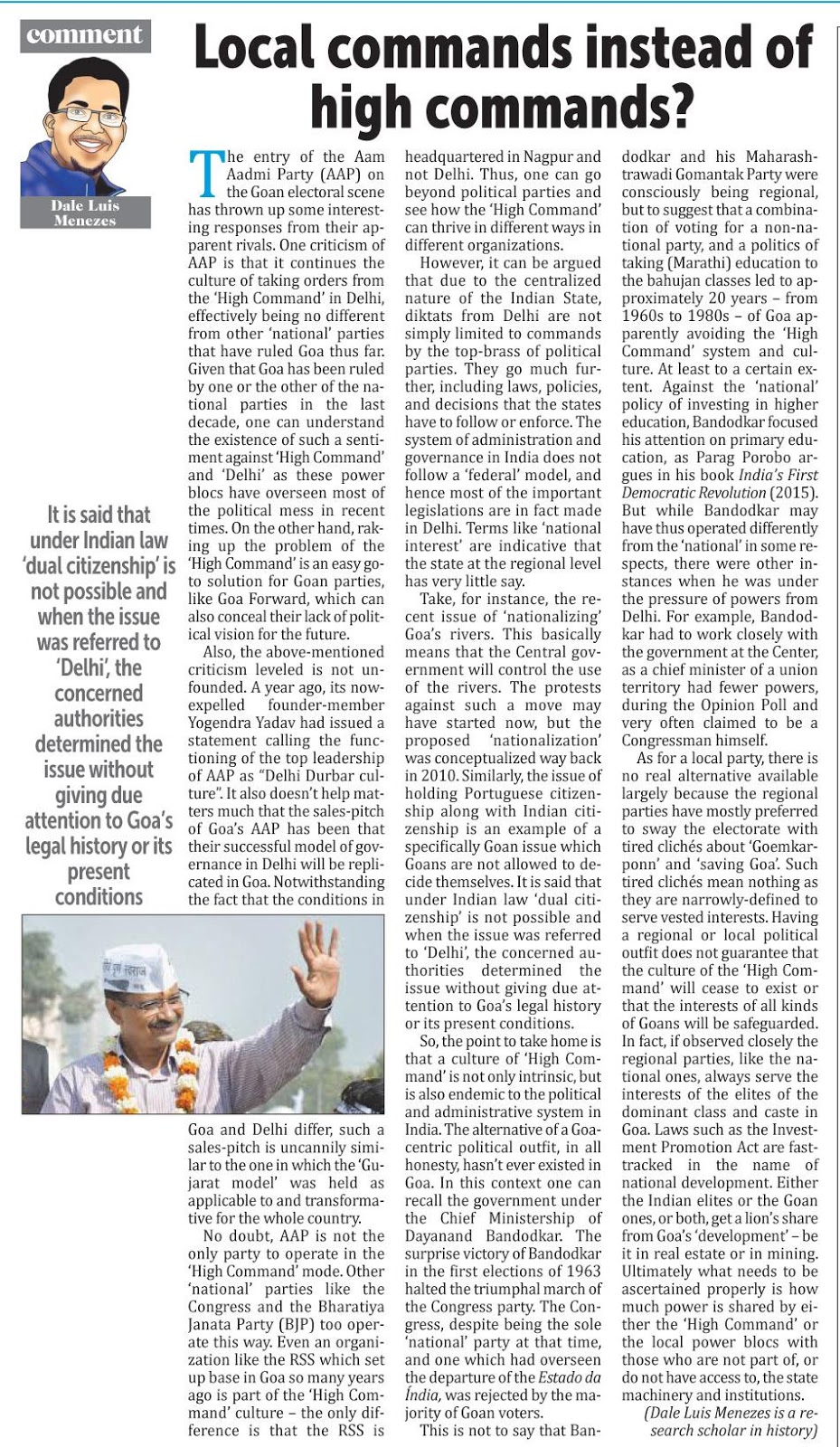
LOCAL COMMANDS INSTEAD OF HIGH COMMANDS?


The entry of the Aam Aadmi Party (AAP) on the Goan electoral scene has thrown up some interesting responses from their apparent rivals. One criticism of AAP is that it continues the culture of taking orders from the ‘High Command’ in Delhi, effectively being no different from other ‘national’ parties that have ruled Goa thus far. Given that Goa has been ruled by one or the other of the national parties in the last decade, one can understand the existence of such a sentiment against ‘High Command’ and ‘Delhi’ as these power blocs have overseen most of the political mess in recent times. On the other hand, raking up the problem of the ‘High Command’ is an easy go-to solution for Goan parties, like Goa Forward, which can also conceal their lack of political vision for the future.

Also, the above-mentioned criticism leveled is not unfounded. A year ago, its now-expelled founder-member Yogendra Yadav had issued a statement calling the functioning of the top leadership of AAP as “Delhi Durbar culture”. It also doesn’t help matters much that the sales-pitch of Goa’s AAP has been that their successful model of governance in Delhi will be replicated in Goa. Notwithstanding the fact that the conditions in Goa and Delhi differ, such a sales-pitch is uncannily similar to the one in which the ‘Gujarat model’ was held as applicable to and transformative for the whole country.

No doubt, AAP is not the only party to operate in the ‘High Command’ mode. Other ‘national’ parties like the Congress and the Bharatiya Janata Party (BJP) too operate this way. Even an organization like the RSS which set up base in Goa so many years ago is part of the ‘High Command’ culture – the only difference is that the RSS is headquartered in Nagpur and not Delhi. Thus, one can go beyond political parties and see how the ‘High Command’ can thrive in different ways in different organizations.

 However, it can be argued that due to the centralized nature of the Indian State, diktats from Delhi are not simply limited to commands by the top-brass of political parties. They go much further, including laws, policies, and decisions that the states have to follow or enforce. The system of administration and governance in India does not follow a ‘federal’ model, and hence most of the important legislations are in fact made in Delhi. Terms like ‘national interest’ are indicative that the state at the regional level has very little say.

Take, for instance, the recent issue of ‘nationalizing’ Goa’s rivers. This basically means that the Central government will control the use of the rivers. The protests against such a move may have started now, but the proposed ‘nationalization’ was conceptualized way back in 2010. Similarly, the issue of holding Portuguese citizenship along with Indian citizenship is an example of a specifically Goan issue which Goans are not allowed to decide themselves. It is said that under Indian law ‘dual citizenship’ is not possible and when the issue was referred to ‘Delhi’, the concerned authorities determined the issue without giving due attention to Goa’s legal history or its present conditions.

So, the point to take home is that a culture of ‘High Command’ is not only intrinsic, but is also endemic to the political and administrative system in India. The alternative of a Goa-centric political outfit, in all honesty, hasn’t ever existed in Goa. In this context one can recall the government under the Chief Ministership of Dayanand Bandodkar. The surprise victory of Bandodkar in the first elections of 1963 halted the triumphal march of the Congress party. The Congress, despite being the sole ‘national’ party at that time, and one which had overseen the departure of the Estado da Índia, was rejected by the majority of Goan voters.


This is not to say that Bandodkar and his Maharashtrawadi Gomantak Party were consciously being regional, but to suggest that a combination of voting for a non-national party, and a politics of taking (Marathi) education to the bahujan classes led to approximately 20 years – from 1960s to 1980s – of Goa apparently avoiding the ‘High Command’ system and culture. At least to a certain extent. Against the ‘national’ policy of investing in higher education, Bandodkar focused his attention on primary education, as Parag Porobo argues in his book India’s First Democratic Revolution (2015). But while Bandodkar may have thus operated differently from the ‘national’ in some respects, there were other instances when he was under the pressure of powers from Delhi. For example, Bandodkar had to work closely with the government at the Center, as a chief minister of a union territory had fewer powers, during the Opinion Poll and very often claimed to be a Congressman himself.

As for a local party, there is no real alternative available largely because the regional parties have mostly preferred to sway the electorate with tired clichés about ‘Goemkarponn’ and ‘saving Goa’. Such tired clichés mean nothing as they are narrowly-defined to serve vested interests. Having a regional or local political outfit does not guarantee that the culture of the ‘High Command’ will cease to exist or that the interests of all kinds of Goans will be safeguarded. In fact, if observed closely the regional parties, like the national ones, always serve the interests of the elites of the dominant class and caste in Goa. Laws such as the Investment Promotion Act are fast-tracked in the name of national development. Either the Indian elites or the Goan ones, or both, get a lion’s share from Goa’s ‘development’ – be it in real estate or in mining. Ultimately what needs to be ascertained properly is how much power is shared by either the ‘High Command’ or the local power blocs with those who are not part of, or do not have access to, the state machinery and institutions. 

(First published in O Heraldo, dt: 28 September, 2016)

Wednesday, August 31, 2016

LANGUAGE WARS AND HOW TO WIN THEM


The recent resolution passed by the Goa Legislative Assembly to include Marathi as an official language has once again ignited the conflict surrounding languages in Goa. That this resolution, proposed by independent MLA Narendra Sawal, was passed on the last day of the Assembly session, and when elections are just round the corner, indicates that it has more to do with shifts and machinations of political power than with the emotional connect of many Goans with the Marathi language. Whether we like it or not, the ‘language issue’ is a potent force for political mobilization and one needs to fight the communal polarization of the ‘language issue’ by opening the language-sphere of Goa to English, Romi Concanim, Portuguese, and Marathi.

The resolution produced the same old frustrating responses from most Goans. Many felt that “Konkani” was their “mother tongue” with which they shared an emotional mother-child relationship, and that there was no place for any other language. Others felt, erroneously so, that those Goans who were demanding official recognition for Marathi should go to Maharashtra. Still others felt that the existing Official Language Act of 1987 (OLA) should not be changed, thus effectively implying that Romi Concanim should also not be given official status. While the Marathi activists were understandably jubilant, this jubilation seemed to be misguided on many levels, as the resolution was passed without any mention of Romi Concanim. To be fair, a week later the Marathi Rajbhasha Samiti demanded that Romi be included in the OLA. This resolution probably owes its existence to recent calls for Marathi-Romi and Hindu-Catholic unity. However, with this resolution by the Samiti coming too late, it would perhaps end up doing too little.

In this context, it is interesting to note the comments that the MLA of St. Andre, Vishnu Surya Wagh, made in the Assembly as well as in his recent writings for a prominent Marathi daily in Goa. Wagh, who is, at the moment of writing, recovering from an illness, had vociferously written against the casteist, communal, and chauvinist politics of nagri Konkani. While supporting the cause of Marathi, Wagh had also made the strong case that Romi Concanim was a legitimate language of Goa, and one that was older than the nagri-scripted Konkani. Wagh also spoke in the Assembly on the Medium of Instruction (MoI) issue. In his characteristic oratorial style, Wagh argued that because Romi was denied to a large number of Catholics, and nagri Konkani foisted on them, Catholics were demanding English education for their wards. While one can partially agree with Wagh, his opposition to English is problematic. For one, English is not just the demand made by Catholics, but bahujan Hindus too, as their socio-economic aspirations are tied to that language. The ‘Marathi-lovers’ must necessarily recognize this fact. Further, to not recognize the importance of English would be to drag the people of Goa back into the narrow and parochial linguistic politics, endangering the education and futures of Goa’s children.

In recent times, Wagh has emerged as the one politician and language activist who has taken a holistic stand on the language question. His arguments extended beyond language per se, to recognize that language is linked to power and communities. However, all the good work that he did proved to be fruitless by the one resolution that was passed in his very presence. So, how are the language wars to be won as well as ended once and for all? To do this one needs to think differently from how we have been thinking so far. One should begin by seeing the MoI issue as not separate but one which emerges out of the already existing language problem. Thus, the problem will fade away if grants to English medium schools are immediately legalized, irrespective of whether they are diocesan or not. It is quite ridiculous that the Goan state which makes laws in English, and conducts state business in English, does not want its young citizens to study in English. One should also think about expanding the linguistic sphere of Goa by recognizing the Portuguese language as important for Goa’s people in terms of legal frameworks, history, culture, and mobility.

Most importantly, Romi Concanim needs to be recognized as official post haste.  Not just this, it is the need of the hour to privilege Romi Concanim over nagri Konkani or even Marathi. With nagri Konkani as official and Marathi allowed to be used for all official purposes, the status quo needs to be shaken. This is so because a lot needs to be done to make Marathi politics work in favor of all Goans. Marathi-supporters have not yet been able to tell us how the interests of Catholics will be safeguarded, considering that jobs have been secured by many with the knowledge of Marathi (and nagri Konkani), despite Marathi being not recognized as fully official. The Marathi-supporters haven’t been able to tell us how they will stop the use of the Marathi language for the spread of Hindutva, for many know that it is through the emotional and cultural bonds of Marathi that Hindutva has mobilized in Goa over the last few decades. The Marathi-supporters haven’t told us why the Marathi movement which began as a pro-bahujan, anti-brahmin, anti-caste movement was compromised in favor of Brahmanism and Hindutva. Marathi activists need to clearly think about how to move away from the ‘Marathi-equals-merger’, a political fear not entirely baseless, which emerged out of the politics of Dayanand Bandodkar and the Maharastrawadi Gomantak Party in the 1960s.

Thus, it is imperative that the language-sphere of Goa is expanded to include Romi Concanim and legalize grants to English as MoI, and only subsequently recognize Marathi as official. Doing so, one would not only escape the claustrophobic language politics of Goa, but also craft a more international Goan citizenry, while effectively challenging the rise of Hindutva.

(First published in O Heraldo, dt: 31 August, 2016)