The entry of the
Aam Aadmi Party (AAP) on the Goan electoral scene has thrown up some
interesting responses from their apparent rivals. One criticism of AAP is that
it continues the culture of taking orders from the ‘High Command’ in Delhi,
effectively being no different from other ‘national’ parties that have ruled
Goa thus far. Given that Goa has been ruled by one or the other of the national
parties in the last decade, one can understand the existence of such a
sentiment against ‘High Command’ and ‘Delhi’ as these power blocs have overseen
most of the political mess in recent times. On the other hand, raking up the
problem of the ‘High Command’ is an easy go-to solution for Goan parties, like Goa
Forward, which can also conceal their lack of political vision for the future.
Also, the above-mentioned
criticism leveled is not unfounded. A year ago, its now-expelled founder-member
Yogendra Yadav had issued a statement calling the functioning of the top
leadership of AAP as “Delhi Durbar culture”. It also doesn’t help matters much that the
sales-pitch of Goa’s AAP has been that their successful model of governance in
Delhi will be replicated in Goa. Notwithstanding the fact that the conditions
in Goa and Delhi differ, such a sales-pitch is uncannily similar to the one in
which the ‘Gujarat model’ was held as applicable to and transformative for the
whole country.
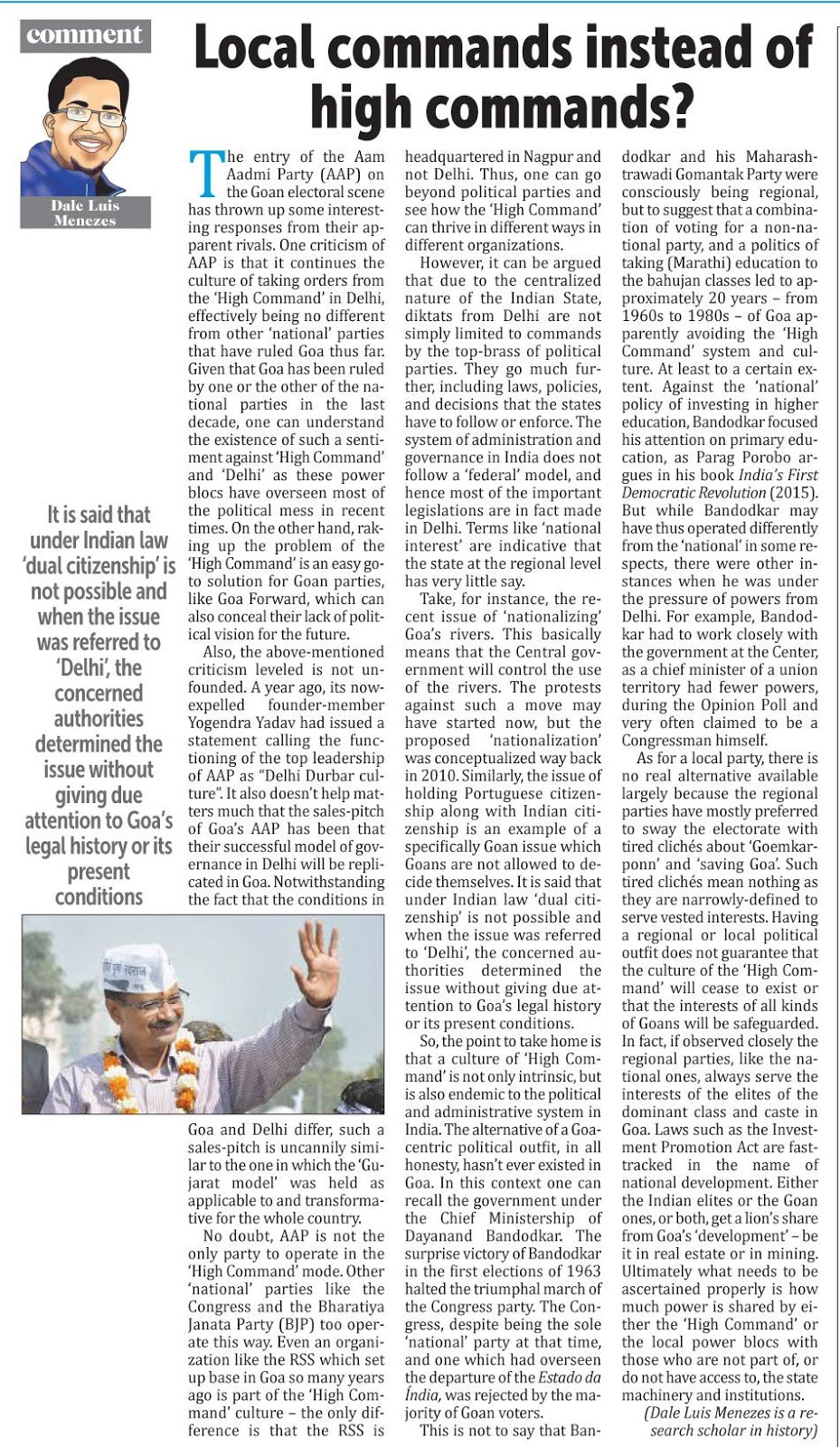
No doubt, AAP is
not the only party to operate in the ‘High Command’ mode. Other ‘national’
parties like the Congress and the Bharatiya Janata Party (BJP) too operate this
way. Even an organization like the RSS which set up base in Goa so many years ago
is part of the ‘High Command’ culture – the only difference is that the RSS is
headquartered in Nagpur and not Delhi. Thus, one can go beyond political
parties and see how the ‘High Command’ can thrive in different ways in
different organizations.
However, it can be argued that due to the
centralized nature of the Indian State, diktats from Delhi are not simply limited
to commands by the top-brass of political parties. They go much further, including
laws, policies, and decisions that the states have to follow or enforce. The
system of administration and governance in India does not follow a ‘federal’
model, and hence most of the important legislations are in fact made in Delhi.
Terms like ‘national interest’ are indicative that the state at the regional
level has very little say.
Take, for
instance, the recent issue of ‘nationalizing’ Goa’s rivers. This basically
means that the Central government will control the use of the rivers. The
protests against such a move may have started now, but the proposed ‘nationalization’ was conceptualized way back in 2010. Similarly,
the issue of holding Portuguese citizenship along with Indian citizenship is an
example of a specifically Goan issue which Goans are not allowed to decide
themselves. It is said that under Indian law ‘dual citizenship’ is not possible
and when the issue was referred to ‘Delhi’, the concerned authorities determined the issue without giving due attention
to Goa’s legal history or its present conditions.
So, the point to
take home is that a culture of ‘High Command’ is not only intrinsic, but is
also endemic to the political and administrative system in India. The
alternative of a Goa-centric political outfit, in all honesty, hasn’t ever existed
in Goa. In this context one can recall the government under the Chief
Ministership of Dayanand Bandodkar. The surprise victory of Bandodkar in the
first elections of 1963 halted the triumphal march of the Congress party. The
Congress, despite being the sole ‘national’ party at that time, and one which
had overseen the departure of the Estado
da Índia, was rejected by the majority of Goan voters.

This is not to
say that Bandodkar and his Maharashtrawadi Gomantak Party were consciously
being regional, but to suggest that a combination of voting for a non-national
party, and a politics of taking (Marathi) education to the bahujan classes led
to approximately 20 years – from 1960s to 1980s – of Goa apparently avoiding the
‘High Command’ system and culture. At least to a certain extent. Against the
‘national’ policy of investing in higher education, Bandodkar focused his
attention on primary education, as Parag Porobo argues in his book India’s First Democratic Revolution (2015).
But while Bandodkar may have thus operated differently from the ‘national’ in
some respects, there were other instances when he was under the pressure of
powers from Delhi. For example, Bandodkar had to work closely with the
government at the Center, as a chief minister of a union territory had fewer
powers, during the Opinion Poll and very often claimed to be a Congressman
himself.
As for a local
party, there is no real alternative available largely because the regional
parties have mostly preferred to sway the electorate with tired clichés about ‘Goemkarponn’
and ‘saving Goa’. Such tired clichés mean nothing as they are narrowly-defined
to serve vested interests. Having a regional or local political outfit does not
guarantee that the culture of the ‘High Command’ will cease to exist or that
the interests of all kinds of Goans will be safeguarded. In fact, if observed
closely the regional parties, like the national ones, always serve the
interests of the elites of the dominant class and caste in Goa. Laws such as
the Investment Promotion Act are fast-tracked in the name of national development.
Either the Indian elites or the Goan ones, or both, get a lion’s share from
Goa’s ‘development’ – be it in real estate or in mining. Ultimately what needs
to be ascertained properly is how much power is shared by either the ‘High
Command’ or the local power blocs with those who are not part of, or do not
have access to, the state machinery and institutions.
(First published in O Heraldo, dt: 28 September, 2016)


