Showing posts with label Panjim. Show all posts

Wednesday, July 20, 2016

PUBLIC HEALTH AND THE CITY OF GOA


The piles of garbage across Goa remind me of an event in Goa’s history. Goa’s recorded history does provide us with instances that enable us to draw a parallel and see the disastrous effects of waste management when not checked properly and seriously. While my attempt in this essay will be to draw parallels with the past, it must also be stated that the problem of garbage management is a recent one associated with factors of rampant urbanization, large-scale use of non-biodegradable materials, and lapses on the part of the State.

After becoming the capital of the Portuguese Empire in Asia, the City of Goa or Velha Goa was ravaged by epidemics at least a couple of times. The fortunes of the City as a great entrepôt or a metropolis were impacted by these epidemics. The Goan scholar José Nicolau da Fonseca writing about the city in his book An Historical and Archæological Sketch of the City of Goa (1878) makes a mention of the devastating epidemic of 1570.

Along with the siege by Ali Adil Shah’s large army that led to food shortages, Fonseca argued that it were the unsanitary conditions then prevailing in the City that were responsible for the outbreak of an epidemic. “The city was in the first place surrounded by marshes and stagnant pools, emitting noxious exhalations, whilst little or no attention was paid to the hygienic conditions essential for the preservation of public health. The muddy banks of the river outside the city were generally covered with the detritus of animal and vegetable matter, which being exposed at low tide to the tropical sun underwent putrefaction, and thereby bred the germs of disease” (p. 150).

Moreover, Fonseca wrote that open defecation took place (with the permission of the Government) within the limits of the City, that there was a lack of access to potable drinking water (due to Governmental neglect), and that garbage littered on the main thoroughfares of the City so much so that “nobody was prevented from throwing any quantity of filth he chose into the streets” increased the devastation. Even before the epidemic, the dirty streets and lack of clean water had contributed to creating unhygienic living conditions.

If one drives around Goa, one is quite shocked (or not) to see piles of garbage dumped along the sides of roads. What is also alarming is the manner in which places close to habitation or water bodies are used as landfill sites. The garbage dumped at the Campal Parade ground in Panjim is a case in point. That garbage is dumped in an area that hosted exhibitions and events, or was an open space for the public is a shocking lapse on the part of the authorities, not to mention an acute health hazard. There are more examples in Panjim itself that enable us to see parallels with the conditions then prevailing in the City of Goa.

The area close to the new building of the Central Library at Patto is being used as a landfill for quite a number of years. Apart from a lack of planning or vision that the authorities and the city administration have displayed, there is also the danger of noxious gases poisoning scholars and general readers or fires causing permanent damage to an institution that houses some of the rarest books, newspapers, magazines, and manuscripts in Asia. Such a premier library should have had a prominent place as an institution symbolic of intellectual production in Goa and not enveloped by the stink and danger of garbage.
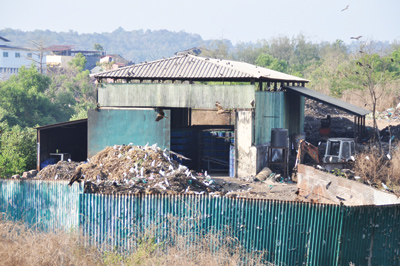
It is precisely such State apathy and a crisis of management that increases the danger to the lives of citizens and reduces the quality of life. Recently, O Heraldo reported that the newly operational Solid Waste Management plant in Saligao was functioning only up to half of its capacity. There were talks about transferring the garbage from Campal to the new plant in Saligao, but it is evident that bureaucratic insouciance and an attitude to pass the responsibility to some other department or individual would result in more garbage piling alongside roads and open spaces right in the middle of cities.

The case of the epidemic of 1570 and the rising problem of garbage management today seems to have striking similarities. For one, the then administration which had a duty of regulating and enforcing laws regarding public health had failed miserably. It can be argued that the present administration is also failing in a similar duty. Secondly, people then as today have no qualms in dumping garbage along the roads. There are also important differences in terms of technology and the manner in which it contributes to the generation and the disposal of waste. But it does appear that history is coming full circle. One may think if this is a case of ‘history repeating itself’ or if it is a case of cyclical history wherein things move from being good to bad and back to good again. For many would recall that public order and civic sense was prevailing in Goan towns and cities during the last few decades of Portuguese rule. Whatever may be the case, it cannot be denied that all of us are facing a major crisis of public health if the status quo in the functioning of public affairs is maintained. And perhaps thinking about such instances in the past might help us in being alert to problems of the present that are increasingly threatening us.

(First published in O Heraldo, dt: 20 July, 2016)

Monday, September 19, 2011

HISTORY OF 'PANGIM' IN SNAPSHOTS

Panjim, the capital of Goa, has very few rivals as far as beauty and architecture in the whole of India. Its wide roads with huge shady trees lining them and the many Indo-Portuguese houses give one a feeling of great joy. I particularly like to take a walk from the Kala Academy area to the ‘ferry’ bus stop whenever I happen to be in Panjim. The cool and salty breeze of the Mandovi acts as a balm on frayed and irritated nerves. This is a city that we all love and cherish.
            This city has changed a lot during the last 10 years. So what do we do if we want to know how Panjim looked like when it was established and how it has grown and evolved ever since? Vasco Pinho’s Snapshots of Indo-Portuguese History – I: Panjim would be a great beginning.
Frederick Noronha
             Vasco Pinho’s book is a collection of events and monuments associated with Panjim. Along with Panjim he also explores the areas that surround this city: Dona Paula, St. Inez and Taleigao. This book is not arranged in a chronological sequence because the aim of the author is only to present the main “vignettes” and important events in the life of Panjim. The topics dealt in the book are described briefly and they surely appeal the reader. Vasco Pinho was compelled to write this book because, “…the entire stretch of Indo-Portuguese history has been converted into an object of relentless attack whenever and wherever it suits some of us. As a result, the level of ignorance about this period is not just palpable, it is incredible.”
            Earlier I had made a reference to the cool and salty breeze of the Mandovi. The etymology of this word “Mandovi” had always bothered me as I came to know that many places outside of Goa were also called Manddvi. But not anymore. Pinho explains, “The name Mandovi or Manddvi is thus derived from the office where duties were collected or from the local practice of collecting mandd (duties) on goods during the pre-Portuguese Hindu and Muslim periods.” A custom-post in Persian or Farsi is known as Mandubi, and that explains, I guess, why many places in India have a name closely similar to Mandovi.
            A very tragic incident which occurred in the Mandovi is also narrated. “For the people of Goa, the Twentieth Century began on a tragic note. A major disaster occurred on December 3, 1901, at 7:00 a.m. The motorized launch ‘GOA’ capsized while crossing the Mandovi from Verém to Pangim. Of the estimated 165 passengers travelling by that launch, 81 met with their watery grave. The passengers were on their way to Velha Goa’s Feast.” Vasco Pinho further informs us that, “On December 3, 1902, a cross was erected on the southern bank of the Mandovi, near the Caes dos Gujires, in memory of the 81 persons who had perished in that disaster.”
            This book is not written in a style that can be termed academic. It was also not intended to be so in the first place. But the information contained in the pages of this book could come in handy to a scholar researching about Panjim. There is also another reason: all the inscriptions on various monuments in Panjim are translated in English. One need not run from pillar to post to read the Portuguese writings, especially because not many Goans can boast of proficiency in the Portuguese language.
            Most of the book is a collection of facts (or should I say glimpses?) strung one after the other, which while making the narrative rather stilted, could be used to study how the city grew in time and space. Vasco Pinho could have arranged the various events, monuments and buildings in his book in such a way that it would give a picture or a sense of the development and evolution of Panjim. Many photographs which this book contains are not large enough and one has to tax one’s eyes to search for the details.
            In this snapshot history of Panjim, the human angle or the people feature rather rarely. It is a history of this building, that street or some other monument or landmark. I recall Shakespeare once remarking, “What is a city without its people?”
            On the other hand, it is worthwhile to know what how a particular street or building was known in the past. This is because in the recent years, Panjim has been at the receiving end of cultural fundamentalism and chauvinism. Efforts are being made to erase names and things that “sound” or “look” Portuguese. Against this background of dark foreboding, Vasco Pinho’s writing would serve to preserve the memory – or rather the history – of this city we love so much. Vasco Pinho also tells us that after liberation Panjim became Panaji, which is a Marathicized version of the Konknni Ponnje.
            A list of all the Viceroys and Governors of Portuguese India is also given in the annexure.
         Lastly, a word of praise must be made to this ‘self-published enterprise’ of Vasco Pinho. The first edition came out in 2007 and due to the overwhelming response, the author set out to revise and enlarge the book in the second edition published in 2009. As much as it is difficult to write a book in the first place, publishing a book using money from one’s own pocket and marketing it can be a huge headache. So kudos to the daring and enterprise of Vasco Pinho!


Snapshots of Indo-Portuguese History – I: Pangim (2nd Ed.) by Vasco Pinho (Panaji: Self published), 2009; pp. 141, Rs. 295/-
Email: vpinho@sancharnet.in

(A version of this article appeared on Gomantak Times, dt: September 20, 2011)