Showing posts with label real estate. Show all posts

Wednesday, July 20, 2016

PUBLIC HEALTH AND THE CITY OF GOA


The piles of garbage across Goa remind me of an event in Goa’s history. Goa’s recorded history does provide us with instances that enable us to draw a parallel and see the disastrous effects of waste management when not checked properly and seriously. While my attempt in this essay will be to draw parallels with the past, it must also be stated that the problem of garbage management is a recent one associated with factors of rampant urbanization, large-scale use of non-biodegradable materials, and lapses on the part of the State.

After becoming the capital of the Portuguese Empire in Asia, the City of Goa or Velha Goa was ravaged by epidemics at least a couple of times. The fortunes of the City as a great entrepôt or a metropolis were impacted by these epidemics. The Goan scholar José Nicolau da Fonseca writing about the city in his book An Historical and Archæological Sketch of the City of Goa (1878) makes a mention of the devastating epidemic of 1570.

Along with the siege by Ali Adil Shah’s large army that led to food shortages, Fonseca argued that it were the unsanitary conditions then prevailing in the City that were responsible for the outbreak of an epidemic. “The city was in the first place surrounded by marshes and stagnant pools, emitting noxious exhalations, whilst little or no attention was paid to the hygienic conditions essential for the preservation of public health. The muddy banks of the river outside the city were generally covered with the detritus of animal and vegetable matter, which being exposed at low tide to the tropical sun underwent putrefaction, and thereby bred the germs of disease” (p. 150).

Moreover, Fonseca wrote that open defecation took place (with the permission of the Government) within the limits of the City, that there was a lack of access to potable drinking water (due to Governmental neglect), and that garbage littered on the main thoroughfares of the City so much so that “nobody was prevented from throwing any quantity of filth he chose into the streets” increased the devastation. Even before the epidemic, the dirty streets and lack of clean water had contributed to creating unhygienic living conditions.

If one drives around Goa, one is quite shocked (or not) to see piles of garbage dumped along the sides of roads. What is also alarming is the manner in which places close to habitation or water bodies are used as landfill sites. The garbage dumped at the Campal Parade ground in Panjim is a case in point. That garbage is dumped in an area that hosted exhibitions and events, or was an open space for the public is a shocking lapse on the part of the authorities, not to mention an acute health hazard. There are more examples in Panjim itself that enable us to see parallels with the conditions then prevailing in the City of Goa.

The area close to the new building of the Central Library at Patto is being used as a landfill for quite a number of years. Apart from a lack of planning or vision that the authorities and the city administration have displayed, there is also the danger of noxious gases poisoning scholars and general readers or fires causing permanent damage to an institution that houses some of the rarest books, newspapers, magazines, and manuscripts in Asia. Such a premier library should have had a prominent place as an institution symbolic of intellectual production in Goa and not enveloped by the stink and danger of garbage.
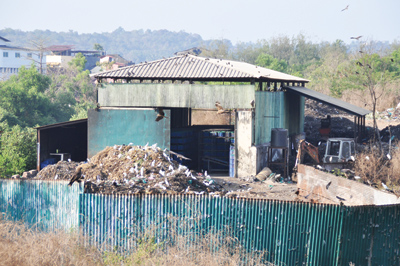
It is precisely such State apathy and a crisis of management that increases the danger to the lives of citizens and reduces the quality of life. Recently, O Heraldo reported that the newly operational Solid Waste Management plant in Saligao was functioning only up to half of its capacity. There were talks about transferring the garbage from Campal to the new plant in Saligao, but it is evident that bureaucratic insouciance and an attitude to pass the responsibility to some other department or individual would result in more garbage piling alongside roads and open spaces right in the middle of cities.

The case of the epidemic of 1570 and the rising problem of garbage management today seems to have striking similarities. For one, the then administration which had a duty of regulating and enforcing laws regarding public health had failed miserably. It can be argued that the present administration is also failing in a similar duty. Secondly, people then as today have no qualms in dumping garbage along the roads. There are also important differences in terms of technology and the manner in which it contributes to the generation and the disposal of waste. But it does appear that history is coming full circle. One may think if this is a case of ‘history repeating itself’ or if it is a case of cyclical history wherein things move from being good to bad and back to good again. For many would recall that public order and civic sense was prevailing in Goan towns and cities during the last few decades of Portuguese rule. Whatever may be the case, it cannot be denied that all of us are facing a major crisis of public health if the status quo in the functioning of public affairs is maintained. And perhaps thinking about such instances in the past might help us in being alert to problems of the present that are increasingly threatening us.

(First published in O Heraldo, dt: 20 July, 2016)

Wednesday, April 1, 2015

NOTES ON A GENTRIFIED GOA


In the last few weeks, two articles – one in the local, and another in the national press – discussed the major upheavals that Goa has witnessed in recent years following the massive in-migration to the state. The first of these articles was penned by Richa Narvekar in Goa Streets a Goan weekly and looked at the process of change from the perspective of shifts in the global economy, and flow of capital. 

Narvekar makes an interesting observation about the rise of the real estate market in Goa and the in-migration of the global, moneyed elites (which includes the cosmopolitan Indian elites): “Hundreds of apartments loom over the street [along the Miramar-Dona Paula road, overlooking the sea] in swanky new buildings, all with lights out; they are unoccupied. All of these have been bought out, but very few of the owners actually live here. Goa has become a major destination for empty ‘investment homes’. As the global rich buy more and more of these investment homes, property values get inflated to the point where average folks are priced out of the market. Construction is booming all over the country, but ironically, so is homelessness”.

Narvekar’s observation is crucial to understanding many of the whirlwind changes that Goa has witnessed in these last few years. This observation exposes a side of Goa’s ‘development’ story that is distinct from the usual focus on garbage, violation of land rules, rampant ecological damage. By looking at how capital flows into Goa and the class and caste of people investing in such ventures one starts to realize that the benefits from the real estate boom, and the consequent use of Goan land, are largely concentrated in the hands of global and Indian elites.

The other article appeared in Outlook – and thus a national magazine – authored by the Goaphile writer and photographer, Vivek Menezes. Noting a contrast between Goans leaving Goa with a Portuguese passport, and others coming into Goa from different parts of the world, Vivek Menezes makes the claim that Goa is leading the way in creating “an alternate idea of India”. So how, according to Vivek Menezes, is Goa leading this trend of creating an alternate idea of India? This is done by Goa being a cosmopolitan hub hosting “ambitious fortune-seekers from around the world”. Vivek Menezes suggests, “While the influx of unskilled labour from across the [Indian] subcontinent continues unstemmed… India’s sunshine state now hosts a bewildering mix of new residents: artists, football players, software developers, chefs and CEOs who are quietly transforming the state’s economy and culture”.

Looking closely at the picture of Goa emerging from the two articles, one cannot help but notice the variance in conclusions at the possible future of Goa. While on the one hand Narvekar is cautious about the process of gentrification due to the migration of certain elites, and indeed warns about its ramifications for Goan society; on the other, Vivek Menezes urges us to see beyond the obvious problems and celebrates it as the basis for its bright future. He suggests that all this gloom and doom will go away as Goa’s innate cosmopolitanism would blur these distinctions of outsider/insider and create a new Goa, and a new idea of India, based on the speech that Amitav Ghosh made in 2011 (in this context, see also this). But the very fact that Goans – largely the working class and minoritized Catholics – leave Goa with a Portuguese passport, while the rich of the world make the proverbial hay when the Goan sun is shining, should itself make us realize that something is not quite right with the way things are operating in Goa.

Vivek Menezes is not the first person to make such an argument and as such one needs to refer back to similar arguments made in the national press over the last few years. Another article, by Namrata Joshi and published also in Outlook in 2012, clearly suggests that there is hope for Goa due  its “[v]ibrant cultural calendar dotted with film fests, litfests, fashion shows and musical events [as well as] [r]enowned artistes, authors and intellectuals setting up base in Goa”.

An article in Times Crest, also published in 2012 , asked “[w]hy are so many writers, artists, photographers and culturewallahs moving to Goa?”,  and had a similar explanation adding that such professionals “have bought houses in Goa and started to spend all their time, or several months of the year, there. Drawn as much by the beauty, openness, and quiet surroundings as by its affordability – though that is fast changing…” It is no secret that many of these ‘culturewallahs’ have invested heavily in ‘Portuguese houses’, in other words in prime and costly Goan real estate.

Such arguments make the case that big-time artists, writers, musicians, and academics making Goa their home is something that needs to be actively accepted and encouraged. And yet, Narvekar points to the flip side of this imagination, indicating that another “essential forerunner to the formation of a gentrified state is the sudden mushrooming of art events. There are art schools, galleries and art event spaces springing up all over the state. But unfortunately, most of the attendees are not the average Goan youth, but young, affluent, alternative migrants. The former can hardly afford the Rs. 300 cocktails or the Rs. 400 mains served at these joints”.


So the question that needs to be posed is whether this in-migration of albeit skilled elite is really bringing any substantial benefits to Goa and Goans? Or is it just another case of gentrification where Goan land is nothing but real estate, and owning an old, so-called Portuguese house merely a status symbol for the global and globalized elites? After all, as the Times Crest article informed in 2012, “having a Goa address is increasingly been perceived as a chic way of saying one has arrived, both professionally and personally”. The whole idea of celebrating such ‘outsiders’, as Vivek Menezes proposes, hides the fact that this celebration is selective; it privileges the already privileged. The ‘outsiders’ who clean the roads of Goa, those who are engaged in construction activities, the labour class basically do not necessarily figure in this narrative of accepting the ‘outsiders’.

In the past, I had argued for the investment in intellectual pursuits so that we would better understand the past and present of Goans and Goa. It was a plea to forge networks so that Goans across the social and economic spectrum would be able to intellectually engage with Goa, and Goan history and culture in a systematic manner. Being skeptical about positive effects of global and economic elites from across the world and India setting up their base in Goa is not necessarily at variance with this earlier suggestion. While it is important to think more closely on who is an ‘insider’ or ‘outsider’, it is also important to be aware of the consequences of constructing and re-thinking identities, especially the consequences on the marginalized – ‘insiders’ or ‘outsiders’. The ‘insider’/‘outsider’ argument cannot reproduce newer discriminations that mirror the old feudal ways of living and being. A truly cosmopolitan and democratic culture cannot exclude on the basis of castes, classes, and gender. The fear is that a gentrified (or a gentrifying) Goa would perhaps not permit this to happen.

(First published in  O Heraldo, dt: 1 April, 2015)