Showing posts with label state planning. Show all posts

Wednesday, July 20, 2016

PUBLIC HEALTH AND THE CITY OF GOA


The piles of garbage across Goa remind me of an event in Goa’s history. Goa’s recorded history does provide us with instances that enable us to draw a parallel and see the disastrous effects of waste management when not checked properly and seriously. While my attempt in this essay will be to draw parallels with the past, it must also be stated that the problem of garbage management is a recent one associated with factors of rampant urbanization, large-scale use of non-biodegradable materials, and lapses on the part of the State.

After becoming the capital of the Portuguese Empire in Asia, the City of Goa or Velha Goa was ravaged by epidemics at least a couple of times. The fortunes of the City as a great entrepôt or a metropolis were impacted by these epidemics. The Goan scholar José Nicolau da Fonseca writing about the city in his book An Historical and Archæological Sketch of the City of Goa (1878) makes a mention of the devastating epidemic of 1570.

Along with the siege by Ali Adil Shah’s large army that led to food shortages, Fonseca argued that it were the unsanitary conditions then prevailing in the City that were responsible for the outbreak of an epidemic. “The city was in the first place surrounded by marshes and stagnant pools, emitting noxious exhalations, whilst little or no attention was paid to the hygienic conditions essential for the preservation of public health. The muddy banks of the river outside the city were generally covered with the detritus of animal and vegetable matter, which being exposed at low tide to the tropical sun underwent putrefaction, and thereby bred the germs of disease” (p. 150).

Moreover, Fonseca wrote that open defecation took place (with the permission of the Government) within the limits of the City, that there was a lack of access to potable drinking water (due to Governmental neglect), and that garbage littered on the main thoroughfares of the City so much so that “nobody was prevented from throwing any quantity of filth he chose into the streets” increased the devastation. Even before the epidemic, the dirty streets and lack of clean water had contributed to creating unhygienic living conditions.

If one drives around Goa, one is quite shocked (or not) to see piles of garbage dumped along the sides of roads. What is also alarming is the manner in which places close to habitation or water bodies are used as landfill sites. The garbage dumped at the Campal Parade ground in Panjim is a case in point. That garbage is dumped in an area that hosted exhibitions and events, or was an open space for the public is a shocking lapse on the part of the authorities, not to mention an acute health hazard. There are more examples in Panjim itself that enable us to see parallels with the conditions then prevailing in the City of Goa.

The area close to the new building of the Central Library at Patto is being used as a landfill for quite a number of years. Apart from a lack of planning or vision that the authorities and the city administration have displayed, there is also the danger of noxious gases poisoning scholars and general readers or fires causing permanent damage to an institution that houses some of the rarest books, newspapers, magazines, and manuscripts in Asia. Such a premier library should have had a prominent place as an institution symbolic of intellectual production in Goa and not enveloped by the stink and danger of garbage.
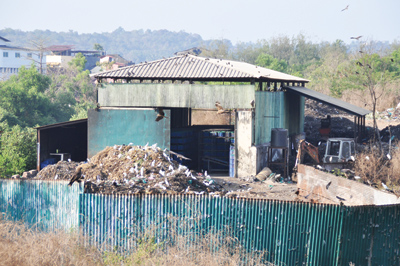
It is precisely such State apathy and a crisis of management that increases the danger to the lives of citizens and reduces the quality of life. Recently, O Heraldo reported that the newly operational Solid Waste Management plant in Saligao was functioning only up to half of its capacity. There were talks about transferring the garbage from Campal to the new plant in Saligao, but it is evident that bureaucratic insouciance and an attitude to pass the responsibility to some other department or individual would result in more garbage piling alongside roads and open spaces right in the middle of cities.

The case of the epidemic of 1570 and the rising problem of garbage management today seems to have striking similarities. For one, the then administration which had a duty of regulating and enforcing laws regarding public health had failed miserably. It can be argued that the present administration is also failing in a similar duty. Secondly, people then as today have no qualms in dumping garbage along the roads. There are also important differences in terms of technology and the manner in which it contributes to the generation and the disposal of waste. But it does appear that history is coming full circle. One may think if this is a case of ‘history repeating itself’ or if it is a case of cyclical history wherein things move from being good to bad and back to good again. For many would recall that public order and civic sense was prevailing in Goan towns and cities during the last few decades of Portuguese rule. Whatever may be the case, it cannot be denied that all of us are facing a major crisis of public health if the status quo in the functioning of public affairs is maintained. And perhaps thinking about such instances in the past might help us in being alert to problems of the present that are increasingly threatening us.

(First published in O Heraldo, dt: 20 July, 2016)

Wednesday, June 22, 2016

SAVIORS, TAMASHA, AND DESPERATION: A VICIOUS CIRCLE


The commencement of the monsoons about a week ago seems to have caught the authorities and public works departments napping. The pathetic manner in which public amenities and resources are (mis)managed add to the frustration and desperation that the citizens of Goa feel, and have felt for a long time. The water-clogged streets of Panjim, Mapusa, and Margao are a manifestation of mismanaged governance. If such incidents happen time after time, year after year, then one wouldn’t be off the mark in categorically stating that Goa is a failed State – in the sense of an administrative and political entity. It has been failing for a long time now.

Since the State fails repeatedly in its duties no matter which political party is in power, it could be suggested that Goan politics has been stuck in a vicious circle for some time now. The vicious circle begins with the repeated failure of the State regardless of the political party at the helm of governance and the ensuing frustration and desperation of the citizens. This leader of a political party or of a social movement – often a charismatic figure – emerges as a figure whose leadership provides the momentum for the change in political fortunes. This leader, invariably as he, is presented as the only savior who can bring about radical and revolutionary changes. Often this charismatic leader gains visibility through the successful staging of ‘spectacles’ such as protest marches or massive rallies at election times.

The argument here is that contemporary Goan politics is about the mobilization of people – in a metaphorical sense – from desperation to hope, and back to the cesspit of desperation. The fundamental and structural problems in Indian politics – be they of caste, language, region, gender, governance, unemployment – are left unaddressed. Problems that drive people into the vicious circle of desperation – hope – desperation in the first place.

While the vicious circle of desperation – hope – desperation may oppress us, to counter it we see the emergence of activists groups and movements, small and large, that attempt to correct the failing State. They are concerned with giving more power to the ordinary citizens in the process of governance. For instance, if there are massive irregularities in land sale across villages, we see many citizen groups emerging that attempt to stop it. They petition the State or they drag them to the court in order to stop the irregularities. So far such movements, though numerous, have had a very limited impact on the functioning of the State and its bureaucracy because their access to state machinery is limited. Such movements have to depend on the goodwill of the political bosses and the bureaucratic machinery to legislate laws that will work in their favor.

Since the activism route does not really work, one has to go back to electoral politics to gain access to the bureaucratic machinery. The only way one can do it is by organizing spectacular rallies. For instance, the case of the Aam Aadmi Party (AAP) in Goa is quite illustrative. Members of AAP campaigned vigorously door-to-door before their massive public rally at Campal. Thus, the massive rally was a key moment both for the self-image of an outfit like AAP and also for others to take them seriously.

With Arvvind Kejriwal projected as a savior and the Goan State riddled with scams and corruption, AAP appears to be ideally positioned to give hope to the Goan masses. In Kejriwal, AAP has the ideal person who emerges from the bureaucratic system which has repeatedly failed the people, and who postures himself as someone who can run it efficiently; indeed, someone who can deliver basic amenities. Additionally he is also the activist who was frustrated by the bureaucratic system. The interesting thing about the AAP is that it acknowledges the problems existing in the State/bureaucratic machinery but emphasizes only the mismanagement and corruption of previous political parties. But this does not account for the fact that it is the state machinery that has seldom worked in the favor of the masses. Political parties come into power and then they are kicked out after a slew of controversies and scams, but the mechanisms of the state are longer-lasting. Bureaucratic machinery is more resilient than the fortunes of a political party.

It is necessary, however, to suggest that there is no point in indulging in utopian visions. There is a value to these visions as long as one also recognizes the urgent necessity of having options in politics; of having a cushion to fall back on in case grand political mobilizations fall flat on their faces. What is meant by having options in politics is akin to having dual citizenship (in the Goan context) allowing us to infuse Goan politics with regimes based on legal rights and also contribute meaningfully to the political systems that uphold these rights.

The word ‘tamasha’ in the title was used specifically for apart from highlighting the problematic role of spectacles, to also play on the two meanings of the word in many South Asian languages. In the first instance, a ‘tamasha’ could mean a performance for entertainment; in the second it could mean talk or actions devoid of any intrinsic meaning. Without recognizing that the State has failed on several counts and the people in Goa have no choice but to be stuck in a vicious circle, Goan politics will forever be a ‘tamasha’. The vicious circle, of course, may never be broken.

(A shorter version of this article was published in O Heraldo, dt: 22 June, 2016)