Showing posts with label football. Show all posts

Wednesday, July 4, 2018

SPORTS, POLITICAL PASSIONS, AND PEACE


For those who believe that sport and politics should not mix, the on-going FIFA World Cup 2018 might be a tad bit disappointing. The game between Switzerland and Serbia witnessed tense moments, leading to a few controversies. Switzerland, whose squad had many players of Balkan heritage, appeared to be the perfect team for a mixture of political rivalries in a sporting match. Especially, since the match was against Serbia, which gained independence after a bloody war fractured Yugoslavia into countries like Albania and Kosovo. Serbia does not recognize Kosovo’s independent status, which made the clash between Switzerland and Serbia all the more tense given that Switzerland’s star players, Granit Xhaka and Xherdan Shaqiri, have Albanian and Kosovan heritage.

What perhaps made matters worse was that Serbia lost thanks to two stunning strikes by Xhaka and Shaqiri – who celebrated by gesturing the Albanian double-headed eagle. It did not help matters throughout the game that players like Xhaka and Shaqiri were heckled by the Serbian fans in the stands. One witnessed such controversies even in the run-up to the World Cup. Argentina cancelled a friendly with Israel, which was to be played in Jerusalem on a stadium built at the site of a former Palestinian village, after global pressure and even uproar. The shadow of bloody political conflicts and wars hanged uneasily over the proceedings of the World Cup; one that is not necessarily conducive to the progress of the beautiful game or for peace in a world that is increasingly being pushed to the brink of more violence.

In such situations, the on- and off-field actions and statements of sportspersons matter. For instance, after the controversy – with a possible two-match ban and/or fine – Shaqiri admitted that it were emotions that led him to celebrate in the manner in which he did, and that he would not like to say more about the matter. Even if he did want to invoke a memory and history of the war and exile that his family faced, and indeed many others too, Shaqiri did not really demonstrate that his actions were motivated by a higher goal. In many ways, his equivocation in the matter – especially to avoid the two-match ban that would have been disastrous for Switzerland’s campaign – makes the invocation of a bloody political conflict on a sporting event of such proportions seem unnecessary and superfluous. Clearly, sports and politics haven’t mixed well.

But we can contrast this with other examples wherein the role of superstar sportsmen has been stellar. Think about Didier Drogba from Ivory Coast, who has played much of his club football for Chelsea. In 2005, Ivory Coast qualified for the first time in the 2006 Germany World Cup. While the team had secured the place with an away 3-1 win against Sudan, back home in the Ivory Coast there was a civil war raging. Drogba and his teammates addressed the nation live from the dressing room and, kneeling down, pleaded for peace. The results were remarkable as the warring factions actually decided to lay down their arms; the peace lasted for about five years. Closer home, Sri Lankan cricketer Kumar Sangakkara appealed to the country to maintain peace, following the anti-Muslim riots in March this year. Many have often cited the statement of former Bangladesh cricket captain, Mashrafe Mortaza, after Bangladesh’s T20 victory in the Asia Cup, when sport-related nationalism borders on war-mongering and insanity. “I am a cricketer,” he said, “but can I save life? A doctor can. But no-one claps for the best doctor in the country. Create myths around them. They will save more lives. They are the stars. The labourers are the stars, they build the country. … I say, those who cry ‘patriotism, patriotism’ around cricket, if all of them for one day did not drop banana skin on the street…or obeyed traffic rules, the country would have changed. [If] this huge energy was not wasted after cricket and was used to do one’s work honestly even for a day, that would be showing patriotism”. Clearly, sports and politics can mix well.

But this mix can be a happy one only if the superstar sportsperson uses his/her stardom in the right way. What this means is that the superstar sportsperson views his/her social and political responsibility as an extension of his/her superstardom. This is not to say that every sportsperson should actively involve themselves in politics if they don’t want to or can’t, but to ensure that their stardom and support from millions of fans is not (mis)used for purposes of jingoism, racism, and war-mongering. The statement issued by the Swedish team, after one of their players, Jimmy Durmaz, was subjected to racist attacks online following a last-minute defeat to Germany in the present World Cup is a case in point. The entire team rallied around Durmaz, who is of immigrant heritage, to present a united front against hate speech. 

There is no way that the FIFA World Cup can be held in an atmosphere where the political does not mix with the sport. In fact, the World Cups in the past were held in extremely volatile and fragile political (as well as economic) conditions; think about the world wars and the breakup of the Soviet Union. Inflamed political passions will, more often than not, be a part of sporting events. Especially because sporting events are frequently used as a distraction from the pathetic political conditions that the masses find themselves in. The question is how the superstar sportsmen and their millions of fans would respond to such moments of hate and distraction.

(First published in O Heraldo, dt: 4 July, 2018)

Wednesday, August 17, 2016

GOA AND EUROPE: NATIONALISM AND 'BONITOS MACACOS'


In the course of discussing the issue of the existence of legal and emotional bonds between Goa and Portugal, and how these bonds enabled the Goan to engage with a larger European world, I had suggested that such an engagement gets hijacked by nationalism. I would like to return to the theme to suggest that there is a longer history of pitting European culture, which is embodied in the Europeanized Goan, against Indian culture. Today, while an act like supporting the Portuguese football team, or reclaiming Portuguese citizenship, or simply demanding English as a Medium of Instruction in primary schools, may invite charges of being ‘anti-national’, about a hundred years ago it was the apparently mindless and shameless ‘aping’ of Western culture that was held up as an obstruction to true civilizational progress. One needs to locate the present allegation of being ‘anti-national’ and being ‘denationalized’ in this history of Goan intellectuals believing that the Goan was a ‘mimic-man’ due to his use of aspects of European culture.

The present problems emerging out of identity conflicts and communal polarization have their roots in a politics that projected a Sanskritically-constructed ‘Indian’ culture as the ‘other’ of Western or European culture. Suffice it to say that a shift was demanded entirely towards this ‘Indian’ culture rather than carefully thinking about the political future of Goans and Goa; a mixed-bag of rights and privileges that would enable cultural and social mobility for the Goans. In other words, rather than defining a politics based on the ground realities of different Goan communities, the nationalism of the elites was imposed on the masses.

In this context one can refer to Evagrio Jorge’s pamphlet A Reforma do Vestuário (1942). Jorge argued that Catholic intolerance and the propaganda of the Estado Novo had convinced the people of Goa that there was nothing better than European culture, making them loath certain aspects of Indian culture. As such, Jorge suggested that a change was needed and this could be brought about by changing to Indian modes of dressing. This would rescue the Goan from the civilizational degradations that had plagued him. Jorge’s propaganda made its arguments and suggestions not only through practical concerns of hygienic clothing for instance, but also in a manner that would culturally humiliate his readers. Arguing that the “heavy European clothing” was unsuited for a hot, tropical climate like ours, Jorge went on to suggest that Goans had to let go of “false ideas of grandeur” regarding European sartorial choices if they did not want to be referred to as “bonitos macacos (beautiful monkeys)”.

It is not really surprising that writers and political activists who thought that Goans were simply mimicking and aping Western culture would use a term like ‘monkey’ to ridicule them. In fact this was not the only way the Europeanized Goan was ridiculed. Jorge, in the same pamphlet, cites at length a passage from Dr. Antonio de Miranda’s Alguns Aspectos da Nossa Mentalidade (1933). Dr. Miranda too argued that a shift towards Indian culture and traditions was necessary. He attempted to criticize what he considered burlesque behavior amongst Goans, but ended up ridiculing the very persons he sought to reform. He recounts an incident about his mundcar, who, having completed his first viaj on board a P&O liner, wanted to present a crucifix to the chapel of his village. To that end he searched all shops in all the ports that his ship had berthed for a crucifix with Christ dressed in a tailcoat and a top-hat – in other words European clothes.
 
Evagrio Jorge
One cannot help but notice that, in suggesting that the engagement of Goans with European culture was burlesque, Dr. Miranda too invoked the ridiculous image of ‘bonitos macacos’ or the mimic-man. It is also interesting that it is the figure of the mundcar which comes in for ridicule. Thus, not all Goans are equally ridiculed and held responsible for Westernization, even if all of them are considered Westernized. Accounts and anecdotes of Goan intellectuals ridiculing the Europeanized Goan are quite revealing, seen from the class/caste perspective. Claims to European culture, then as today, had the potential of re-figuring the power-relations in Goa; one that elites increasingly shifting towards Indian nationalism wanted to counter. Through European dressing and the Portuguese language, the mundcar could make a claim for equality with the bhatkar. After all, given that the majority of Goan population today belongs to the former mundcarial class, it can easily be pointed out that it is the mundcarial underclass that is largely opting for a Portuguese passport and is being increasingly attacked for not having any loyalty to the Indian nation and culture today.

One needs to recognize that the claims to Europe and European-ness by the Goan are not a recent phenomenon, emerging due to the ability of Goans to reclaim their Portuguese citizenship. Issues of caste and class would undercut assertions that demand power and privilege to be distributed justly. One can also see how a nationalist politics demanding fidelity to Indian culture can neutralize lower class assertion and also obstruct the mobility of persons. Indulging in ridicule and outrage over this issue would only further the problem of Goans becoming strangers in Goa.

(First published in O Heraldo, dt: 17 August, 2016)

Wednesday, August 3, 2016

GOA AND EUROPE: ON EMOTIONAL AND LEGAL BONDS


Two headlines in the last month are a good example of the irony at work in Goan politics. Following Portugal’s surprise win at the Euro 2016, one headline read: “Euro win unites Goa & Portugal” (12 July, 2016). The second headline a few days later read: “27,000 Goans with both Portuguese and Indian passports to be struck off poll rolls” (20 July, 2016). The first headline highlighted the emotional bonds between Goa and Portugal, with many of the comments by former Goan footballers emphasizing that the Portuguese football team had such a large support base here due to the “Portuguese rule” over different parts of Goa over a period of 451 years. The second headline drew our attention to the legal and diplomatic issue surrounding the vexed dual citizenship affair, and the current impossibility to hold both Portuguese and Indian citizenship at the same time.

If one were to look at the legal history, Portugal started recognizing certain tax-paying Goans as its citizens at least from 1826 when the Carta Constitutional was brought into force, reinforced further in 1910. The Salazarian Estado Novo despite its curbs on political organization did not restrict the right of citizenship of Goans. This was markedly different from what happened in neighboring British India where Britain refused to recognize even elite Indians as imperial citizens. It is interesting to note how following Portugal’s success on the football pitch, emotional ties are highlighted more by commentators than the legal ties, and when the question of legal issues emerge, the emotional ties are always kept out. It seems that the celebrations over football have nothing to do with this legal history that saw Goans first being recognized as Portuguese citizens, and after the Indian armed action, saw Goans reclaiming this right to work and engage with a larger European world.

To be fair, following or in the build-up to any big football match that Portugal plays, there are always reports that pour from the former ‘colonies’ about the support the football team receives and how it is the colonial history that provides this connect. However, parts of this colonial history which included the extension of citizenship to the colonies is not highlighted or willfully ignored. In Goa, the celebrations over such a victory additionally get hijacked by nationalism wherein rightwing groups declare that it is anti-national to cheer for the Portuguese football team. Thus, the history of colonial oppression is one that liberal as well as rightwing observers remember during such sporting events, as it is certainly odd to cheer a former colonizers’ football team in a post-colonial world. While the moderate or liberal commentators may marvel at the emotional display for the Portuguese team (in Goa as well as in other former colonies), the rightwing commentators would outright condemn it.

If the fascination with the emotional response to the Portuguese football team is marked by a selective memory of colonial history, the issue of dual citizenship is marked by a complete amnesia about the same. The legal history of the Portuguese citizenship of Goans is ignored and the issue is seen entirely through the lens of Indian cultural nationalism that seems to supersede everything. 

The rationale given to strike-off 27,000 Goans from the electoral rolls was that “as per the Representation of People’s Act and the Election Rules, one has to be an Indian citizen to cast one’s vote. Also, the concept of dual citizenship does not exist in the country [India]”. What such a statement does not account for is the fact that Indian laws were unilaterally imposed on Goa from 1961without any regard for the region’s history or without the assent of the inhabitants. With the normalization of diplomatic relations between Lisbon and New Delhi in 1975, Portugal gave the option to reclaim its citizenship to those who were residing in the former Portuguese India, as well as their children. Bearing in mind such a history, Jason Keith Fernandes, a legal anthropologist and Herald columnist argued that “if Goan migration seems to be turning into a one-way exit, it is because of the oppressive legal regime that the Indian state insists on. Goans are not obtaining Portuguese passports; they are merely reclaiming the Portuguese citizenship that they have always enjoyed… A legal regime honest about history would undoubtedly allow for a more dynamic movement of Goans between Goa and other places”.
 
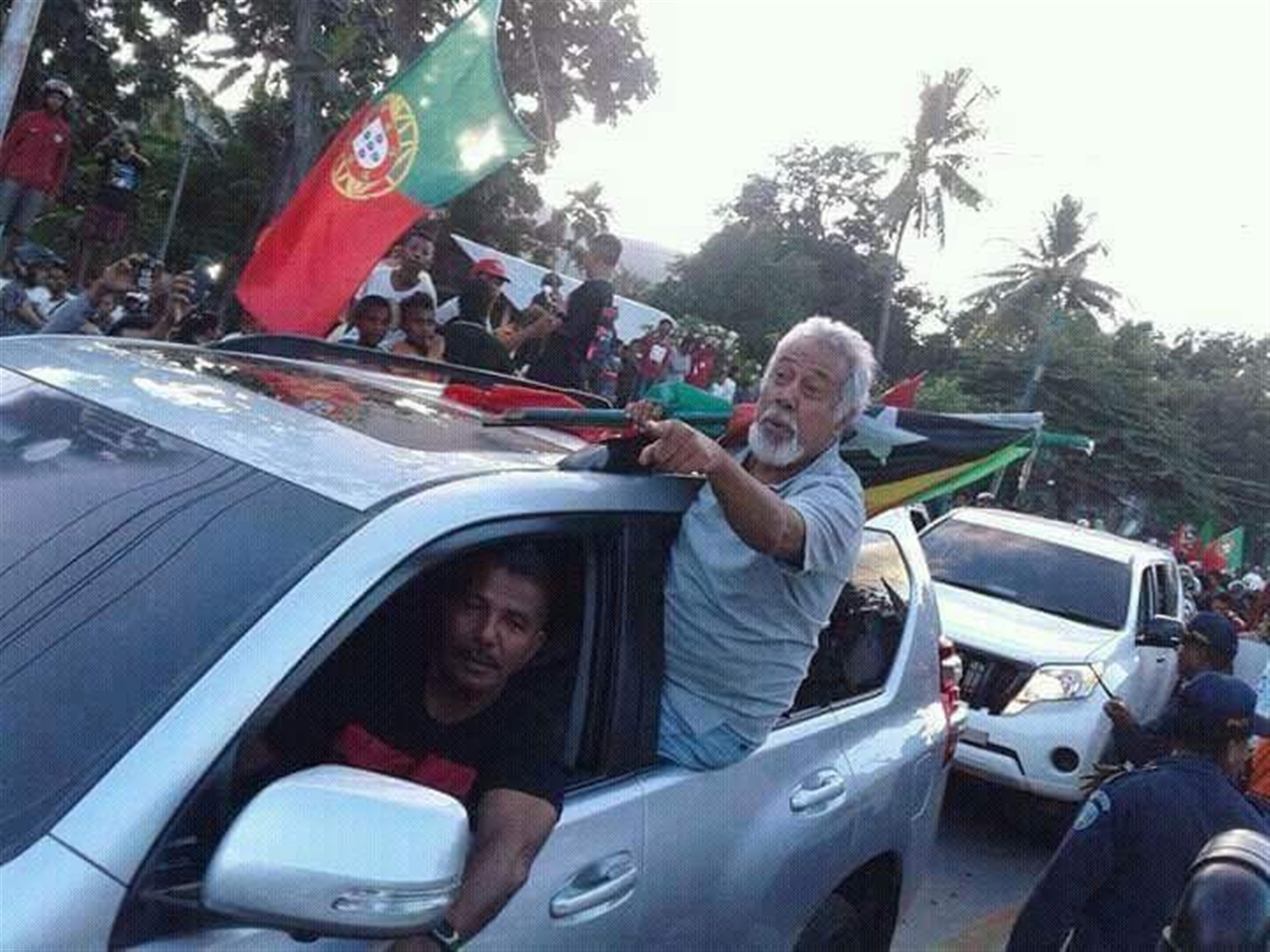
In East Timor
The move to remove 27,000 Goans from the Indian electoral rolls also reeks of a sinister and short-sighted plan, especially since the assembly elections are round the corner. A demographic swing of 27,000 people who will not be able to vote either makes it easy for some or difficult for others in the forthcoming elections. Given that the legal question is not yet debated and settled properly, hasty moves such as deleting names off electoral rolls will further compromise Goan identity. Yet again the destiny of large number of Goans will be determined by some who are unwilling to safeguard those interests and dismissive of Goa’s legal history, making the mobility of Goans in and out of their own homeland difficult. Most probably the issue of allowing Goans to hold dual citizenship will remain unresolved as the issue would lose its political value after the elections, while liberal and rightwing commentators would continue to wonder why in Goa (as well as in other former Portuguese colonies) a football match can evoke such emotional responses.

It would perhaps not be out of place to say that the Goan support to the Portuguese football team emerges not only due to a shared colonial history, but also a legal history of equal citizenship embedded within the shared colonial history. Eder’s brilliant and fantastic 109th-minute strike should essentially remind us of this.

(First published in O Heraldo, dt: 3 August, 2016)

Wednesday, January 21, 2015

FC GOA FLAGS AND GOAN IDENTITY


Sports – and sporting events – and their link with nationalism is unmistakable. Yet, despite being so obvious this link is rarely scrutinized critically. The celebration of Goanness in the victories of FC Goa in the recently concluded ISL Championship is an appropriate example. One can suggest that such a celebration of Goanness was never seen before as far as football in Goa is concerned. So what does this mad euphoria for FC Goa tell us about Goa and Goan identity?

One of the most overt ways in which Goanness was celebrated through FC Goa was by displaying FC Goa’s flag with vehement enthusiasm both inside the stadium as well as outside. Driving to various towns and villages in Goa with a friend, I was struck by how ubiquitous the flags were. Cars, scooters, houses, as well as shops were seen proudly displaying the flags. Michael Billig in his book Banal Nationalism (1995) underscores the importance of ‘flagging the homeland’ in our everyday lives. This ‘flagging’ does not simply refer to the physical object of the flag of a nation, but the many abstract and symbolic ways in which we are reminded of our homeland or nation every day. Words such as ‘we’, ‘ours’, ‘theirs’, etc., Billig argues, subconsciously remind us of our nations and homelands every day. Billig looks at how the newspapers use these abovementioned words in the most banal manner and suggests that newspapers are a site for ‘flagging the homeland’ in day-to-day life. Billig singles out sports as an area wherein the homeland is continuously ‘flagged’ in a banal manner with much enthusiasm, whatever may be the political affiliation of the newspaper.

The link between sports and ‘flagging the homeland’ was also observed by Zoltan Grossman. Writing in a lighter vein about the Green Bay Packers football (the one where they pick up the ball and run!) team in Wisconsin, USA, Grossman discussed how their first Super Bowl victory in 1997 made people behave in a very ‘nationalistic’ and ‘patriotic’ way. Similar to the scene in Goa, Green Bay Packers fans waved flags and displayed their pride through car stickers. And perhaps they went overboard when they considered the turf of their home stadium as sacred earth! Grossman, though writing in a satirical and lighter vein, does draw parallels with how nations are imagined and how national territory is marked.

Needless to say, the failure and success of FC Goa was keenly discussed and followed in the press. Despite the celebrity presence in the form of Bollywood and cricket personalities, die-hard FC Goa fans maintained that they overwhelmingly supported the team because the Brazilian legend, Zico was the coach, and more importantly “that they finally ha[d] a ‘Goa’ team” to support. For his part, co-owner of FC Goa Dattaraj Salgaocar, writing in a local newspaper asserted that FC Goa was successful in uniting the Goan people. “FC Goa,” he said, “may have lost in the penalty shootout in the semi finals, but I believe that it has won the hearts of Goa and our entire country. Our vision of uniting the people of Goa through football has come true; every Goan has been rooting for our team”.

While today we may celebrate football as being quintessentially Goan, the history of its promotion in Goa in relation to the Portuguese state, and commercial interests within Goa has more than what meets the eye. There is an obvious link between mining firms/families and football in Goa, and as such it demonstrates a pattern. As Constantino Xavier based at the John Hopkins University, Washington DC noted in one of his columns, the Portuguese state or Estado Novo promoted football in the 1950s, which the mining companies capitalized on immediately. (Interestingly, many blamed the initial losing streak of FC Goa on the irregularities in the mining sector!).

Xavier also notes the link with the promotion of football in Goa with nationalism, “Passion for football became a symbol of passion for Portugal. In 1955, Mozambique’s Ferroviarios of Lourenço Marques [or Maputo] visited Goa on tour, which was followed in 1959 by the Port Trust Club of Karachi. The highlight came in May of 1960, when a reserve team from giants Sport Lisboa e Benfica showed up for three test matches”. So if we are proudly waving flags in celebration of Goan football and thus Goanness, the history of this may point to factors other than the cliché that football runs in the blood of every Goan. Indeed, FC Goa’s slogan ‘Força Goa’ is similar to ‘Força Portugal’, used to passionately cheer the Portuguese football team. The ‘flagging’ of FC Goa also points to the significance of Portugal for Goan identity and how the history of Goan identity is intimately tied to the Portuguese presence in Goa. Unfortunately, this history is not yet written. All we have for now is the stray but interesting comment that Xavier made recently.

The FC Goa euphoria came at a time when this was the only news that was worth looking forward to. Football offered hope and a reason to celebrate Goa. As it mostly happens with nationalism, the celebration of Goan identity through FC Goa flags came at the cost of forgetting how fractured this very Goan identity is. But sport and its deep connection with nationalism can be seen as providing a space for instant bonding, despite the internal fractures in a society. This was seen after Spain won its maiden World Cup in 2010, uniting the country despite regions like Catalonia and Basque demanding more autonomy. Commentators also noted the remarkable number of Spanish flags that were flown across the country following the victory. If at all any unity has been achieved, as the ‘flagging’ of FC Goa would suggest, it would mean nothing if we do not ask some tough questions about the things we love and cherish as Goans. If we love football then we need to dissect the sport thoroughly. We should not only be worried about utilizing and developing Goan talent in football, but how this sport – the beautiful game – unites us as Goans.

(First published in  O Heraldo, dt: 21 January, 2015)