Wednesday, November 9, 2016

THE ‘GOA DECLARATIONS’, FROM CHOGM TO BRICS


There was a sense of déjà vu around the Eighth BRICS summit. In fact, the more one thinks about how the BRICS summit was organized, and how international cooperation in trade and diplomacy was discussed, one is struck by the similarities with the Commonwealth Heads of Government Meet (CHOGM) which though held in New Delhi in 1983, featured Goa as the site of a retreat for all the visiting dignitaries.

Both BRICS 2016 and CHOGM 1983 issued ‘Goa Declarations’. Both these documents can be compared to see how similar or different they are. These declarations contained summaries of the political, diplomatic, and economic challenges ahead of member nations, and how these member-nations would cooperate with each other in the future for a peaceful world. While the declarations made from Goa may have been concerned largely with international cooperation, there seems to be hardly any long-term benefits for Goa. Goa seems to be only a location to strike deals.

These summits are touted to be economically important. In fact, such summits seem to have a contrary effect on the economies of the participating nations. Probably because the economic vision embedded in the ‘Goa Declarations’ are centered on ‘development’, rather than the people.  Take for instance the economic history of Goa post-CHOGM 1983, which ushered in a wave of rapid urbanization along the coast – an area that is both ecologically sensitive and home to communities with traditional livelihoods. Development according to the CHOGM model would mean to bulldoze much of this with little consideration for the people already existing there. CHOGM 1983 and BRICS 2016 provided similar solutions of pumping massive investments through mega-projects in order to rectify the global economic crises. We in Goa do not need to be told the destruction that mega-projects bring to our land and ecology.

A few years after the likes of Margaret Thatcher, Pierre Trudeau, and Robert Mugabe holidayed in Goa, the Goa government formulated a Master Plan for tourism in keeping with the then Central government’s policy on tourism development. Tourism, under this scheme, was conceptualized as benefiting all; one that would modernize Goan society. However this Master Plan was one that precisely promoted the massive mega-projects, and hence the déjà vu hits one hard in the face when the Chief of Protocol, Ministry of External Affairs explained that Goa provided the apt setting for BRICS 2016 because it is “vibrant, cosmopolitan… [and] always been welcoming visitors”.

While CHOGM 1983 can be said to have initiated this massive and unchecked tourism development, BRICS 2016 seems to only build up on the ‘development’ of CHOGM 1983; adding, no doubt, to the activities of such bodies like the Investment Promotion Board in promoting mega-projects. The infrastructure for BRICS 2016 already existed due to the economic model espoused by CHOGM 1983. While CHOGM 1983 created Goa as a location of luxury tourism consumption, BRICS 2016 sustains such luxury consumption. This is precisely the neo-liberal economic agenda that Goans need to be guarded against.

Part of the neo-liberal agenda of CHOGM 1983 was to discard “protectionism” and allow for the domestic markets of member countries to be opened up to foreign manufactures in order to fix the global economy. In turn, while noting that the global economy as it stands today needs recovery BRICS 2016 indicated its support to the policies of the World Trade Organization, in effect, to foster trade by further opening the domestic markets. This would mean, then as now, that small and cottage industries would not get any special protection should a multi-national company market similar goods. While big industrialists and businessmen may delight over the benefits of such summits, common people would obviously be less enthusiastic, given that these benefits rarely trickle down.

More tourism would also mean the indiscriminate destruction of land. While CHOGM 1983 saw the acquisition of new land for roads and hotels, BRICS 2016 did not witness any such new land acquisition, although there were protests about suspicious-looking land usage proposals. There was, one thinks, no more land along the coast to acquire for new hotel resorts, being as it is over saturated with starred hotels. This process of land acquisition has never been a happy one for subjects of the Indian state, Goans included. For instance, during CHOGM 1983, we have reports available of two elderly ladies, Josephine Lobo, and Preciosa Menezes (then aged 73 and 75 respectively) who fought against the takeover of their land for the expansion of a starred hotel. The septuagenarians were not the only ones to have opposed the ‘development’ during CHOGM 1983, with other CHOGM-related projects, too, coming under protests.

In fact it can be said that collaborations such as BRICS will accentuate this form of tourism, despite the use of such terms like “sustainable development” in their economic vision. One can see that the ‘development’ that BRICS-like summits tend to promote also tend to acquire land – first were the coastal areas, now it seems to be moving to the hinterland; to the plateaus of Betul, Mopa, and more recently Loliem. The ‘development’ that BRICS espouses ultimately needs land, and in a place where land is scare this can only mean disaster.

For these reasons – and particularly due to the fact that not much has changed for the good from CHOGM 1983 – Goans must be clear that summits like BRICS and CHOGM are wasteful and have only suspicious returns to those who host them. And when they are over, the hosts (or the people of Goa) are the ones who are left to clean up the mess.

(First published in O Heraldo, dt: 9 November, 2016)

Wednesday, October 26, 2016

COLONY LOST?


An article in The Guardian recently claimed “artists” and “hipsters” to be the new agents that drive the process of gentrification. Though the article was about the current situation in Britain, similarities could be drawn with Goa’s own fraught tourism-led development. According to the article, artists and hipsters “are the neoliberal state’s troops”. Artists first move into certain areas that seem to have decayed or have not developed, and “sow the seeds of cultural capital. ... Both artists and (some) of the hipsters – the ones who haven’t ‘settled’ yet – will move on, exploring, breaking away (again), developing new potential sites for capital investment. And so the cycle of gentrification starts all over”.

The Goan parallels with the quote above may not be obvious on first reading. Goa’s unchecked development of the tourism and real-estate industry started with Goa being exposed to the neoliberal economic setup of India. What has this to do with the influx of artists and hipsters in Goa? The idea of Goa as a ‘touristic heaven’ or a ‘pleasure periphery’ was constructed on a Goan landscape that was populated by agrarian villages, making the acquisition of  real-estate, in due course of time, elite status symbols coveted by the artists, writers, and the upwardly mobile professionals from Indian metros – or the catch-all desi misnomer, “culturewallahs”. The neoliberal economic setup and the easy mobility afforded by the Indian nation-state led to the large scale gentrification of sea-side villages that we are witnessing today – a process either exemplified by the rise of ‘mega projects’ or the emergence of ‘Portuguese houses’ as markers of chic and luxurious lifestyle.

Another parallel is how people who drive this gentrification in Goa can leave anytime for better pastures. Very often the “culturewallahs” who move to Goa claim that their commitment to Goa and its people is much deeper than a sudden decision to shift to Goa. It is not simply an investment in Goan real estate. However, a recent assertion by Deepti Kapoor, who had moved to Goa but has now decided to go elsewhere due to the deteriorating situation here, testifies to the skin-deep character of this commitment. It also reveals the disaster that gentrification is, for Goans, who unfortunately have to live in the mess that such a development leaves behind. What does Goa get out of this? Art? And what is the relevance of such art?

To say that the affluent global and Indian elites can move to Goa due to the financial resources available to them is only half the story. This is why we need to dwell on the notion of ‘colony’ in relation to gentrification. Like the colonies established during the height of European imperialism, the ‘colonies’ established by the real-estate industry have an element of exclusivity to them. One’s social location determines who gets access into these ‘colonies’. To think of gentrification as a process by which ‘colonies’ get established allows us to see that rather than being harbingers of modernization and progress – or of art or culture – they are, in fact, a recapitulation of South Asia’s age-old and timeless hierarchies. 

It is the emergence of such ‘colonies’ that defines the ‘brand value’ of Goa in recent times. These gentrified places, while a good economic investment, also simultaneously become a refuge for the rich…a utopia tucked away from the hustle and bustle of the world. Thus, while these places are physically enclosed by way of allowing access only to a privileged few, they are also cut-off from the social and political realities of the world. Only when these utopian places are threatened for any kind of reason – then one sees a remarkable outrage that gets blown out of proportion.
 
Pic: Vishvesh Kandolkar
Consider the recent case of the unfortunate murder of a perfume-maker who had made Goa her home. Her death was mourned by a huge outrage. The critique that the same attention was not paid to another murder which happened on the same day is insufficient. The reason why one person’s murder was discussed down to its last detail and the other was almost ignored was also due to the fact that the other murder occurred in a nondescript ‘vaddo’. To be fair, most of the gentrified neighborhoods that have emerged in Goan villages have been constructed in various ‘vadde’, but the gentrification makes all the difference. Compared to the genteel location of the murder of the Goa-based perfumer, the nondescript ‘vaddo’ in a Goan village is insignificant.

Juxtaposing the social and physical locations of the two murders allows us to see that the comments by numerous glitterati and literati to declare categorically that the crime against the perfumer signaled the demise of the once great Goa, is nothing but a fear of losing privilege. It is not an outrage marked by concern for Goa. For the same people couldn’t care any less when large chunks of Goan land were (and are) grabbed from ordinary, hard-working Goans. Considering that most of the land grabbed from Goans goes largely to build resorts, second-homes, and ‘colonies’ made available for the disposable pleasure of the same elites, one can understand why there isn’t any outrage.

Gentrification thus is a process by which localities get taken over by the rich, simultaneously pushing out the locals. It is also a process by which the locals are slowly rendered powerless. Goa’s problem with gentrification does not need any outrage or lamentations of demise, but to recognize first that the problem exists, and what and who engendered it. 

(First published in O Heraldo, dt: 26 October, 2016)

Wednesday, October 12, 2016

CENTRES OF EXCELLENCE: EDUCATION AND SOCIAL JUSTICE


The villagers of Loliem-Polem in Canacona are up in arms. They are opposing, it seems, a ‘mega project’. Only in this case, the ‘mega project’ in question is a proposal for a new sprawling 120-acre campus of the Indian Institute of Technology (IIT) to be set up in Goa. Considering that this is a plan for the development of cutting-edge higher education, some people are at a loss to understand the protest. However, given Goa’s history with large-scale projects that gobble up land and other natural resources, one can see why the villagers are anxious about the take-over of so much land.

That apart, those who argue for the IIT campus to be set up in order to bring quality educational institutions to Goa may have good intentions, but do not seem to see the larger picture of what education is supposed to do for society. Hence, there is another dimension to the issue, that of social justice in education; one that needs to be considered along with the land issue. Given that IITs have witnessed the emergence of pro-Hindutva lobbies, as well as the recent anti-caste assertion, one would expect that those who bat for the IIT in Goa will take these happenings on board as well.

If we ask ourselves what is the most basic function of education, the answer surely would be to enable a person to be gainfully employed due to the skills that he receives after years of schooling and college. Additionally, we can also say that the educational system needs to produce enlightened citizenry. To that end, everyone should have a right to an education. But in recent years, we have witnessed repeated instances of discriminatory practices that precisely undermine this right to education for all. While the issue of the Medium of Instruction (MoI) can be cited as an example of how primary education of young children is sacrificed at the altar of politicking, the unfortunate death of Rohith Vemula at the Hyderabad Central University illustrates how universities and higher educational institutions have a long way to go to secure social justice for the most marginalized of the population. This is why claims of excellence by elite Indian educational institutions need to be taken with a pinch of salt.

If we focus closely on the impact that the new IIT will have on Goa, it would seem that the benefits would not accrue to the majority of the locals as easily as one may think. Getting into IITs is not easy. Especially since admissions are done on the basis of the Joint Entrance Exam (JEE) in which lakhs of aspirants try their luck. The preparation for the JEE generally requires specialized ‘coaching’ in private institutes, where the candidates have to pay lakhs of rupees. There was an argument that the new IIT campus in Goa will be a boost for the largely agrarian communities of Loliem-Polem and surrounding areas. However, considering the immense financial capital necessary to prepare for the entrance exam, would the children of such agrarian communities in Loliem-Polem – or for that matter any such communities in Goa – be able to fairly compete? One doesn’t think so.

While an IIT may spring up, it is no guarantee of equal opportunity. To add to it, majority of Goan students would be disadvantaged because they do not possess the resources necessary to “crack” the entrance exam. Implementing policies of social justice and inclusiveness has been a problem for all educational institutions in India. The idea that ‘merit’ trumps everything is at the root of discriminatory practices – often relating to caste – in Indian universities. While the universities oriented towards the humanities will at least be mildly embarrassed to peddle the argument of ‘merit’, even if caste-based discrimination goes on unabated, there are many technology institutes in India that still recruit students solely on the basis of ‘merit’. What ultimately this would mean is that if the ratio of a section of students in these elite campuses is low (such as Goan to non-Goan, or lower-caste to upper-caste), then these groups of students can be seen to lack ‘merit’, ‘talent’ or ‘ability’. Activists working on the issue of Dalit students in campuses have highlighted how they are discriminated against for lacking ‘merit’.

Speaking specifically of higher education in Goa, one cannot leave out Goa’s only university. For a small place like Goa, a centre of excellence should necessarily be one with a range of courses from the sciences to the humanities and social sciences. An establishment like the Goa University could be better suited, as opposed to an IIT whose focus is largely the sciences and technology. This is not to say that moving away from ‘only technical education’ to a combination of ‘technical-humanities education’ will make all the problems of discrimination, as discussed earlier, go away. Indeed, if the recent news reports and analysis of the manner in which affirmative action is scuttled in Goa University are to be taken note of, then it is indicative that having humanities-based courses does not guarantee a level playing-field. And yet one can make the case that having a range of courses from the sciences and humanities would allow a student access and choice to an all-round curriculum.

For if we are interested in bringing quality education and in making sure that the fruits of education reach all students, then our conception of higher education should be broader. The one-sided onus and value that is placed on technical and science-based education should give way to valuing the acquisition of various types of knowledges, even if it seems that such knowledge does not have an immediate market value. Indeed, fostering a community and culture requires that we also promote education in the humanities.

Making an argument for Goan students benefitting from centres of excellence set up on Goan soil, does not mean that one is making a ‘Goan v/s outsider’ argument, or that one is trying to suggest that non-Goan students are not welcome. Indeed, educational hubs can only be lively spaces when there is a diversity of scholars and students who interact with each other. However, there is something ‘colonial’ about arguments that completely ignore the fact that communities who lose their lands do not get much in return. ‘Colonial’ because giving up land can itself be extractive with guarantees of any returns being at best debatable.

Perhaps, we need to be open to the possibility that the people of Loliem-Polem are not just fighting to save a lush, fertile piece of land. 

Illustration: Angela Ferrao.

(A shorter version was first published in O Heraldo, dt: 12 October, 2016)

Wednesday, September 28, 2016

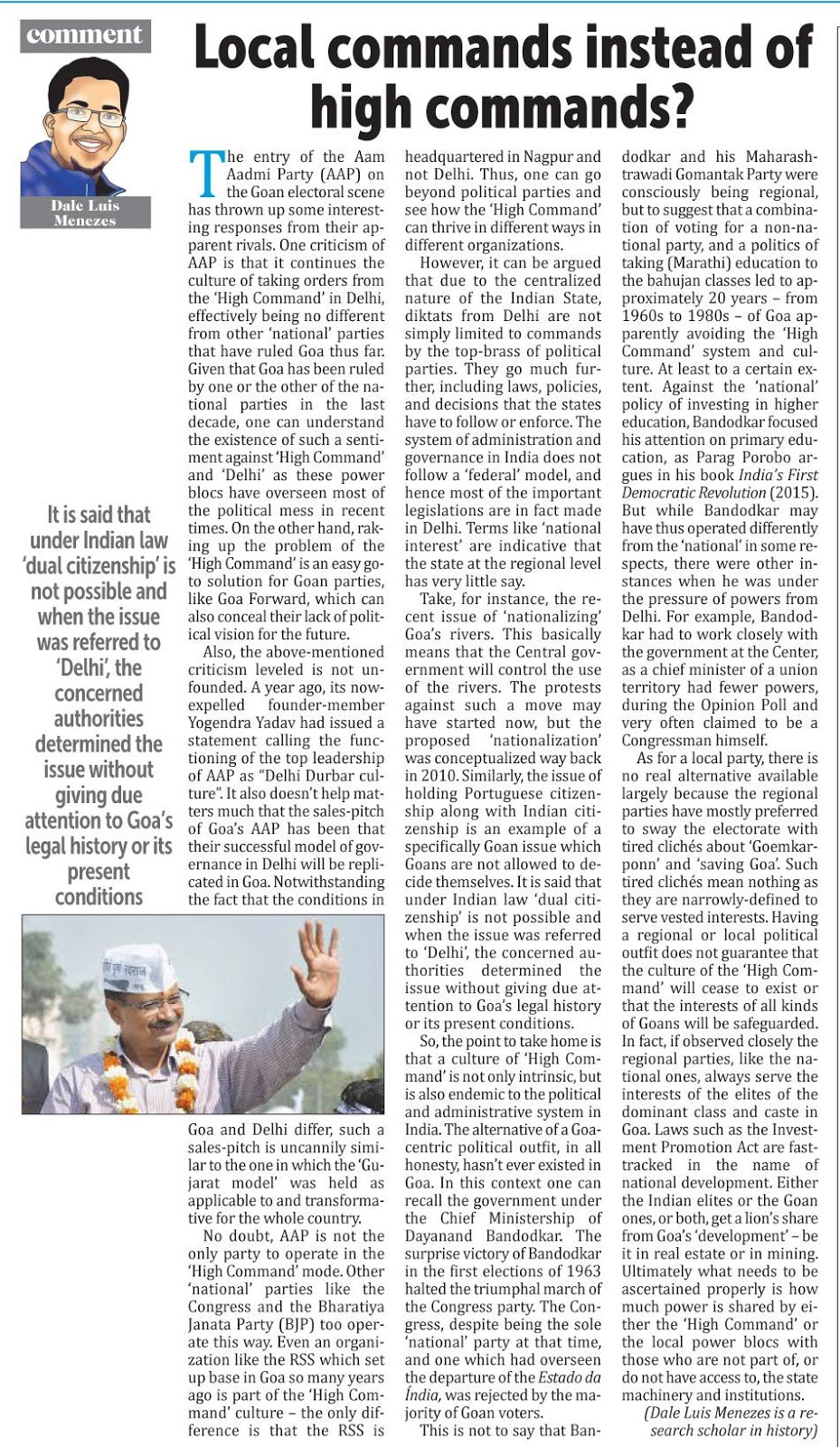
LOCAL COMMANDS INSTEAD OF HIGH COMMANDS?


The entry of the Aam Aadmi Party (AAP) on the Goan electoral scene has thrown up some interesting responses from their apparent rivals. One criticism of AAP is that it continues the culture of taking orders from the ‘High Command’ in Delhi, effectively being no different from other ‘national’ parties that have ruled Goa thus far. Given that Goa has been ruled by one or the other of the national parties in the last decade, one can understand the existence of such a sentiment against ‘High Command’ and ‘Delhi’ as these power blocs have overseen most of the political mess in recent times. On the other hand, raking up the problem of the ‘High Command’ is an easy go-to solution for Goan parties, like Goa Forward, which can also conceal their lack of political vision for the future.

Also, the above-mentioned criticism leveled is not unfounded. A year ago, its now-expelled founder-member Yogendra Yadav had issued a statement calling the functioning of the top leadership of AAP as “Delhi Durbar culture”. It also doesn’t help matters much that the sales-pitch of Goa’s AAP has been that their successful model of governance in Delhi will be replicated in Goa. Notwithstanding the fact that the conditions in Goa and Delhi differ, such a sales-pitch is uncannily similar to the one in which the ‘Gujarat model’ was held as applicable to and transformative for the whole country.

No doubt, AAP is not the only party to operate in the ‘High Command’ mode. Other ‘national’ parties like the Congress and the Bharatiya Janata Party (BJP) too operate this way. Even an organization like the RSS which set up base in Goa so many years ago is part of the ‘High Command’ culture – the only difference is that the RSS is headquartered in Nagpur and not Delhi. Thus, one can go beyond political parties and see how the ‘High Command’ can thrive in different ways in different organizations.

 However, it can be argued that due to the centralized nature of the Indian State, diktats from Delhi are not simply limited to commands by the top-brass of political parties. They go much further, including laws, policies, and decisions that the states have to follow or enforce. The system of administration and governance in India does not follow a ‘federal’ model, and hence most of the important legislations are in fact made in Delhi. Terms like ‘national interest’ are indicative that the state at the regional level has very little say.

Take, for instance, the recent issue of ‘nationalizing’ Goa’s rivers. This basically means that the Central government will control the use of the rivers. The protests against such a move may have started now, but the proposed ‘nationalization’ was conceptualized way back in 2010. Similarly, the issue of holding Portuguese citizenship along with Indian citizenship is an example of a specifically Goan issue which Goans are not allowed to decide themselves. It is said that under Indian law ‘dual citizenship’ is not possible and when the issue was referred to ‘Delhi’, the concerned authorities determined the issue without giving due attention to Goa’s legal history or its present conditions.

So, the point to take home is that a culture of ‘High Command’ is not only intrinsic, but is also endemic to the political and administrative system in India. The alternative of a Goa-centric political outfit, in all honesty, hasn’t ever existed in Goa. In this context one can recall the government under the Chief Ministership of Dayanand Bandodkar. The surprise victory of Bandodkar in the first elections of 1963 halted the triumphal march of the Congress party. The Congress, despite being the sole ‘national’ party at that time, and one which had overseen the departure of the Estado da Índia, was rejected by the majority of Goan voters.


This is not to say that Bandodkar and his Maharashtrawadi Gomantak Party were consciously being regional, but to suggest that a combination of voting for a non-national party, and a politics of taking (Marathi) education to the bahujan classes led to approximately 20 years – from 1960s to 1980s – of Goa apparently avoiding the ‘High Command’ system and culture. At least to a certain extent. Against the ‘national’ policy of investing in higher education, Bandodkar focused his attention on primary education, as Parag Porobo argues in his book India’s First Democratic Revolution (2015). But while Bandodkar may have thus operated differently from the ‘national’ in some respects, there were other instances when he was under the pressure of powers from Delhi. For example, Bandodkar had to work closely with the government at the Center, as a chief minister of a union territory had fewer powers, during the Opinion Poll and very often claimed to be a Congressman himself.

As for a local party, there is no real alternative available largely because the regional parties have mostly preferred to sway the electorate with tired clichés about ‘Goemkarponn’ and ‘saving Goa’. Such tired clichés mean nothing as they are narrowly-defined to serve vested interests. Having a regional or local political outfit does not guarantee that the culture of the ‘High Command’ will cease to exist or that the interests of all kinds of Goans will be safeguarded. In fact, if observed closely the regional parties, like the national ones, always serve the interests of the elites of the dominant class and caste in Goa. Laws such as the Investment Promotion Act are fast-tracked in the name of national development. Either the Indian elites or the Goan ones, or both, get a lion’s share from Goa’s ‘development’ – be it in real estate or in mining. Ultimately what needs to be ascertained properly is how much power is shared by either the ‘High Command’ or the local power blocs with those who are not part of, or do not have access to, the state machinery and institutions. 

(First published in O Heraldo, dt: 28 September, 2016)