Saturday, July 14, 2012

SACRED ART, MODERN PERCEPTIONS


A span of 450 years of colonial experience has provided Goa with numerous cultural interactions from many regions and countries of the world. These cultural interactions, be they in food, music, art etc, have enriched the Goan culture in ways that many of us may not know. Influences from Persia, Africa and Europe inter alia are little known facts. In the architecture of Goan churches, these influences, be they Islamic/Islamicate, Persian and European have fairly been numerous as is suggested by scholarly research, particularly by Dr. Paulo Varela Gomes’ latest book Whitewash, Red Stone: A History of Church Architecture in Goa (2011. New Delhi: Yoda Press). But what if this centuries-old heritage in the form of church buildings and the art they house is not preserved and is withering due to ravages of time, neglect and the elements?
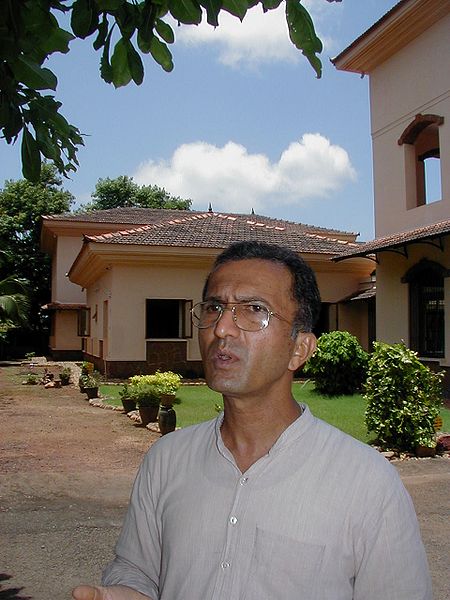
Agnelo Fernandes (C), Nickson (R) and Glen (L)
            The answer to preserve and protect our heritage is obviously to conserve and restore such buildings and art. But since Goa is a small place with too many churches and specimens of art and since every one of us has seen such buildings and art being neglected and destroyed, such a situation merits the asking of a very pertinent question: do we have the skill and the consciousness required to preserve our heritage? A common complain in Goa is konn monis nant or there are no skilled people that are easily available. But I feel such a view results from our own ignorance of the people involved in conservation/restoration of sacred art as well as the failure of such people in building networks that would facilitate the movement of information.
The altar of the Quepem church that needs restoration
            Agnelo Fernandes and his two sons Nickson and Glen are engaged in the conservation and restoration of sacred art heritage. Originally hailing from Borda but now settled in Arlem, Margao Agnelo Fernandes’ tradition of restoration and conservation stretches back to his great-grandfather; making Nickson and Glen the fourth generation heirs to carry forward the family tradition. Agnelo and his sons are fondly known as the Bicos because it was the nickname of Caetano Fernandes, who had started this family tradition. The Bicos are a very passionate lot about their trade. One could go on-and-on listening to them – especially Agnelo Fernandes –about their latest projects and other experiences of the past. When I visited them, the first thing Agnelo Fernandes and his sons did was to bring one specimen after another and explain to me the technique and patience that went in working on each art object.
            We settled down to chat about various issues that I was most interested to learn from them. Agnelo Fernandes, the father is not much of a talker. I got the impression that he prefers to allow his work and art to speak for him. Nickson on the other hand is the most articulate and illustrative. It was from the experience of Agnelo Fernandes and his sons that I wanted to know what are the hurdles and problems that are faced by them. How do the lay people react and respond to their own heritage and why it is important for us to urgently start thinking about creative ways to take the issue of the heritage, and particularly of sacred art, right to the people.
The painting in the sacristy of Quepem Church needing restoration
            The most recent major project that Agnelo Fernandes and his sons have completed is the painting and partial restoration of the Holy Cross Church in Quepem. Earlier, the Bicos had worked in Bombay (St. Andrew’s Church), Cochin (Church of Our Lady of Hope) and in Mangalore (Bethany Convent) amongst others.
            According to Agnelo Fernandes and his sons, the interior decoration of the Quepem church is “unique” and “rare” in Goa. The church need not be destroyed, Nickson says, as it would be a mistake. They are of the unanimous opinion that the beautiful, gold-gilded altar should be conserved and reinforced as it is about to be spoilt.
            “It [conservation and restoration] is a long process and people need to be educated,” Nickson says when asked about why such projects are not taken more freely by the lay parishioners. “Lay people have no knowledge of restoration/conservation and they want something new,” he further adds. ‘New’ in the sense of how lay people desire the end result to be jazzy and kitschy.
            If Agnelo and his sons try to argue otherwise, then the oft-repeated pretentious phrase ‘We are paying’ is directed at them. If such is the behaviour of the lay people, then what about the priests of the churches that they have worked with? “Some of the priests want to put their own tastes in the project,” they say. As a result Agnelo Fernandes and his sons have walked away from many jobs for a reason that can be euphemistically referred to as creative differences!
Another painting which needs attention
            So is there a policy regarding the sacred art of the Archdiocese of Goa and Daman, I ask. “No, there is no policy,” I am informed. Talking to Agnelo Fernandes and his sons, I got the feeling that much of the problems stem from our ignorance. But Nickson is especially hopeful, for he feels that the heritage scene is showing signs of change. Last October, the Fundação Oriente had organized a workshop which brought together priests, academics and technicians – like the Bicos – on one platform. Nickson is of the opinion that such efforts could lead to an increased awareness in heritage matters.
            Our heritage and how we understand and view it would define us as a community. With a cohesive and practical policy regarding sacred heritage yet to be on a sound footing coupled with the general apathy of the laity, it is high time that we start thinking of sustainable models to preserve our heritage for the future

(A version of this article appeared on Gomantak Times, dt: July 14, 2012).

Friday, July 6, 2012

CASTE AND COMPROMISE


Love triumphs all, is a theme that is not new to any of us. We have experienced this theme in movies, TV soaps and literature: the lovers go against all odds to assert their love for each other and to gain acceptance in a wider society of their (generally) clandestine affair. I have always felt that such narratives provide a utopian picture of the real world for us. Things are not always as black and white as they are made to appear…
               Pandharinath D. Lotlikar’s debut novel Toddzodd joins the long list of such narratives. He is no stranger to the readers of Konknni, having contributed to various magazines and having written both in Romi and nagri. Formerly with the All India Radio and Durdarshan, he decided to publish his first novel in the Roman script because he wanted his novel to reach a wider audience all the while acknowledging the important contribution of writers in this particular script to the corpus of Konknni literature.
               The story that Pandharinath Lotlikar sets out to tell is one which moves back-and-forth between many identities: Catholic-Hindu, rich-poor, upper-caste-lower-caste. The protagonist of the novel is Suzan who is Catholic, as the name suggests. Suzan is also a girl coming from a financially modest family and as suggested by the narrative of the novel, one can safely presume that she is of low-caste birth. She falls in love with the son of her boss and their amorous affair eventually leads Suzan to unwed pregnancy. Although the son, who is known as Babush, agrees to marry her, there is a lot of opposition from his family. Hence, Suzan has to abort the child and due to the stigma attached to unwed pregnancy, along with her mother leaves for the Gulf where her father is employed.
               Suzan has a very sympathetic and ‘modern-thinking’ uncle. He is of the opinion that narrow barriers such as caste and wealth should not come between the union of two people. To that effect, Suzan’s family visits the house of Babush to discuss the marriage arrangements. But they are driven out very unceremoniously and due to influential contacts of the father of Babush with the police, they even get arrested. Babush is cast as a playboy, who even after the fiasco with Suzan does not stop his philandering and hedonistic ways. After a few years Suzan returns back to Goa.
               Due to his immoral behaviour, Babush receives a lot of infamy and his chances of a happy married life are impaired because of his previous record. Babush starts to drown his sorrows in alcohol, which concerns his parents. His parents Mr. and Mrs. Khomvtte (Khaunte) are these elitist bigots who like to keep their distance from the ‘others’ and who never fail to insult those people who are low-castes, for instance Subhada’s friend Udai. The story takes a turn when their daughter Subhada elopes with a boy from Bihar. It is here they realize that Subhada’s friend Udai, who was from the barber’s community and who had just completed his studies in medicine could have been a suitable match for their daughter.
               The bigoted parents realize their faults and set out to make amends. Bubush now has to redeem himself in the eyes of Suzan because he realizes that he still has feelings for her. Since Babush helps Suzan’s family in a nasty property dispute involving an unscrupulous builder from Delhi, things start to change for the better. In the end they get married and even the estranged daughter and son-in-law of Mr. Khomvtte are reunited with the family. Happy ending!
               Although there is a happy ending to this novel, I believe that there are many issues that the author has raised and some that he has glossed over and such issues need to be critically examined. In order to break the narrow shackles of caste, Pandharinath Lotlikar suggests and in a way endorses least possible interference by adults when the question of their children’s marriage is concerned. But the rubric of adlem chintop (old thinking) is too broad or vague to discuss caste divisions or religious divisions. There are no clear-cut indications of whether the author is pointing towards caste or religion. The idea that inter-caste/religious marriages can lead to greater social justice and general happiness is not something that one can easily accept because the power and gender relations of caste and marriage are much more confounding than the simplistic view that we find in Toddzodd like, for instance, “Vornna vevostha” or Varna hierarchy is no longer existent in contemporary and technologically advanced times.
               Although Suzan is the protagonist of the novel, her role is that of the passive bystander. Most of the decisions pertaining to her life are either made by her uncle, Antao or she is shown as having no other option but to accept what fate has in store for her. When Suzan gets married she is shown to have converted to the religion of her husband and even gets her name changed to Suman – one who has a good/pure mind. The author here doesn’t dwell much on this aspect of the story; it is treated as something very natural in the course of events of the story. Suzan’s voice is not her own and it is in the treatment and construction of the character of Suzan that the contradictions, conflicts and dichotomies of such thinking, like that of Pandharinath Lotlikar, come to the fore. It also exposes the shaky arguments that are made by the author against caste/religion-based inequalities for on one hand a call is given to abandon the old (read as bad) and burst forth into the new, which is egalitarian and good; but on the other one can find such practices of not only asking a woman to convert but also fundamentally changing her identity by way of giving a new name. And because the author has not bothered to comment and clarify his stand on this glaring contradiction, I feel that it has been glossed over. Although the idea behind this novel is the compromises that parents should make when marriage of their children is concerned, Suzan the poor and presumably low-caste Catholic girl seems to be making the most compromises.
            Politics of representation and caste aside, Pandharinath has a beautiful way of writing Konknni. It is simple yet mellifluous. There are some genuine laugh-out-loud moments in the novel such as the prank that is played on Babush during the Carnival ball! If we beak the title Toddzodd into two equal halves we get two different words: todd (=to break) and zodd (=to join). I feel that one needs to break a lot of casteist mindsets before we start building a new society. Perhaps then toddzodd or compromise may not be required.

Toddzodd by Pandharinath D. Lotlikar (Panjim/Ponnji: Dalgado Konknni Akademi), 2011; pp. 155, Rs. 50/-; Phone: 91-0832-2221688 (Available at Dalgado Konknni Akademi, Panjim)

(A version of this article appeared on Gomantak Times, dt: July 7, 2012) 

Saturday, June 30, 2012

MOTHER AND MADNESS


Em and The Big Hoom is the debut novel of the Bombay-based journalist and litterateur Jerry Pinto, who has his roots in the village of Moira. A well-known figure in the journalistic circles, it came as no surprise when the imminent publication of his novel was much talked about in the press and what is more, an excerpt from the book wasalso published by a very prominent publication. This novel has received rave reviews in the national press, with the Indian Express calling it “insanely good” and such celebrity writers like Amitav Ghosh and Kiran Desai giving a huge thumbs-up for it. Following the release of the novel Jerry Pinto was featured in major national dailies, giving many interviews and never once failing to charm us by his wit and depth of thought. So when so much good stuff has been in the air about a novel that everybody says is good, I opened Em and The Big Hoom with a lot of premeditated ideas.
            The title of the book is at once enigmatic. It gives nothing away: the fact that it deals with a mentally ill protagonist, Imelda or Em and her dutiful and devoted husband Augustine or The Big Hoom. The couple has two children, Susan and a son: the narrator of the novel who curiously remains unnamed. The Narrator (let’s call him that) is on a quest to learn about the genesis of his mother’s illness; what was it that triggered it in the first place and why was his father standing rock-solid besides his mother despite everything. He tries to understand his mother and at the same time come to terms with his mother’s mental illness. Telling this story then becomes an act of catharsis for the Narrator. The novel describes the family, with all its eccentricities, laughter and tragedy.
            Jerry Pinto in his novel has tried to see the humane side of a Goan Catholic working-class family battling with mental illness. The family is dysfunctional. They live in a crowded and chaotic city – Bombay; in a one-bedroom-hall-kitchen flat. The Narrator has to endure these pressures, all the while dealing with his own adolescence as he ekes out a living for himself. Along with the story of his parents, the Narrator also tells about his frustrations, hopes and fears.
            This novel is dark and brutally honest, yet it is told with lively humour and has a host of colourful characters. Em is a lady who smokes a lot of beedis, has frequent bouts of mania and depression, and who tries many times to kill herself. She doesn’t hesitate to talk about her sex life with her children, much to the discomfort of the Narrator! The Big Hoom on the other hand, is a reserved person who is the rock of the family while Susan, the daughter, appears to be playing a less significant role. The Narrator has to construct the story from scratch as the details that he seeks have to be patiently obtained from Em. He has the daunting task of sifting through the enormous amounts of notes and letters that Em wrote, for she had this habit of jotting her musings and thoughts down on paper.
Jerry Pinto has written a delightful novel and there is no doubt about it. For a topic as serious as this, one breezes through the pages with effortless ease. His lilting prose provides this space for empathizing with the Mendes’ of Mahim, who are battling with mental illness in their family. The portrayal of the Catholic family is unlike the stereotypical rubbish that the film industry has been churning out over the years, and one that the rest of this country believes to be true. And since we are on the topic, novels like Em and The Big Hoom and Savia Viegas’ Let me tell you about Quinta, which are published by ‘big’ publishers, could go a long way in changing this perception about the Goan Catholic.
The novel also raises a few issues about the idea of motherhood. Em loves her children but she seems to be against the idea of motherhood. For she says that she didn’t wanted to be a “mudh-dha” [her inflected version of mother] and that she would be stuck “being someone whose definition isn’t even herself.” The portrayal of Em is not the regular romanticized, ever-loving-ever-giving mother but a more nuanced and a complex one. The son on the other hand seems to be torn between his love and duty towards his mother and trying to find his own independence and space away from his mentally ill mother. He also fears that his mother’s mental illness might be transmitted to him through the “genes”. Perhaps this is why the Narrator tries so hard to understand his mother and take care of her.
Jerry Pinto also attempts to paint a picture of the grind that mentally ill patients and their families have to go through: how patients are treated in hospitals as well as the attitudes of the doctors and society. Although there was space for a damning indictment of how the system operated during the times the novel was set in, Jerry Pinto does not channel much of his attention in this direction. Caste is briefly discussed in the novel, but the references are fleeting. The attitudes towards mental illness and the protagonist from a caste-based perspective could have been elaborated, especially when there are moments, brief ones they may be, when Jerry tries to suggest caste inequalities, but stops short for some reason. Although Jerry describes emotions and the suicide attempts by Em in raw detail, the dearth of descriptions of those cramped places (the setting for the novel) in which the people – and particularly the working-class – of Bombay negotiate their lives on a daily basis could have enriched the reading experience.
Jerry Pinto went through a grueling process of 27 drafts over a period of 25 years and this novel is worth every minute of your time. How one understands this book would be one’s own way to appreciate it. This is a novel that one has to connect or understand on a very personal level. Em and The Big Hoom will stay with me for quite some time.

Em and The Big Hoom by Jerry Pinto (New Delhi: Aleph Book Company), 2012; pp. 235, Rs. 495/- [ISBN: 978-81-923280-2-7]

(A version of this article appeared on Gomantak Times, dt: June 30, 2012)

Saturday, June 23, 2012

26 ONE-ACT SERMONS


Theater in Konknni is a form of art that is very popular in Goa. Of late, it is heartening to note that many manuscripts are being published and a decent corpus of tiatrs and plays are now available for the general reader. Of the many tiatrs and collections of short one-act plays, Arso: 26 Nattkuleancho Jhelo by Fr. Michael Fernandes is one such book. This collection under review, consist of twenty-six one-act plays and the novelty about this book is that the titles follow the sequence of the roman alphabets from A-Z.
            Fr. Michael Fernandes is a young priest hailing from Benaulim. He has published his writings in various Konknni newsmagazines like Jivit, Gulab, Goan Review, V.Ixtt and some periodicals published by the Church in Goa. An alumnus of the Saligão seminary, Fr. Michael had also contributed to the nagri Konknni daily Sunaparant in its Campus Reporter section. A versatile writer experimenting with such diverse forms of writing such as essays, stories, poems, lyrics and besides being a playwright Arso is Fr. Michael’s first book.
            If we take an overview of Fr. Michael’s collection, we would find that these plays are written to impart good moral values. The plots are simple and move in a direction that allows the author to end with a homily. Issues such as teenage love, respect for elders and parents, honesty, Christian values, concern for the environment etc are discussed in Arso. Fr. Michael also discusses issues like the Goan identity and heritage in the face of rampant changes due to external influences and the in-migration of people from other states. After reading the book, one gets this impression that the main purpose of the author is to impart a virtuous and moralistic message to the readers and the audience. A recurring feature of the book, that one notices, is the rapid change-of-heart to lead a good, moral life of the bad characters found in the book. The way these characters pledge to reform themselves sometimes appears to be too easily done and that the author has taken shelter in convenience. Given the time and space constraints of a one-act play, such brevity is however understandable.
            In Bãym or Well, Fr. Michael stresses the importance of our traditional wells and also the need to conserve water. The use of a particular Saxtti dialect in this play makes interesting reading. In fact there are a few other instances where Fr. Michael has also experimented with other dialects, which is quite a commendable task. In some of the plays, the dialogues for lay characters are written in a way a priest would preach a sermon (for instance in Advogad), which makes the scene being enacted seem unreal. Is there a need to use lofty examples from the Bible at every turn of the phrase?
            That we should care for our old parents is one message that runs throughout the book. The position that Fr. Michael takes on such an issue is not a new one and we have all heard such arguments at various platforms. Fr. Michael’s position will be clear from the following quote from Inam’ where Marcus, a character in the play says thus: “Dor eka putak ani dhuvek mhozo ulo – tumchim avoy-bapuy kitlim-i zanttim pasun zalear, tankam pois korum nakat, nhoi mhonn azilant-ui ghalum nakat. Kiteak, je tyag ani koxtt tumchim avoy-bapuy tumche khatir kaddtat te sonvsarantle her khuinchech monis kaddchenant.” [This is my call to every son and daughter. No matter how old and infirm your parents may be, do not turn away from them, nor admit them in an old-age home. For they have toiled for you like nobody else in this world]. Though in agreement that we should care for the people who love us, is it always practical and feasible to walk the path that Fr. Michael is suggesting?
            I would also like to single out another play that could have benefitted from some fresh thinking by a very young priest like Fr. Michael. In Maim (Mother), in return for a lakh of rupees which would secure Alroy a job, the idols of Mother Mary need to be destroyed and he has to proclaim that there is no use in believing in Mother Mary. Alroy does as he is required by “the group” and immediately he meets with an accident. Or in Tallnni or Temptation, which is a story about two brothers. Since their mother has to go out shopping, she tells her two boys to sincerely sit down and study for their exams which are fast approaching. One brother succumbs to temptation and goes out with his friends to play – only to drown in a river in an act of Devan khast layli (God has punished).
This idea of divine retribution should be abandoned by young priests like Fr. Michael. Rather than continuing with old and stale ideas, Fr. Michael could have infused his writings with a new spirit, one that celebrates life with all its faults and shortcomings. I shall stop here lest I begin to sound too preachy!
            Though many of the themes repeat and overlap in many of the plays, the collection does not seem to be a boring repetition. In other words, the plays are written in a way that sustains the interest of the reader. Arso is neatly printed and bound with almost zero typos. The cover illustration by Alvito D’Costa, though a bit clichéd, is artfully done. The only problem is that the name of the author deserved better visibility, for it seems to be lost in one corner of the cover. In summation, this book not only makes a good read but could come handy to schools looking for scripts of one-act plays to be staged during the annual gatherings. For it is only by encouraging young writers like Fr. Michael that more Konknni writings would blossom forth.

Arso: 26 Nattkuleancho Jhelo by Fr. Michael Fernandes (Benaulim/Bann’nnavle: Micferns Prokaxon), 2010; pp. IX+237, Rs. 100/-; Phone: 91-0832-2221688 (Available at Dalgado Konknni Akademi, Panjim)

(A version of this article appeared on Gomantak Times, dt: June 23, 2012)

For the Konkani translation of this article see here. 

Sunday, June 17, 2012

‘ENFANT TERRIBLE’ OR GOA’S FOREMOST NATIONALIST


If there is one Goan, writing in Portuguese, who has enjoyed a decent literary corpus of translation into English and a steady stream of media and academic attention, it has to be José Inácio Candido de Loyola, more popularly known as Fanchu Loyola. In 2007, the journalist Alexandre Moniz Barbosa had translated and compiled a series of Fanchu Loyola’s essays titled Passionate and Unrestrained (See my review on GT: 21 July, 2010 ). Earlier, in 2000, another collection of his essays was also published. This collection, which is presently under review, is edited by the Jesuit Charles J. Borges and translated by Lino Leitão. This review will try to focus on the many introductory essays at the beginning of the book and also try to pose a few new questions vis-à-vis the writings of Fanchu Loyola.
          Besides the editor and the translator of the book, essays of Carmo D’Souza, Yona Loyola-Nazareth, Fanchu Loyola’s octogenarian daughter now based in Canada and Joseph Barros are also included. They familiarize us with the book as well as try to give an insight into the life and times of Fanchu Loyola. These introductory essays or notes are not critical of Loyola’s writings and his political ideologies; they do not go any deeper than providing a brief biographic sketch, thereby giving the impression that they are more like secular hagiographies. However, the short essay that the daughter of Fanchu Loyola wrote is remarkable.
Returning after an unsuccessful meeting with Nehru where Loyola tried to convince the Prime Minister to have a plebiscite in Goa, Yona Loyola-Nazareth recalls, “I never comprehended the depth of his love for Goa till he returned to Bombay in 1958. He returned from a visit to Jawaharlal Nehru in Delhi quite defeated and disconsolate. I could not fathom his distress. He paced restlessly up and down the hallway, sighing until I could not bear it any longer. I questioned him. His answer puzzled me at that time, ‘My child, we have lost Goa. You and I have lost Goa.’ Lost Goa? In 1958? He then proceeded to tell me that although he had done his utmost to persuade Nehru to conduct a plebiscite in Goa, he was convinced that with Krishna Menon at the helm, a ‘military take-over’ of Goa was imminent.”
Fanchu Loyola was a nationalist, but not like the ones who were fighting for the inclusion of Goa into the Indian Union. He was opposed more to the dictatorial reign of Salazar and, as this book makes it amply clear; he never challenged the sovereignty of the Portuguese over its colonies in India.
Krishna Menon
The idea of Fanchu Loyola – the man – that this collection of writings provides is markedly different from the ones that the newer collection Passionate and Unrestrained provides. In the latter Loyola appears to be cautious and civil, though a fiercely outspoken man but in this collection under review, Loyola comes off as an enfant terrible (to borrow the words of Joseph Barros). He spoke critically and directly of the policies of the government and could be very caustic towards his intellectual rivals. Fanchu Loyola replying to one Pereira Batalha concluded his letter thus, “…I view my enemies as tiny frogs and you, Sir, among them is the tinniest, a very tiny ant and despicable. Giants like me crush them under their feet.”
Loyola constantly uses terms like “public” or “people” in this collection to indicate popular support to his views and policies and that his views and policies are in conjunction with the larger public. At this point we cannot forget that most of Loyola’s writings were published in the journal of his own party (India Portuguesa) as well as other journals he established and edited. As of now all we can say is that Loyola’s views were at best claims that need to be rigorously interrogated or tested. The question as to which class of people Fanchu Loyola and his party men were trying to woo, can shed new light on the dynamics of politics of those times.
Though a lawyer himself, it is interesting to note that Loyola never used the law or his legal acumen to discuss remedial measures for the social problems he was discussing. He would stress that the people had degraded morally and had become cowards and it stopped at that. Rather he waxed eloquent on the economic questions and ills of the state, like an economist using tabular data and statistics to argue his case. However, it must be said that he was an avid supporter of enacting and amending legislation to increase the economic productivity of the land. A case in point can be his advocacy of legislative measures to increase agricultural productivity rather than fertilizers and improved irrigation!
Charles Borges
Loyola was a believer in agriculture bringing economic prosperity to the land, with small-scale and cottage industries supplementing agriculture. This is one area where his idea of modernity is of much interest. Fanchu Loyola’s idea of modernity was, in a way, like that of Gandhi, which centered on the village as well as agriculture. Fanchu Loyola was no fan of industrialization and factories, like Nehru was and whose vision of modernity contrasted with that of Gandhi.
In a telling quote, Fanchu Loyola expounds why he did not believe in big factories and industrialization, “I want to propose a question. Why do we not process our coconuts, and start an industry of that nature? Let us not dream big dreams. Big dreams mean big factories, large capital, high technology, expert directors and a skilled working force. Given our modest means, my dear Luis Maria, we cannot afford to lay the foundation of big undertakings. But we can establish small-scale industries, and set them up in our villages. They do not require machinery, nor graduate technicians, nor capital that runs into five figures.”
There is no point in commenting on whether Fanchu Loyola could have written his essays in a better way or could have produced better nuanced arguments. The fact is that his writings can only be put to greater and deeper scrutiny. Excluding the essay that Yona Loyola-Nazareth wrote, the editor, translator and other contributors could have done a much more researched and informed job in evaluating the life and writings of Fanchu Loyola.

Goa’s Foremost Nationalist José Inácio Candido de Loyola: The Man and his Writings edited by Charles Borges, Trans. By Lino Leitão (New Delhi: Concept Publishing), 2000; pp. xlv+218, Rs. 400/- [ISBN: 81-7022-868-9]

(A version of this article appeared on Gomantak Times (Weekender), dt: June 17, 2012)

Monday, June 11, 2012

IDEALIZED PASTS: AN INTRODUCTION TO SALIGÃO


Fr. Nascimento J. Mascarenhas is a very well known priest in Goa. Apart from being a priest for many decades, he has also authored several books on the clergy of Goa and is also intimately associated with the Archdiocesan bulletin Renovação. Fr. Nascimento was and is actively involved in various online forums about the village of Saligão in particular and online Goan forums in general. And through contributing village-related articles and trivia on such forums, The Land of the Sal Tree was born, a book entirely devoted to the myths, history and people of Saligão.
            Fr. Nascimento’s project promises to be a very novel one as all those quaint traditions, superstitions and trivia of a uniquely Goan village are included in the book. This book – as the author is humble enough to claim – is not an individual effort. Fr. Nascimento had the earnest backing of many Saliganvkars, chief among them being the Canada-based illustrator of the book Mel D’Souza and Frederick Noronha. Mel D’Souza (who is also a journalist and author) is a genius in drawing and sketching and his lines enliven the text and take the reader to an altogether different experience. In Acknowledgements, we do find Fr. Nascimento honestly considering Mel to be the co-author of the book, and Mel in his “trademark modesty” asking his role to be “played down”.
            The book introduces us to the village of Saligão: its various wards or vaddes, the prominent houses and monuments of the villages, the well-known as well as the not-so-well-known village personalities and the various stories that Fr. Nascimento as a young boy had heard and which stayed with him for the rest of his life. Fr. Nascimento also reminisces about his boyhood that was spent in Saligão and the various people who shaped his personality. The book is a remarkable introduction to a small village of Goa and a project that has the potential for emulation by other villages as well. Dr. Olivinho Gomes’ Village Goa, a book on the village of Chandor can be mentioned inthis context. Though academic, it can help in guiding such projects.
            Fr. Nascimento’s account of the construction of the Mae de Deus church is truly illuminating. He has dug out a lot of facts from the archives. But the lengthy list of the costs and materials incurred to build the church (pp. 104-112) could have been included as an annexure as it mars the flow of the book. The Land of the Sal Tree is not connected by a single large, unifying narrative. It is rather a collection of diverse stories written with and viewed from the eyes of passionate nostalgia (or should I say saudades?). It gives us an idealized picture of Sailigão; a picture the younger generation will be in awe of, but one that they may not be able to relate to. This book presents a rather fossilized picture of the past and it seems to yearn for a veritable museum where all that was cherished will be preserved as it is. 
            Amongst the many interesting stories that Fr. Nascimento narrates, is one of a boy called Galdinho (related to Mel D’Souza apparently) who climbed the steeple of the Saligão church in a bid to impress a girl! But by far the most surprising and awesome story in the book is of Anthony de Mello, one of the luminaries of Saligão. Anthony de Mello was a great cricketer who put Indian cricket on the world map and was also instrumental in establishing the Board of Control for Cricket in India (BCCI). The words of Vijay Merchant, another doyen of Indian cricket are produced here, as appearing in the book: “For sheer cricket administration capability, confidence and enthusiasm, there was never anyone to equal de Mello. He was the man who organized the Board of Control for Cricket in India, was its first Honorary Secretary, India’s cricket representative in international cricket conferences, and, finally, its President…His trump card was his bowling and tremendous enthusiasm…Anthony will always be remembered as the builder of stadiums without having anything in the bank to his credit…there will never be another Anthony de Mello in Indian cricket.” Surely now, Anthony de Mello rightfully deserves one of the stadiums of the Goa Cricket Association to be named after him.
            The book is neatly written with the quality of the language standing as a salient feature. But the various articles that have been collected in this book could have been edited further to avoid repetition and to maintain the focus on the theme that is the village of Saligão. Many of the traditions, superstitions and habits that are found in Saligão are also found in rest of Goa, such as the traditional games that were played and the way certain festivals are celebrated. Such commonly-occurring traditions and customs should not have been singled out for elaborate treatment.
            In tracing the history of the village and its people, Fr. Nascimento has done a commendable job. But one can’t help but notice some very problematic statements being made in this process. While categorically acknowledging that the legend of Parasurama “is just a myth” Fr. Nascimento when speaking about the migration of non-indigenous people states, “…the attractions of this land subjected it to an influx of various races in the course of human migration, resulting in the establishment of certain social patterns that evolved into a distinct Hindu culture. This civilization prevailed for thousands of years until the late 15th century when countries in Europe started seeking new lands to colonize or expand trade.” The term “race” is very problematic as the boundaries defining one “race” from another are vague and blurred due to miscegenation. Secondly, Fr. Nascimento sees such migration of people culminating into a distinct Hindu culture. This is not surprising as the colonial and the subsequent nationalist historiography, on which Fr. Nascimento draws quite substantially, has tried to conceptualize a pre-Portuguese past that is Hindu in its conception. But this is not so. Muslim or what is known as Islamicate and other identities have also shaped and influenced the culture of Goa and, sadly, they do not seem to have been included in Fr. Nascimento’s analysis.
            We all know how some Brahmin or “Indo-Aryan” settlers came to Goa in the dim and distant past from north India. Apparently many of them had settled in Saligão. Such families find mention in the book along with their genealogies after conversion to Christianity. These families had displaced the indigenous population. The way such a process is talked about is a matter of concern. Ages ago, the “upper-caste settlers” pushed the indigenous people to the fringes of Saligão and this is but a microcosmic reflection of how in our society today such indigenous or low-caste people are kept on the “fringes” and hence cannot be spoken in such idealized, conflict-free terms. Here’s what Fr. Nascimento says, “When the Indo-Aryan clans arrived in Goa, they took over the agricultural land and neighbourhoods from the indigenous people who were moved to the fringe of the villages. They divided the territory into malos (provinces), and sub-divided the malos into gãos (villages).”
           The Saligão project (if I may call this book) will hopefully inspire many such books focusing on Goan villages produced by the villagers themselves. But rather than the quaint and nostalgic account, we look forward to more critical engagement that would promise to go beyond our ideas of idealized pasts as well as saudades.
Land of the Sal Tree, Stories of the history, legends and traditions of Saligão, a typical Goan village by Fr. Nascimento J. Mascarenhas (Saligão, Goa: Goa 1556), 2012; pp. xix+290, Rs. 350/- [ISBN: 978-93-80739-35-9]
 
(A version of this article appeared on Gomantak Times, dt: June 11, 2012)

Tuesday, May 22, 2012

LOVE IN TIMES OF DECOLONIZATION

“Gõyank suttka mellunk thoddinch vorsam urlolim. Doxim vattamnim suttke zhuzari chollvolli choloytale. He chollvollintlo ek zhuzari aslo, Zuzart. To bhiyenastanam Purtugezam add zhogoddlo. Sogllo lok tachi toknnay kortale. Tachi toknnay aikonuch Catharina tachea mogant poddlem. Gõychi suttka korunk zhuztanam Zuzartan aplo jiv vompun dilo. Hech karonnank lagon ‘Catharina’ hem sobit nanv ‘Kotrin’ zalem,” [The Liberation of Goa was just round the corner. The Freedom Fighters were taking the movement forward. Amongst the many, Zuzart was one such Freedom Fighter who fought without any fear against the Portuguese. Everybody admired him and this public admiration made Catharina fall madly in love with him. Zuzart became a martyr while fighting for Goa’s freedom. It is due to this reason that a beautiful name like ‘Catharina’ became ‘Kotrin’] thus goes the intriguing and interesting in-flip cover blurb of Willy Goes’ latest Konknni novel in the Roman script. Smartly written, this blurb immediately sucked me right into the kadombori!
            ‘Kotrin’ is set against the background of the Liberation of Goa from the Portuguese and the language agitation to make Konknni the raj bhas of Goa. Kotrin actually is about two women. Though seemingly parallel, eventually they intersect: Catharina, the one who falls madly in love with a freedom fighter, of whom she has only heard about but has never set eyes upon and as a consequence loses her sanity and Venisha, an MA student of psychology who due to chance and academic interest starts investigating and probing the life of Catharina.
            The novel opens with Catharina/Kotrin being in a bad state of mental health where she thinks that she is pregnant with the child of her lover. Being a freedom fighter, Zuzart was being hounded by the Portuguese police and in particular by a tyrant called Agente Monteiro. As fate would have it, in the present times there is also another police inspector called Monteiro, whose daughter is Venisha. Since Kotrin knew that Agente Monteiro was the one who had killed Zuzart, she would curse this present-day ‘Monteiro’ on the streets in a loud voice. Once, during a public function Venisha hear Kotrin’s rants against ‘Monteiro’ and thinks that the woman is actually cursing her own father – Inspector Monteiro! This sets Venisha on a mission to find the truth about this insane lady. 
            Throughout the novel, Venisha is portrayed as comparing and contrasting her own life with that of Kotrin and sometimes their lives overlap. Venisha also comes in contact with Dr. Alvaro, a friend of Kotrin’s family and who also hails from the same village as Kotrin’s. Dr. Alvaro and his wife, whenever possible, try to take care of Kotrin, who by now is wandering the streets and sleeping in parks and bus stands. It is through Dr. Alvaro that Venisha learns about Kotrin: how she became what she became.
            We are told in the novel that Catharina’s infatuation and attraction towards Zuzart was only due to his bravery and dedication to the cause of the Liberation of Goa. Catharina had never seen Zuzart, but had only heard the villagers speak highly of him. Further in the novel we are told that such an obsession of Catharina is due to a childhood habit where she wanted anything that others praised and liked. In an otherwise well written and smoothly flowing novel, the characterization of Catharina should have been improved and elaborated. The reader would have liked an intense psychological portrait of Catharina as to why she behaves in a certain way. Certainly, here was the occasion to introduce a complex character, for it is the mental structure of Catharina that forms the keystone of the novel. That a childhood habit of obstinately wanting whatever others like/praised could lead to insanity is a notion weak in its conception.
            Since the novel is set against the background of such historically significant events like the Liberation of Goa and the language agitation, a few comments on such a genre of novels would not be out of place. It is heartening to see that writers in the Romi script of Konknni are experimenting with such models of narration. Hopefully, it would spawn more such novels. But using real historical events can be tricky. On one hand it gives one scope to comment on events like decolonization, contemporary politics (like in Rushdie’s Midnight’s Children) but on the other hand if the multiple voices of history are not recognized and understood properly, one runs into the risk of repeating anachronistic clichés in history.
            For instance, when Willy Goes talk about freedom fighters and the liberation movement, the idea is that everybody was against the Portuguese colonials. But this is not so. Many were just fighting against the dictatorship of Salazar and not against the Portuguese.
            The novel ends with the death of Kotrin. Venisha’s boyfriend is made to play the part of Zuzart since Kotrin, on her death bed, is longing to see Zuzart and everybody around her believes that she is hanging onto life for her last wish to be fulfilled. Though the death is somewhat dramatic, Willy however succeeds in touching our hearts. The ending of the novel – the way it is written – is expertly handled.
            Willy Goes is certainly a remarkable talent to the Romi Konknni world and doubtlessly, without his novels and other books, the corpus of Konknni literature would have been slightly deficient. An interesting aspect of this novel is the use of many Portuguese words when describing the time before the Liberation of Goa. These words were quite common in our speech a few decades ago and Willy Goes by using such words has produced a beautiful effect in the narration and dialogues.

Kotrin by Willy Goes (Panjim: Dalgado Konknni Akademi), 2012; pp. 135, Rs. 100/-; Phone: 91-0832-2221688

(A version of this article appeared on Gomantak Times, dt: May 22, 2012)

Read the Konkani translation here. 

Tuesday, March 20, 2012

SCRIPTING A NEW FUTURE: Towards an Inclusive Progress of Konkani

The two-day national seminar organized by Jagotik Konkani Songhotton (Global Konkani Organization) – JKS for short - at Kalaangann, Mangalore last week on ‘Scripts & Languages of Modern India, with Special Reference to Konkani’ brought into sharp focus the issue of nagri hegemony over other Konkani scripts (Roman, Kannada, Malayalam and Perso-Arabic) and the realization that positive political actions would only be forthcoming if the strategies were changed. Held on 10th and 11th March, 2012, the seminar was organized to gain from intellectuals and academics while trying to situate the unique problem of Konkani in a wider context of study areas such as linguistics, literature, linguistic politics, power, dominance and justice.
Led by dynamic JKS leaders such as Tomazinho Cardozo (also the president of the Tiatr Academy of Goa) and Eric Ozario (also the Gurukar of the Mangalore-based Mandd Sobhann)  the seminar had an impressive line-up of academics: Mangalore’s very own Dr. Valerian Rodrigues, professor at the Centre of Political Studies, Jawarharlal Nehru University (JNU) was the chairperson while other resource persons included Dr. Anvita Abbi, professor of linguistics, JNU, Dr. Alok Rai, professor of English, Delhi University, Dr. Asha Sarangi, also from JNU, Dr. Pratap Naik, the former director of Thomas Stephens Konknni Kendr and Dr. Madhavi Sardesai, professor of Konkani, Goa University.
            In his signature style of being brief, clear and to-the-point, Eric Ozario made five assertions at the beginning of the seminar. Some of the key elements of these assertions are: a) The issue of ‘dialect’ is directly linked with the issue of ‘script. b) Many a time, while attempting to impose a particular script, what is really sought to be imposed is a particular dialect. c) A firm belief that unity among any people (including Konkani) can be achieved only by respecting all varieties and not by imposing one and destroying other. d) The slogan – ‘ek bhas, ek lipi, ek sahitya, ek samaz…’ smacks of fascism and is very dangerous for the future of Konkani.
Dr. Valerian Rodrigues
             The well-organized and well-attended seminar did prove to give a lot of insights and food for thought. During the discussions, one got the impression that the issue of scripts had caused a lot of hurt and resentment among the Konkanivadis who were not of the nagri camp. Time and again the chicanery of the Official Language Act and the back-stabbing indulged in by the nagri lobby came to the fore. Ironically, nobody from the ‘nagri camp’ attended the seminar. We sent invitations, reminded Eric bab who went one step further and said that there was nothing ‘godly’ about devnagri and that ‘dev’ was only added to give a false sanctification and halo to this script.
            Delivering his keynote address, Dr. Rodrigues said, “Script issue or script controversy is not confined to Konkani alone. It’s a much larger issue. It bedevils several languages and script communities.” Trying to view the script issue through the lenses of power, dominance and policy formation, the political scientist from JNU stated, “The script controversy is deeply mired in political contentions. The Saraswats, Gaud Saraswats and a section of the Catholics have come to believe that their genealogical roots lie at the banks of the Saraswati river in the north. The Sangh Parivar is a major presence in the entire Konkani-speaking belt today, particularly in Goa and Karnataka coast. The devnagri script reinforces a specific kind of dominance…” The script issue should also force us to think about what kind of India we wanted, he stressed, in the sense of a nation-state.
            Dr. Anvita Abbi (Script and Language: Relationship and Contention), amongst others, raised the issue of rendering people illiterate overnight if they were forced to switch from one script to another or an entirely new script was invented. She argued that Brahmi is the progenitor of all the contemporary Indian scripts and hence nagri was better suited to represent the sounds of Konkani. But her argument ultimately appeared to boil down to ‘purity and pollution’ where what is perceived to be Indian is considered ‘pure’ and what is perceived to be foreign is relegated to second-class position.
Dr. Alok Rai
          Dr. Alok Rai (Language, Script and Dominance in India), who used the analogy of the Urdu-Hindi controversy, an area where he has worked extensively and wrote his classic book Hindi Nationalism, asked some pointed questions: what happens when (a) a language and (b) a script dies and (c) What is killed when a script is killed. (Interestingly, in the discussion, Dr. Abbi put forth the view that scripts never die, but are always killed). He also shifted our focus from the factors that are visible for the scripts controversy to the ones that are not, saying that we need to focus on those factors that really drive the movement forward. Similarly, Dr. Asha Sarangi (Language and Territory: Issues of Rights and Identities) argued that along with viewing scripts and languages aiding the production of literature, we should also include the production of knowledge in the sense of social sciences.
            Though Dr. Madhavi Sardesai (The Case for a Single Script for Konkani) could not make it to the seminar for health reasons, her paper was nevertheless read in her absence and discussed. She made four main arguments (as summed up by the chairperson), which were debunked by some of the participants as well as Dr. Pratap Naik who presented the next paper. Dr. Sardesai argued that from the late 19th century there has been a strong advocacy of the nagri script by stalwarts of Konkani. Such resolutions were passed in the numerous Parishads or Conferences before and after the Liberation of Goa. It was however counter-argued that such conferences were only attended by the nagri lobbyists and those sympathetic to the nagri cause and hence there was no democratic representation. Secondly, Dr. Sardesai felt that since Konkani in nagri could produce books on scientific topics, it was better developed. Frederick Noronha from Goa challenged this assertion saying that the number of such books were not significant and that Konkani – whether in romi or nagri – was not able to produce any original ideas so far.
            Using nagri, Dr. Sardesai further said, would enable Konkani speakers to acquire language skills in other languages that use nagri, such as Marathi and Hindi. If this be true, then why restrict us to nagri alone, why not Kannada and other south Indian scripts? Multiple scripts have also hindered the emergence of literary criticism, asserted Dr. Sardesai. But as Frederick Noronha pointed out, by making such an argument we were only barking up the wrong tree. Literary criticism can happen in any language. Personally I feel, English can be a good option as the issue of script, dialect etc. is circumvented and the required intellectual rigor can also be inculcated in the same.
Dr. (Fr.) Pratap Naik
             Dr. Pratap Naik stuck to the bare facts and debunked myth after myth that the protagonists of one-script-one-language had created and so lovingly tended to all these years. Since Dr. Madhavi Sardesai made a case for a single script for Konkani, Dr. Pratap Naik felt the need to argue otherwise (The Case for Multi-Scripts for Konkani). Using his personal experiences as well as his vast knowledge on matters of Konkani literature and linguistics Dr. Pratap accused the one-script protagonists as “…only interested in…power and money.”
            Though the seminar had no speaker to analyze all the issues mentioned above in a purely historical context and try to theorize about the problems from the archival material and other published material, the seminar nonetheless was a success. There was a tiny bit of detail that I could not overlook during the two-day long seminar. The backdrop on the stage had a vast banner that had Romi, Nagri and Kannada scripts but no Malayalam and Perso-Arabic, thus in a way not giving these scripts the deserved representation. The challenge from here on is to create a discourse that is all inclusive and also to systematically generate arguments that would deconstruct the nagri hegemony over the production of Konkani writings as well as the access to resources that become available to the speakers of a particular language.

(A version of this article appeared on Gomantak Times, dt: March 21, 2012)