Wednesday, September 14, 2016

RIGHT OR NOT RIGHT? THE CURIOUS GAMES OF THE POLITICAL CLASS


The apparent fissure between the RSS and its Goa leadership, and the tension between the Goa RSS and the BJP was projected in the media as an important development in the country. The sacking of Subhash Velingkar from his duties as the head of the Goa RSS unit, and his subsequent forming of an RSS unit in Goa, independent of Nagpur, were events of importance for the upcoming elections in 2017 and 2019, according to many political commentators. While Velingkar was sacked by the Nagpur leadership which led to mass resignation of hundreds of RSS members in Goa, one is at a loss to understand how is it that the rebel-organization still claims to maintain administrative and official links with the Nagpur headquarters. Indeed, there was never any talk of disowning the ideology of the RSS. As such one needs to ask if this apparent revolt in the RSS is really significant or not.

The context in which we understand the so-called RSS revolt in Goa will determine the political future of Goa for the next five or ten years. Presently, this so-called revolt has been understood as one erupting due to the upcoming elections. If anything, elections are only a small part of the causes that provoked the so-called revolt. One needs to instead focus on how the interventions of the RSS and other political parties have created, or sustained, conditions in which Hindutva and marginalization persists.

Let us try to see how the apparent fissures can or will impact some of the burning issues of policy- and legislation-making in Goa. If we take the issue of Medium of Instruction (MoI), nothing appears to be so radical vis-à-vis the fissures in the RSS. The ostensible reason for the sacking and revolt of Velingkar is his refusal to accept the decision of government grants to Diocesan-run schools. Velingkar feels that such grants should be completely stopped. While the BJP government, under the then chief ministership of Manohar Parrikar, had cleverly skirted the issue of allowing government funding for all English medium schools, by only allowing grants to “minority institutions”, the hardcore RSS members and the equally Hindutvavadi Bharitya Bhasha Suraksha Manch (BBSM) saw even this as a betrayal of the Hindutva or majoritarian cause. Thus, the issue now got projected as one driven by apparent Christian interests, whereas in reality it was a legitimate demand made by a number of Goan communities. The manner in which the MoI issue has been handled thus far has jeopardized the education and futures of all Goan children. And as I have pointed out in the past on several occasions, the lack of government funding to English will further affect low-income and bahujan families by depriving them of the tools of social mobility.

This politics of casteism embedded in the mobilization of Velingkar and his BBSM was acknowledged by the Forum for Rights of Children’s Education (FORCE) as being “anti-Bahujan Samaj”.  Denying social mobility to the bahujan classes is very much within the RSS’s vision of maintaining the four-fold Indian hierarchy of varnas and thousands of jatis for keeping intact the dominance and superiority of the upper caste Hindu. In the case of Velingkar and the BBSM this is done in the guise of protecting Indian culture and languages, while making sure that no steps are taken to ensure that various bahujan and minoritized communities would get social and economic mobility.

In many ways, Velingkar’s silence over the casinos exposes his hypocrisy. Velingkar claims that his opposition to English is because English is equivalent to ‘Western culture’ which compromises the fundamental ideology of the RSS. However, the numerous volte faces by this government on the issue of casinos did not lead to any protests by Velingkar. The casinos surely check all the boxes of promoting Western culture, apart from being harmful to the riverine environment of the Mandovi and the livelihoods related to this ecology. But only English education leads to the destruction of Indian culture, going by Velingkar’s revolt.

While on the topic of Indian culture and how the RSS polices anything outside this narrowly defined Indian culture, one needs to see how Hindutva operates in marginalizing communities. Immediately after Velingkar’s apparent split became public, right-wing think tanks started analyzing the event as one that was created because the Church and the Church-run institutions were given favorable treatment by the BJP government. In other words, the apparent appeasement of minoritized communities and their institutions are responsible for the failure of the BJP to uphold their own ideology. In fact, days after the apparent revolt when the breakaway faction lead by Velingkar clarified that they would go back to the RSS proper once they successfully oust the BJP in the coming elections, Velingkar also revealed that he would like to oppose moves demanding dual citizenship, and the promotion of Portuguese culture through cultural fests. One need not be a rocket scientist to realize that Velingkar is effectively targeting not Portuguese or Western culture but the Christian communities who are associated with these cultures.

While it is true that elections are around the corner, one needs to be wary of how such political revolts and bickering can divert our attention away from important policies and legislations. Velingkar was always clear that the principles of the RSS cannot be ever sacrificed, even if it means working against the BJP in Goa. Even if it might appear to be a game-changer, the core of what really drives organizations like the RSS and the BBSM has not changed one bit.

(First published in O Heraldo, dt: 14 September, 2016)

Wednesday, August 31, 2016

LANGUAGE WARS AND HOW TO WIN THEM


The recent resolution passed by the Goa Legislative Assembly to include Marathi as an official language has once again ignited the conflict surrounding languages in Goa. That this resolution, proposed by independent MLA Narendra Sawal, was passed on the last day of the Assembly session, and when elections are just round the corner, indicates that it has more to do with shifts and machinations of political power than with the emotional connect of many Goans with the Marathi language. Whether we like it or not, the ‘language issue’ is a potent force for political mobilization and one needs to fight the communal polarization of the ‘language issue’ by opening the language-sphere of Goa to English, Romi Concanim, Portuguese, and Marathi.

The resolution produced the same old frustrating responses from most Goans. Many felt that “Konkani” was their “mother tongue” with which they shared an emotional mother-child relationship, and that there was no place for any other language. Others felt, erroneously so, that those Goans who were demanding official recognition for Marathi should go to Maharashtra. Still others felt that the existing Official Language Act of 1987 (OLA) should not be changed, thus effectively implying that Romi Concanim should also not be given official status. While the Marathi activists were understandably jubilant, this jubilation seemed to be misguided on many levels, as the resolution was passed without any mention of Romi Concanim. To be fair, a week later the Marathi Rajbhasha Samiti demanded that Romi be included in the OLA. This resolution probably owes its existence to recent calls for Marathi-Romi and Hindu-Catholic unity. However, with this resolution by the Samiti coming too late, it would perhaps end up doing too little.

In this context, it is interesting to note the comments that the MLA of St. Andre, Vishnu Surya Wagh, made in the Assembly as well as in his recent writings for a prominent Marathi daily in Goa. Wagh, who is, at the moment of writing, recovering from an illness, had vociferously written against the casteist, communal, and chauvinist politics of nagri Konkani. While supporting the cause of Marathi, Wagh had also made the strong case that Romi Concanim was a legitimate language of Goa, and one that was older than the nagri-scripted Konkani. Wagh also spoke in the Assembly on the Medium of Instruction (MoI) issue. In his characteristic oratorial style, Wagh argued that because Romi was denied to a large number of Catholics, and nagri Konkani foisted on them, Catholics were demanding English education for their wards. While one can partially agree with Wagh, his opposition to English is problematic. For one, English is not just the demand made by Catholics, but bahujan Hindus too, as their socio-economic aspirations are tied to that language. The ‘Marathi-lovers’ must necessarily recognize this fact. Further, to not recognize the importance of English would be to drag the people of Goa back into the narrow and parochial linguistic politics, endangering the education and futures of Goa’s children.

In recent times, Wagh has emerged as the one politician and language activist who has taken a holistic stand on the language question. His arguments extended beyond language per se, to recognize that language is linked to power and communities. However, all the good work that he did proved to be fruitless by the one resolution that was passed in his very presence. So, how are the language wars to be won as well as ended once and for all? To do this one needs to think differently from how we have been thinking so far. One should begin by seeing the MoI issue as not separate but one which emerges out of the already existing language problem. Thus, the problem will fade away if grants to English medium schools are immediately legalized, irrespective of whether they are diocesan or not. It is quite ridiculous that the Goan state which makes laws in English, and conducts state business in English, does not want its young citizens to study in English. One should also think about expanding the linguistic sphere of Goa by recognizing the Portuguese language as important for Goa’s people in terms of legal frameworks, history, culture, and mobility.

Most importantly, Romi Concanim needs to be recognized as official post haste.  Not just this, it is the need of the hour to privilege Romi Concanim over nagri Konkani or even Marathi. With nagri Konkani as official and Marathi allowed to be used for all official purposes, the status quo needs to be shaken. This is so because a lot needs to be done to make Marathi politics work in favor of all Goans. Marathi-supporters have not yet been able to tell us how the interests of Catholics will be safeguarded, considering that jobs have been secured by many with the knowledge of Marathi (and nagri Konkani), despite Marathi being not recognized as fully official. The Marathi-supporters haven’t been able to tell us how they will stop the use of the Marathi language for the spread of Hindutva, for many know that it is through the emotional and cultural bonds of Marathi that Hindutva has mobilized in Goa over the last few decades. The Marathi-supporters haven’t told us why the Marathi movement which began as a pro-bahujan, anti-brahmin, anti-caste movement was compromised in favor of Brahmanism and Hindutva. Marathi activists need to clearly think about how to move away from the ‘Marathi-equals-merger’, a political fear not entirely baseless, which emerged out of the politics of Dayanand Bandodkar and the Maharastrawadi Gomantak Party in the 1960s.

Thus, it is imperative that the language-sphere of Goa is expanded to include Romi Concanim and legalize grants to English as MoI, and only subsequently recognize Marathi as official. Doing so, one would not only escape the claustrophobic language politics of Goa, but also craft a more international Goan citizenry, while effectively challenging the rise of Hindutva.

(First published in O Heraldo, dt: 31 August, 2016)

Wednesday, August 17, 2016

GOA AND EUROPE: NATIONALISM AND 'BONITOS MACACOS'


In the course of discussing the issue of the existence of legal and emotional bonds between Goa and Portugal, and how these bonds enabled the Goan to engage with a larger European world, I had suggested that such an engagement gets hijacked by nationalism. I would like to return to the theme to suggest that there is a longer history of pitting European culture, which is embodied in the Europeanized Goan, against Indian culture. Today, while an act like supporting the Portuguese football team, or reclaiming Portuguese citizenship, or simply demanding English as a Medium of Instruction in primary schools, may invite charges of being ‘anti-national’, about a hundred years ago it was the apparently mindless and shameless ‘aping’ of Western culture that was held up as an obstruction to true civilizational progress. One needs to locate the present allegation of being ‘anti-national’ and being ‘denationalized’ in this history of Goan intellectuals believing that the Goan was a ‘mimic-man’ due to his use of aspects of European culture.

The present problems emerging out of identity conflicts and communal polarization have their roots in a politics that projected a Sanskritically-constructed ‘Indian’ culture as the ‘other’ of Western or European culture. Suffice it to say that a shift was demanded entirely towards this ‘Indian’ culture rather than carefully thinking about the political future of Goans and Goa; a mixed-bag of rights and privileges that would enable cultural and social mobility for the Goans. In other words, rather than defining a politics based on the ground realities of different Goan communities, the nationalism of the elites was imposed on the masses.

In this context one can refer to Evagrio Jorge’s pamphlet A Reforma do Vestuário (1942). Jorge argued that Catholic intolerance and the propaganda of the Estado Novo had convinced the people of Goa that there was nothing better than European culture, making them loath certain aspects of Indian culture. As such, Jorge suggested that a change was needed and this could be brought about by changing to Indian modes of dressing. This would rescue the Goan from the civilizational degradations that had plagued him. Jorge’s propaganda made its arguments and suggestions not only through practical concerns of hygienic clothing for instance, but also in a manner that would culturally humiliate his readers. Arguing that the “heavy European clothing” was unsuited for a hot, tropical climate like ours, Jorge went on to suggest that Goans had to let go of “false ideas of grandeur” regarding European sartorial choices if they did not want to be referred to as “bonitos macacos (beautiful monkeys)”.

It is not really surprising that writers and political activists who thought that Goans were simply mimicking and aping Western culture would use a term like ‘monkey’ to ridicule them. In fact this was not the only way the Europeanized Goan was ridiculed. Jorge, in the same pamphlet, cites at length a passage from Dr. Antonio de Miranda’s Alguns Aspectos da Nossa Mentalidade (1933). Dr. Miranda too argued that a shift towards Indian culture and traditions was necessary. He attempted to criticize what he considered burlesque behavior amongst Goans, but ended up ridiculing the very persons he sought to reform. He recounts an incident about his mundcar, who, having completed his first viaj on board a P&O liner, wanted to present a crucifix to the chapel of his village. To that end he searched all shops in all the ports that his ship had berthed for a crucifix with Christ dressed in a tailcoat and a top-hat – in other words European clothes.
 
Evagrio Jorge
One cannot help but notice that, in suggesting that the engagement of Goans with European culture was burlesque, Dr. Miranda too invoked the ridiculous image of ‘bonitos macacos’ or the mimic-man. It is also interesting that it is the figure of the mundcar which comes in for ridicule. Thus, not all Goans are equally ridiculed and held responsible for Westernization, even if all of them are considered Westernized. Accounts and anecdotes of Goan intellectuals ridiculing the Europeanized Goan are quite revealing, seen from the class/caste perspective. Claims to European culture, then as today, had the potential of re-figuring the power-relations in Goa; one that elites increasingly shifting towards Indian nationalism wanted to counter. Through European dressing and the Portuguese language, the mundcar could make a claim for equality with the bhatkar. After all, given that the majority of Goan population today belongs to the former mundcarial class, it can easily be pointed out that it is the mundcarial underclass that is largely opting for a Portuguese passport and is being increasingly attacked for not having any loyalty to the Indian nation and culture today.

One needs to recognize that the claims to Europe and European-ness by the Goan are not a recent phenomenon, emerging due to the ability of Goans to reclaim their Portuguese citizenship. Issues of caste and class would undercut assertions that demand power and privilege to be distributed justly. One can also see how a nationalist politics demanding fidelity to Indian culture can neutralize lower class assertion and also obstruct the mobility of persons. Indulging in ridicule and outrage over this issue would only further the problem of Goans becoming strangers in Goa.

(First published in O Heraldo, dt: 17 August, 2016)

Wednesday, August 3, 2016

GOA AND EUROPE: ON EMOTIONAL AND LEGAL BONDS


Two headlines in the last month are a good example of the irony at work in Goan politics. Following Portugal’s surprise win at the Euro 2016, one headline read: “Euro win unites Goa & Portugal” (12 July, 2016). The second headline a few days later read: “27,000 Goans with both Portuguese and Indian passports to be struck off poll rolls” (20 July, 2016). The first headline highlighted the emotional bonds between Goa and Portugal, with many of the comments by former Goan footballers emphasizing that the Portuguese football team had such a large support base here due to the “Portuguese rule” over different parts of Goa over a period of 451 years. The second headline drew our attention to the legal and diplomatic issue surrounding the vexed dual citizenship affair, and the current impossibility to hold both Portuguese and Indian citizenship at the same time.

If one were to look at the legal history, Portugal started recognizing certain tax-paying Goans as its citizens at least from 1826 when the Carta Constitutional was brought into force, reinforced further in 1910. The Salazarian Estado Novo despite its curbs on political organization did not restrict the right of citizenship of Goans. This was markedly different from what happened in neighboring British India where Britain refused to recognize even elite Indians as imperial citizens. It is interesting to note how following Portugal’s success on the football pitch, emotional ties are highlighted more by commentators than the legal ties, and when the question of legal issues emerge, the emotional ties are always kept out. It seems that the celebrations over football have nothing to do with this legal history that saw Goans first being recognized as Portuguese citizens, and after the Indian armed action, saw Goans reclaiming this right to work and engage with a larger European world.

To be fair, following or in the build-up to any big football match that Portugal plays, there are always reports that pour from the former ‘colonies’ about the support the football team receives and how it is the colonial history that provides this connect. However, parts of this colonial history which included the extension of citizenship to the colonies is not highlighted or willfully ignored. In Goa, the celebrations over such a victory additionally get hijacked by nationalism wherein rightwing groups declare that it is anti-national to cheer for the Portuguese football team. Thus, the history of colonial oppression is one that liberal as well as rightwing observers remember during such sporting events, as it is certainly odd to cheer a former colonizers’ football team in a post-colonial world. While the moderate or liberal commentators may marvel at the emotional display for the Portuguese team (in Goa as well as in other former colonies), the rightwing commentators would outright condemn it.

If the fascination with the emotional response to the Portuguese football team is marked by a selective memory of colonial history, the issue of dual citizenship is marked by a complete amnesia about the same. The legal history of the Portuguese citizenship of Goans is ignored and the issue is seen entirely through the lens of Indian cultural nationalism that seems to supersede everything. 

The rationale given to strike-off 27,000 Goans from the electoral rolls was that “as per the Representation of People’s Act and the Election Rules, one has to be an Indian citizen to cast one’s vote. Also, the concept of dual citizenship does not exist in the country [India]”. What such a statement does not account for is the fact that Indian laws were unilaterally imposed on Goa from 1961without any regard for the region’s history or without the assent of the inhabitants. With the normalization of diplomatic relations between Lisbon and New Delhi in 1975, Portugal gave the option to reclaim its citizenship to those who were residing in the former Portuguese India, as well as their children. Bearing in mind such a history, Jason Keith Fernandes, a legal anthropologist and Herald columnist argued that “if Goan migration seems to be turning into a one-way exit, it is because of the oppressive legal regime that the Indian state insists on. Goans are not obtaining Portuguese passports; they are merely reclaiming the Portuguese citizenship that they have always enjoyed… A legal regime honest about history would undoubtedly allow for a more dynamic movement of Goans between Goa and other places”.
 
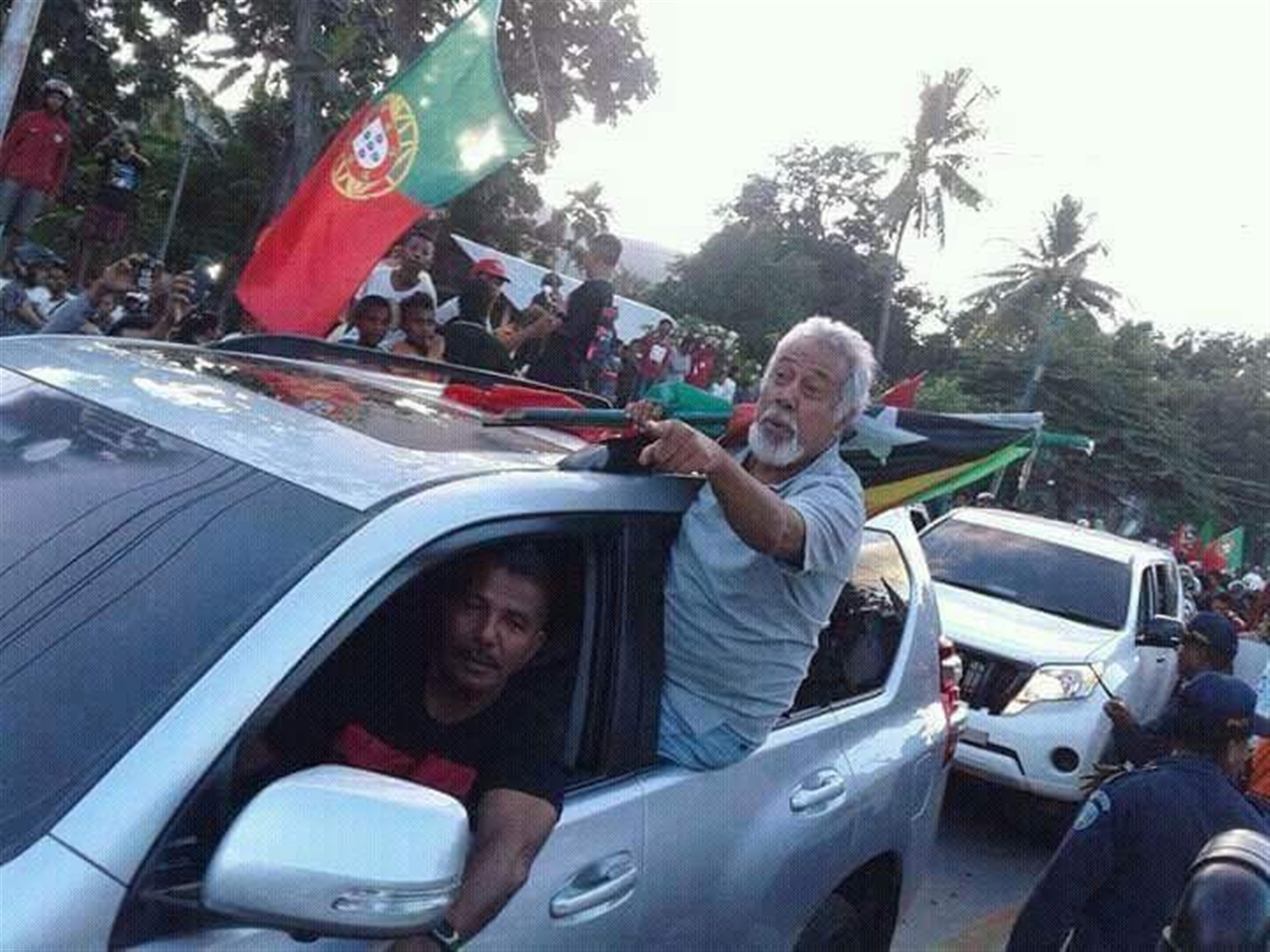
In East Timor
The move to remove 27,000 Goans from the Indian electoral rolls also reeks of a sinister and short-sighted plan, especially since the assembly elections are round the corner. A demographic swing of 27,000 people who will not be able to vote either makes it easy for some or difficult for others in the forthcoming elections. Given that the legal question is not yet debated and settled properly, hasty moves such as deleting names off electoral rolls will further compromise Goan identity. Yet again the destiny of large number of Goans will be determined by some who are unwilling to safeguard those interests and dismissive of Goa’s legal history, making the mobility of Goans in and out of their own homeland difficult. Most probably the issue of allowing Goans to hold dual citizenship will remain unresolved as the issue would lose its political value after the elections, while liberal and rightwing commentators would continue to wonder why in Goa (as well as in other former Portuguese colonies) a football match can evoke such emotional responses.

It would perhaps not be out of place to say that the Goan support to the Portuguese football team emerges not only due to a shared colonial history, but also a legal history of equal citizenship embedded within the shared colonial history. Eder’s brilliant and fantastic 109th-minute strike should essentially remind us of this.

(First published in O Heraldo, dt: 3 August, 2016)